NEET-XII-Physics
neet 2020 questions with solutions year:2020
Note: Please signup/signin free to get personalized experience.
Note: Please signup/signin free to get personalized experience.
10 minutes can boost your percentage by 10%
Note: Please signup/signin free to get personalized experience.
- Qstn #15Light with an average flux of `` 20\,\Omega/cm^2 `` falls on a non-reflecting surface at normal incidence having surface area `` 20\,cm^2 `` . The energy received by the surface during time span of `` 1\,minute `` is :
(A) `` 10 \times 10^3J ``
(B) `` 12 \times 10^3J ``
(C) `` 24 \times 10^3J ``
(D) `` 48 \times 10^3J ``
digAnsr: CAns : Energy received = Intensity `` \times `` Area `` \times `` Time
`` I=\frac{E}{A} ``
`` E=IAt ``
`` =\frac{20}{10^{-4}}\times 20\times 10^{-4}\times 60 ``
`` =24 \times 10^{3}\,J ``
- Qstn #16A spherical conductor of radius 10cm has a charge of `` 3.2 \times 10^{-7} C `` distributed uniformly. What is the magnitude of electric field at a point `` 15\,cm `` from the centre of the sphere ?
`` (\frac {1}{4\pi \epsilon_o} = 9 \times 10^9 Nm^2/C^2) ``
(A) `` 1.28 \times 10^4\,N/C ``
(B) `` 1.28 \times 10^5\,N/C ``
(C) `` 1.28 \times 10^6\,N/C ``
(D) `` 1.28 \times 10^7\,N/C ``
digAnsr: BAns : Electric field outside a conducting sphere
`` E=\frac{1}{4\pi\varepsilon_{0}} \frac{Q}{r^{2}} ``
`` =\frac{9\times10^{9}\times3.2\times10^{-7}}{225\times10^{-4}} ``
`` =0.128\times10^{6} ``
`` =1.28\times10^{5} N /C ``
- Qstn #17In a certain region of space with volume `` 0.2 \,m^3 `` , the electric potential is found to be `` 5\,V `` throughout. The magnitude of electric field in this region is:
(A)zero
(B)0.5 N/C
(C)1 N/C
(D)5 N/C
digAnsr: AAns : Since electric potential is found throughout constant, hence electric field,
`` E=-\frac{dV}{dt}=0 ``
- Qstn #18The increase in the width of the depletion region in a p-n junction diode is due to :
(A)forward bias only
(B)reverse bias only
(C)both forward bias and reverse bias
(D)increase in forward current
digAnsr: BAns : In reverse bias, external battery attracts majority charge carriers
So, width of the depletion region increases
- Qstn #19A `` 40\, \mu\,F `` capacitor is connected to a `` 200\,V `` , `` 50\,Hz `` ac supply. The rms value of the current in the circuit is, nearly :
(A)1. 7 A
(B)2. 05 A
(C)2. 5 A
(D)25. 1 A
digAnsr: CAns : The rms value of the current
`` i_{\text{rms}}=C\,\omega\,\varepsilon_{\text{rms}} ``
`` C=40\times10^{-6}F ``
`` \omega=2\pi\,f =100\,\pi ``
`` \varepsilon_{\text{rms}}=200\,V ``
`` \therefore i_{\text{rms}}=200\times40\times10^{-6}\times2\pi\times50 ``
`` =2.5\,A ``
- Qstn #20The mean free path for a gas, with molecular diameter `` d `` and number density `` n `` can be expressed as :
(A) `` \frac {1}{\sqrt{2} n \pi d} ``
(B) `` \frac {1}{\sqrt{2} n \pi d^2} ``
(C) `` \frac {1}{\sqrt{2} n^2 \pi d^2} ``
(D) `` \frac {1}{\sqrt{2} n^2 \pi^2 d^2} ``
digAnsr: BAns : Mean free path for a gas sample `` \lambda_{m}=\frac{1}{\sqrt{2}\pi d^{2} n} ``
where d is diameter of a gas molecule and n is molecular density
- Qstn #21For transistor action, which of the following statements is correct ?
(A)Base, emitter and collector regions should have same doping concentrations.
(B)Base, emitter and collector regions should have same size.
(C)Both emitter junction as well as the collector junction are forward biased.
(D)The base region must be very thin and lightly doped.
digAnsr: DAns :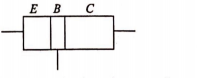
For Bi-polar junction transistor,
Length profile is `` L_{C}>\,L_{E}>\,L_{B} ``
and doping profile is `` E>\,C>\,B ``
- Qstn #22Light of frequency 1.5 times the threshold frequency is incident on a photosensitive material. What will be the photoelectric current if the frequency is halved and intensity is doubled?
(A)doubled
(B)four times
(C)one-fourth
(D)zero
digAnsr: DAns : `` K_{1}=1.5 \,hv_{0}-\phi_{0}=0.5\,hv_{0} ``
`` K_{2}=\frac{1.5}{2}hv_{0}-hv_{0}=-0.25\,hv_{0} ``
`` \because `` Kinetic energy can never be negative, so no emission and `` i=0 ``
- Qstn #23When a uranium isotope `` ^{235}_92 U `` is bombarded with a neutron, it generates `` ^{89}_{36} Kr `` , three neutrons and :
(A) `` ^{144}_{56} Ba ``
(B) `` ^{91}_{40} Zr ``
(C) `` ^{101}_{36} Kr ``
(D) `` ^{103}_{36} Kr ``
digAnsr: AAns : `` ^{235}_{92}U + ^{1}_{0}n \rightarrow ^{89}_{36}Kr+3 ^{1}_{0}n+X_{X}^{A} ``
`` 92+0=36+Z ``
`` \Rightarrow Z=56 ``
`` 235+1=89+3+A ``
`` \Rightarrow A=144 ``
So, `` ^{144}_{56}Ba `` is generated
- Qstn #24The energy required to break one bond in DNA is `` 10^{-20}J `` . This value in eV is nearly
(A)6
(B)0.6
(C)0.06
(D)0.006
digAnsr: CAns : `` 1\,eV=1.6\times 10^{-19}\\,J ``
`` 1\,J=\frac{1}{1.6\times 10^{-19}}eV ``
`` 10^{-20}\,J=\frac{10^{-20}}{1.6\times 10^{-19}}eV ``
`` =0.06\,eV ``
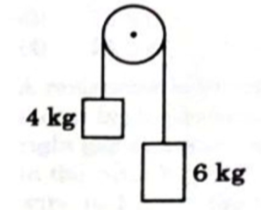
- Qstn #25Two bodies of mass `` 4\,kg `` and `` 6\,kg `` are tied to the ends of a massless string. The string passes over a pulley which is frictionless (see figure). The acceleration of the system in terms of acceleration due to gravity (g) is :
(A)g
(B)g/2
(C)g/5
(D)g/10
digAnsr: CAns : The acceleration of the system `` a=\frac{\left(m_{2}-m_{1}\right)g}{m_{1}+m_{2}} `` where `` m_{1}>\,m_{2} ``
`` a=\frac{(6-4)g}{6+4} ``
`` =\frac{2g}{10} ``
`` a=\frac{g}{5} ``
- Qstn #26A wire of length L, area of cross section A is hanging from a fixed support. The length of the wire changes to `` L_1 `` when mass M is suspended from its free end. The expression for Young’s modulus is:
(A) `` \frac {MgL_1}{AL} ``
(B) `` \frac {Mg(L_1-L)}{AL} ``
(C) `` \frac {MgL}{AL_1} ``
(D) `` \frac {MgL}{A(L_1-L)} ``digAnsr: D:
- Qstn #27The average thermal energy for a mono-atomic gas is : ( `` k_B `` is Boltzmann constant and T, absolute temperature)
(A) `` \frac {1}{2} k_BT ``
(B) `` \frac {3}{2} k_BT ``
(C) `` \frac {5}{2} k_BT ``
(D) `` \frac {7}{2} k_BT ``
digAnsr: BAns : Average thermal energy `` =\frac{3}{2}K_{B}T ``
(where 3 is translational degree of freedom)
For monoatomic gas total degree of freedom
`` f= 3 `` (translational degree of freedom)
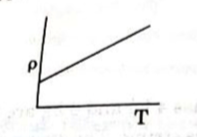
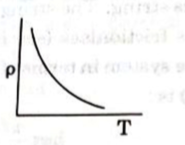
- Qstn #28Which of the following graph represents the variation of resistivity `` (\rho) `` with temperature (T) for copper ?
(A)
(B)
(C)
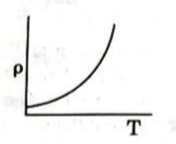
(D)
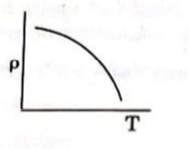
digAnsr: CAns : For some metals like copper, resistivity is nearly proportional to temperature although a non linear region always exists at very low temperature
- Qstn #29The color code of a resistance is given below :
The values of resistance and tolerance, respectively, are :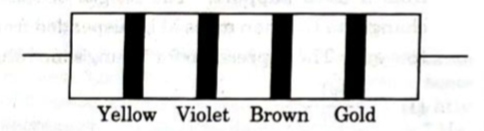
(A)470 `` k\Omega,5\% ``
(B)47 `` k\Omega,10\% ``
(C)4.7 `` k\Omega,5\% ``
(D)470 `` \Omega,5\% ``
digAnsr: DAns : From colour coding information for electric resistances, we have
`` \begin{matrix}{\text{Yellow}}&{\text{Violet}}&{\text{Brown}}&{\text{Gold}}\\ 4&7&1&5\%\end{matrix} ``
So, `` R=47 \times 10^{1} \pm\,5\% ``
`` R=470\,\Omega\,\pm\,5\% ``