NEET-XII-Physics
exam-1 year:2016
Note: Please signup/signin free to get personalized experience.
Note: Please signup/signin free to get personalized experience.
10 minutes can boost your percentage by 10%
Note: Please signup/signin free to get personalized experience.
- Qstn #30A gas is compressed isothermally to half its initial
volume. The same gas is compressed separately
through an adiabatic process until its volume is
again reduced to half. Then :-
(1) Compressing the gas isothermally will require
more work to be done.
(2) Compressing the gas through adiabatic process
will require more work to be done.
(3) Compressing the gas isothermally or
adiabatically will require the same amount of
work.
(4) Which of the case (whether compression
through isothermal or through adiabatic
process) requires more work will depend upon
the atomicity of the gas.digAnsr: 2Ans : 2
Sol.
V0 2V0 V
O
P
isothermal
adiabatic
Wext = negative of area with volume-axis
W(adiabatic) > W(isothermal)
- Qstn #31A potentiometer wire is 100 cm long and a constant
potential difference is maintained across it. Two
cells are connected in series first to support one
another and then in opposite direction. The balance
points are obtained at 50 cm and 10 cm from the
positive end of the wire in the two cases. The ratio
of emf's is :-
(1) 5 : 1
(2) 5 : 4
(3) 3 : 4
(4) 3 : 2digAnsr: 4Ans : 4
Sol.
+
=
1 2
1 2
E E 50
E E 10
&implies;
+
=
1
2
2E 50 10
2E 50 10
&implies; =1
2
E 3
E 2
- Qstn #32A astronomical telescope has objective and
eyepiece of focal lengths 40 cm and 4 cm
respectively. To view an object 200 cm away from
the objective, the lenses must be separated by a
distance :-
(1) 37.3 cm
(2) 46.0 cm
(3) 50.0 cm
(4) 54.0 cmdigAnsr: 4Ans : 4
Sol. Using lens formula for objective lens
=
0 0 0
1 1 1
v u f
&implies; = +
0 0 0
1 1 1
v f u
&implies; = +
0
1 1 1
v 40 200
=
+ 5 1
200
&implies; v0 = 50 cm
Tube length = |v0| + fe = 50 + 4 = 54 cm.
- Qstn #33Two non-mixing liquids of densities and
n``\rho `` (n > 1) are put in a container. The height of
each liquid is h. A solid cylinder of length L and
density d is put in this container. The cylinder floats
with its axis vertical and length pL(p < 1) in the
denser liquid. The density d is equal to :-
(1) {1 + (n + 1)p}``\rho `` (2) {2 + (n + 1)p}``\rho ``
(3) {2 + (n - 1)p}``\rho `` (4) {1 + (n - 1)p}``\rho ``digAnsr: 4Ans : 4
Sol.
d
(1 - p)L
n pL
L A d g = (pL) A (n)g + (1 - p) L A g
&implies; d = (1 - p) + pn = [1 + (n - 1)p]
- Qstn #34To get output 1 for the following circuit, the correct
choice for the input is
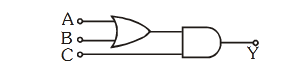
(1) A = 0, B = 1, C = 0
(2) A = 1, B = 0, C = 0
(3) A = 1, B = 1, C = 0
(4) A = 1, B = 0, C = 1digAnsr: 4Ans : 4
Sol. (A + B) C = 1 &implies; C = 1
- Qstn #35A piece of ice falls from a height h so that it melts
completely. Only one-quarter of the heat produced
is absorbed by the ice and all energy of ice gets
converted into heat during its fall. The value
of h is :
[Latent heat of ice is 3.4 × ``10^5`` J/kg and
g = 10 N/kg]
(1) 34 km
(2) 544 km
(3) 136 km
(4) 68 kmdigAnsr: 3Ans : 3
Sol.
mgh
4
= mL
&implies; h =
4L
g =
54 3.4 10
10
= 136 km.
- Qstn #36The ratio of escape velocity at earth (``v_e``) to the
escape velocity at a planet (``v_p``) whose radius and
mean density are twice as that of earth is :-
(1) 1 : 2
(2) 1 : ``2 \sqrt2``
(3) 1 : 4
(4) 1 : ``\sqrt2``digAnsr: 2Ans : 2
Sol. Ve =
=
32GM 2G 4. R
R R 3 R
∴ Ratio = 1 : 2 2
- Qstn #37If the magnitude of sum of two vectors is equal to
the magnitude of difference of the two vectors, the
angle between these vectors is :-
(1) 0°
(2) 90°
(3) 45°
(4) 180°digAnsr: 2Ans : 2
Sol. + =
A B A B = = 90°.
- Qstn #38Given the value of Rydberg constant is ``10^7m^{-1}``, the
wave number of the last line of the Balmer series
in hydrogen spectrum will be :-
(1) 0.025 × ``10^4m^{-1}``
(2) 0.5 × ``10^7m^{-1}``
(3) 0.25 × ``10^7m^{-1}``
(4) 2.5 × ``10^7m^{-1}``digAnsr: 3Ans : 3
Sol.
1
= RZ2
2 2
2 1
1 1
n n
= 107 × 12
2 2
1 1
2
&implies; wave number =
1
= 0.25 × 10⁷ m-1
- Qstn #39A body of mass 1 kg begins to move under the
action of a time dependent force
``\vec{F}`` = ( ``2 t \hat{i}`` + ``3t^2`` ``\hat{j}`` ) N
where `` \hat{i}`` and ``\hat{j}`` are unit vectors along x and y axis.
What power will be developed by the force at the
time t ?
(1) (``2t^2 + 3t^3``)W
(2) (``2t^2 + 4t^4``)W
(3) (``2t^3 + 3t^4``)W
(4) (``2t^3 + 3t^5``)WdigAnsr: 4Ans : 4
Sol. = +
2ˆ ˆF 2ti 3t j
= +
2dv ˆ ˆm 2ti 3t j
dt
(m = 1 kg)
&implies; = +
v t
2
0 0
ˆ ˆdv (2ti 3t j)dt &implies; = +
2 3ˆ ˆv t i t j
Power =
F.v = (2t3 + 3t5)W
- Qstn #40An inductor 20 mH, a capacitor 50 µF and a resistor
40 ``\Omega`` are connected in series across a source of emf
V = 10 sin 340 t. The power loss in A.C. circuit is :-
(1) 0.51 W
(2) 0.67 W
(3) 0.76 W
(4) 0.89 WdigAnsr: 1Ans : 1
Sol. XC = = -6
1 1
C 340 50 10
= 58.8
XL = L = 340 × 20 × 10-3 = 6.8
Z = +
2 2
C LR (X X )
= + = 2 240 (58.8 6.8) 4304
P = 2rmsi R =
2
rmsV R
Z
=
2
10 / 2
4304
× 40 =
50 40
4304
= 0.47 W
So best answer (nearest answer) will be (1)
- Qstn #41If the velocity of a particle is v = At + ``Bt^2``, where
A and B are constants, then the distance travelled
by it between 1s and 2s is :-
(1) 3/2 A + 4B
(2) 3A+7B
(3)3/2 A + 7/3 B
(4)A/2 + B\3digAnsr: 3Ans : 3
Sol. V = At + Bt2 &implies; = + 2
dx
At Bt
dt
&implies;
x
0
dx = +
2
2
1
(At Bt )dt
&implies; x = + 2 2 3 3
A B
(2 1 ) (2 1 )
2 3
= +
3A 7B
2 3
- Qstn #42A long solenoid has 1000 turns. When a current
of 4A flows through it, the magnetic flux linked with
each turn of the solenoid is 4 × ``10^{-3}`` Wb. The self
inductance of the solenoid is :-
(1) 4H
(2) 3H
(3) 2H
(4) 1HdigAnsr: 4Ans : 4
Sol. Flux linked with each turn = 4 × 10⁻³ Wb
∴ Total flux linked = 1000[4 × 10⁻³] Wb
total = 4 &implies; L i = 4 &implies;L = 1H
- Qstn #43A small signal voltage V(t) = ``V_0 ``sin``\omega``t is applied
across an ideal capacitor C :-
(1) Current I (t), lags voltage V(t) by 90°.
(2) Over a full cycle the capacitor C does not
consume any energy from the voltage source.
(3) Current I (t) is in phase with voltage V(t).
(4) Current I (t) leads voltage V(t) by 180°.digAnsr: 2Ans : 2
Sol. Power = Vrms . Irms cos
as cos = 0 (Because = 90°)
∴ Power consumed = 0 (in one complete cycle)
- Qstn #44Match the corresponding entries of column-1 with
coloumn-2 (Where m is the magnefication
produced by the mirror) :-
Column-1 Column-2
(A) m = -2 (a) Convex mirror
(B) m = -1/2 (b) Concave mirror
(C) m = +2 (c) Real image
(D) m = +1/2 (d) Virtual image
(1) A ``\rightarrow `` b and c, B ``\rightarrow `` b and c, C ``\rightarrow `` b and d,
D ``\rightarrow `` a and d.
(2) A ``\rightarrow `` a and c, B ``\rightarrow `` a and d, C ``\rightarrow `` a and b,
D ``\rightarrow `` c and d
(3) A ``\rightarrow `` a and d, B ``\rightarrow `` b and c, C ``\rightarrow `` b and d,
D ``\rightarrow `` b and c
(4) A ``\rightarrow `` c and d, B ``\rightarrow `` b and d, C ``\rightarrow `` b and c,
D ``\rightarrow `` a and ddigAnsr: 1Ans : 1
Sol. m = +ve &implies; virtual image
m = -ve &implies; real image
|m| > 1 &implies; magnified image
|m| < 1 &implies; diminished image