NEET-XII-Physics
exam-2 year:2016
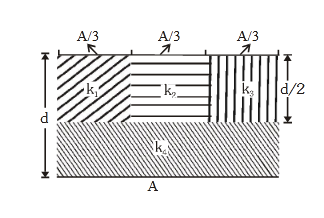
- Qstn #91A parallel-plate capacitor of area A, plate
separation d and capacitance C is filled with four
dielectric materials having dielectric constants k1,
k2, k3 and k4 as shown in the figure below. If a single
dielectric material is to be used to have the same
capacitance C in this capacitor, then its dielectric
constant k is given by :-
(1)``\frac 2k``= ``\frac{3}{k_1 + k_2 + k_3}`` + ``\frac{1}{k_4}``
(2)``\frac 1k``= ``\frac{1}{k_1}`` + ``\frac{1}{k_2}`` + ``\frac{1}{k_3}`` + ``\frac{3}{2k_4}``
(3)`` k = k_1 + k_2 + k_3 + 3k_4``
(4) `` k =\frac 23`` ``( k_1 + k_2 + k_3 )+ 2k_4``digAnsr: 1Ans : (1)
Sol. Put k1 = k2 = k3 = k4 and check answer
- Qstn #92The potential difference (``V_A - V_B``) between the points
A and B in the given figure is :-

(1) + 6 V
(2) + 9 V
(3) - 3 V
(4) + 3 VdigAnsr: 2Ans : (2)
Sol. A
2A
2 1
B
3V
VB = VA - (2 × 2) - 3 - (2 × 1)
&implies;VA - VB = 9V
- Qstn #93A filament bulb (500 W, 100 V) is to be used in a
230 V main supply. When a resistance R is
connected in series, it works perfectly and the bulb
consumes 500 W. The value of R is :-
(1) 26 ``\Omega``
(2) 13 ``\Omega``
(3) 230 ``\Omega``
(4) 46 ``\Omega``digAnsr: 1Ans : (1)
Sol.
Bulb
R
100 V
500 W
130 V
230 V
Current through bulb =
P 500W
5A
V 100V
= =
Therefore
130V
R 26
5A
= =
- Qstn #94A long wire carrying a steady current is bent into
a circular loop of one turn. The magnetic field at
the centre of the loop is B. It is then bent into a
circular coil of n turns. The magnetic field at the
centre of this coil of n turns will be :-
(1) 2nB
(2) ``2n^2B``
(3) nB
(4) ``n^2B``digAnsr: 4Ans : (4)
Sol. Since = 2R = n(2r) &implies; =
R
r
n
For one turn 0iB
2R
= and
For n turn 0niB '
2r
=
&implies;
= =
2
20n iB n B
2R
- Qstn #95A bar magnet is hung by a thin cotton thread in a
uniform horizontal magnetic field and is in
equilibrium state. The energy required to rotate it
by 60° is W. Now the torque required to keep the
magnet in this new position is :-
(1)``\frac{\sqrt3 W}{2}``
(2) ``\frac{2W}{\sqrt3 }``
(3)``\frac{W}{\sqrt3 }``
(4) ``\sqrt3 ``WdigAnsr: 4Ans : (4)
Sol. = MB sin 60° .....(1)
W = MB (1 - cos60°) .....(2)
From (1) and (2)
=
3 / 2
W 1/2
&implies; = W 3
- Qstn #96An electron is moving in a circular path under the
influence of a transverse magnetic field of
3.57 ``10^{-2}`` T. If the value of e/m is
1.76 X ``10^{11}`` C/kg, the frequency of revolution of
the electron is :-
(1) 62.8 MHz
(2) 6.28 MHz
(3) 1 GHz
(4) 100 MHzdigAnsr: 3Ans : (3)
Sol. f =
eB
2 m
=
11 21.76 10 3.57 10
f
2 3.14
Hz
f = 109 Hz or 1 GHz
- Qstn #97Which of the following combinations should be
selected for better tuning of an L-C-R circuit used
for communication ?
(1) R = 15 ``\Omega``, L = 3.5 H, C = 30 ``\mu``F
(2) R = 25 ``\Omega``, L = 1.5 H, C = 45 ``\mu``F
(3) R = 20 ``\Omega``, L = 1.5 H, C = 35 ``\mu``F
(4) R = 25 ``\Omega``, L = 2.5 H, C = 45 ``\mu``FdigAnsr: 1Ans : (1)
Sol. For better tuning, Q-factor must be high.
∴
= o
L
Q
R
1 L
RLC
=
1 L
R C
=
R and C should be small and L should be high.
- Qstn #98A uniform magnetic field is restricted within a region
of radius r. The magnetic field changes with time
at a rate ``\frac {\vec {db}}{dt}``. Loop 1 of radius R > r encloses the
region r and loop 2 of radius R is outside the region
of magnetic field as shown in the figure below. Then
the e.m.f. generated is :-

(1)``-\frac {\vec {db}}{dt}````\pi R^2`` in loop 1 and zero in loop 2
(2) ``-\frac {\vec {db}}{dt}````\pi r^2`` in loop 1 and zero in loop 2
(3) Zero in loop 1 and zero in loop 2
(4) ``-\frac {\vec {db}}{dt}````\pi r^2`` in loop 1 and ``-\frac {\vec {db}}{dt}````\pi r^2`` in loop 2.digAnsr: 2Ans : (2)
Sol. For Loop 1
ind
d dB
A cos0
dt dt
= =
2 dBr
dt
=
For Loop 2, ind = 0 as no flux linkage
- Qstn #99The potential differences across the resistance,
capacitance and inductance are 80 V, 40 V and
100 V respectively in an L-C-R circuit. The power
factor of this circuit is :-
(1) 0.8
(2) 1.0
(3) 0.4
(4) 0.5digAnsr: 1Ans : (1)
Sol.
= L C
R
V V
tan
V
100 40 3
80 4
= = or = 37°
Power factor = cos = cos 37° =
4
5
or 0.8
- Qstn #100A 100 ``\Omega`` resistance and a capacitor of 100 ``\Omega``
reactance are connected in series across a 220 V
source. When the capacitor is 50% charged, the
peak value of the displacement current is :-
(1) 4.4 A
(2) 11 2 A
(3) 2.2 A
(4) 11 AdigAnsr: 3Ans : (3)
Sol.
= = = =
+
0
d max c max 0
2 2
220 2
(i ) (i ) i
Z 100 100
=2.2A
As we are asked amplitude of displacement current.
So, need not worry about charge on capacitor.
- Qstn #101Two identical glass (``\mu_g``= 3/2) equiconvex lenses of
focal length f each are kept in contact. The space
between the two lenses is filled with water
(``\mu_w`` = 4 / 3). The focal length of the combination
is :-
(1) ``\frac {4f}{3}``
(2) ``\frac {3f}{4}``
(3) ``\frac {f}{3}``
(4) fdigAnsr: 2Ans : (2)
Sol. 3
2
3
2
µ =3
4
3
f1
f2
f3
µ =1
µ =2
= =
1 3
R
f f
3
2 -1
2
= R = f (given)
= = =
2
-R -3 3
f R - f
4 2 2
2 -1
3
= + +
eq 1 2 3
1 1 1 1
f f f f
= + +
1 2 1
-
f 3f f
&implies; =
eq
1 4
f 3f &implies;
=eq
3f
f
4
- Qstn #102An air bubble in a glass slab with refractive index
1.5 (near normal incidence) is 5 cm deep when
viewed from one surface and 3 cm deep when
viewed from the opposite face. The thickness (in cm)
of the slab is :-
(1) 12
(2) 16
(3) 8
(4) 10digAnsr: 1Ans : (1)
Sol. -x
O
x
x
5cm=
.....(i)
x
3cm
=
.....(ii)
From (i) and (ii)
= (5+3)= 12cm
- Qstn #103The interference pattern is obtained with two
coherent light sources of intensity ratio n. In the
interference pattern, the ratio ``\frac {I_{max} - i_{min}}{I_{max} + i_{min}}`` will be :-
(1)``\frac {\sqrt n}{(n+1)^2}``
(2)``\frac {2\sqrt n}{(n+1)^2}``
(3)``\frac {\sqrt n}{(n+1)}``
(4)``\frac {2\sqrt n}{(n+1)}``digAnsr: 4Ans : (4)
Sol. Let =
1
2
I n
1
+
=
+ + +
2 2
1 2 1 2max min
2 2
max min
1 2 1 2
I I - I - II - I
I I I I I - I
=
+
1 2
1 2
4 I I
2(I I )
Dividing numerator and denominator by I2
required ratio
1
2
1
2
I2 I 2 n
I n 11
I
= =
+
+
- Qstn #104A person can see clearly objects only when they lie
between 50 cm and 400 cm from his eyes. In order
to increase the maximum distance of distinct vision
to infinity, the type and power of the correcting lens,
the person has to use, will be :-
(1) concave, - 0.2 diopter
(2) convex, + 0.15 diopter
(3) convex, + 2.25 diopter
(4) concave, - 0.25 diopterdigAnsr: 4Ans : (4)
Sol. As we want to correct myopia. So, far point must
go to infinity.
v = -4 m, u = -, P = ?
P = = =
1 1 1 1 1
- -
f v u -4
= - 0.25 D
(-) implies concave mirror