NEET-XII-Physics
exam-2 year:2016
- Qstn #105A linear aperture whose width is 0.02 cm is placed
immediately in front of a lens of focal length 60 cm.
The aperture is illuminated normally by a parallel
beam of wavelength 5 X ``10^{-5}`` cm. The distance of
the first dark band of the diffraction pattern from
the centre of the screen is :-
(1) 0.20 cm
(2) 0.15 cm
(3) 0.10 cm
(4) 0.25 cmdigAnsr: 2Ans : (2)
Sol. f = D = 60 cm
For first minima,
-7 -3
-2 -2
D 5 10 60 5 10 60
y
a 2 10 10 2
= = =
= 0.15 cm
- Qstn #106Electrons of mass m with de-Broglie wavelength ``\lambda``
fall on the target in an X-ray tube. The cutoff
wavelength (``\lambda_0``) of the emitted X-ray is :-
(1)``\lambda_0``= ``\frac {2m^2c^2\lambda^3}{h^2}``
(2) ``\lambda_0``= ``\lambda``
(3)``\lambda_0``= ``\frac {2mc\lambda^2}{h}``
(4) ``\lambda_0``= ``\frac {2h}{mc}``digAnsr: 3Ans : (3)
Sol.
h h
p
p
= &implies; =
KE of electrons = = =
2 2
2
p h
E
2m 2m
Also in X-ray 0
hc
E
= &implies;
2
0
2mc
h
=
- Qstn #107Photons with energy 5 eV are incident on a
cathode C in a photoelectric cell. The maximum
energy of emitted photoelectrons is 2 eV. When
photons of energy 6 eV are incident on C, no
photoelectrons will reach the anode A, if the
stopping potential of A relative to C is :-
(1) - 1 V
(2) - 3 V
(3) + 3 V
(4) + 4 VdigAnsr: 2Ans : (2)
Sol. = = 2s max 0
1
eV mv h
2
2 = 5 - &implies;=3 eV
In second case
eVs = 6 - 3 = 3 eV &implies;Vs = 3 V.
∴ VAC = -3 V
- Qstn #108If an electron in a hydrogen atom jumps from the
3rd orbit to the 2nd orbit, it emits a photon of
wavelength ``\lambda``. When it jumps from the 4th orbit to
the 3rd orbit, the corresponding wavelength of the
photon will be :-
(1)20/7 ``\lambda``
(2)20/13 ``\lambda``
(3)16/25 ``\lambda``
(4)9/16 ``\lambda``digAnsr: 1Ans : (1)
Sol. Transition : 3 2 &implies;Wavelength
Transition : 4 3 &implies;Wavelength '=
2
2 2
2
2 2
1 1 1
RZ
' 20 202 3 '
1 1 1 7 7
RZ
' 3 4
= &implies; = &implies; =
=
- Qstn #109The half-life of a radioactive substance is 30 minutes.
The time (in minutes) taken between 40% decay and
85% decay of the same radioactive substance is :-
(1) 45
(2) 60
(3) 15
(4) 30digAnsr: 2Ans : (2)
Sol. decay 40% 85%
Remaining 60% 15%
60%
1
2
t
30%
1
2
t
15%
∴t = 2t1/2 = 60 min.
- Qstn #110For CE transistor amplifier, the audio signal voltage
across the collector resistance of 2 k``\Omega`` is 4 V. If the
current amplification factor of the transistor is
100 and the base resistance is 1 k``\Omega``, then the input
signal voltage is :-
(1) 30 mV
(2) 15 mV
(3) 10 mV
(4) 20 mVdigAnsr: 4Ans : (4)
Sol. = 100; V0 = 4V; Ri = 103 ;
R0 = 2 × 10³ ; Vi = ?
AV =
3
0 0
3
i i i
V R 4 2 10
100
V R V 10
= &implies; =
&implies; Vi = 20 mV
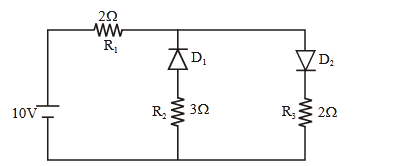
- Qstn #111The given circuit has two ideal diodes connected as
shown in the figure below. The current flowing
through the resistance ``R_``1 will be :-
(1) 1.43 A
(2) 3.13 A
(3) 2.5 A
(4) 10.0 AdigAnsr: 3Ans : (3)
Sol. Current will not flow through D1 as it is reverse
biased. Current will flow through cell, R1, D2 and R3.
∴
10
i
2 2
=
+
= 2.5 A
12
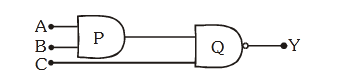
- Qstn #112What is the output Y in the following circuit, when
all the three inputs A,B,C are first 0 and then 1 ?
(1) 1,0
(2) 1,1
(3) 0,1
(4) 0.0digAnsr: 1Ans : (1)
Sol.
AB
y = (AB)C
P
Q
A
B
C
for A = B = C = 0 ; y = 1
for A = B = C = 1 ; y = 0
- Qstn #113Planck's constant (h), speed of light in vacuum
and Newton's gravitational constant (G) are three
fundamental constants. Which of the following
combinations of these has the dimension of length?
(1)``\sqrt \frac {hc}{(G)}``
(2) ``\sqrt \frac {Gc}{(h^\frac 32)}``
(3) ``\sqrt \frac {Gh}{(c^\frac 32)}``
(4)``\sqrt \frac {Gh}{(c^\frac 52)}``digAnsr: 3Ans : (3)
Sol. x y zh G c
M0L1T0 = (ML2T-1)x (M-1L3T-2)y (LT-1)z
= Mx-y L2x+3y+z T-x-2y-z
Equating :
3/ 2
1 1 3
x y 0 x ;y ;z
2 2 2
2x 3y z 1
hG
x 2y z 0
c
= &implies; = = =
+ + =
&implies; =
- Qstn #114Two cars P and Q start from a point at the same
time in a straight line and their positions are
represented by ``x_p(t) = at + bt^2`` and ``x_Q (t) = ft - t^2``.
At what time do the cars have the same velocity ?
(1)``\frac {a+ f}{2(1+ b)}``
(2)``\frac { f -a}{2(1+ b)}``
(3)``\frac {a- f}{(1+ b)}``
(4)``\frac {a+ f}{2(b - 1)}``digAnsr: 2Ans : (2)
Sol. xP(t) = at + bt2 xQ(t) = ft - t2
vP = a + 2bt vQ = f - 2t
as vP = vQ
a + 2bt = f - 2t
&implies;
f a
t
2(1 b)
=
+
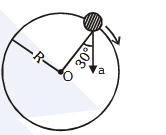
- Qstn #115In the given figure, a = 15 ``\frac {m}{s^2}`` represents the total
acceleration of a particle moving in the clockwise
direction in a circle of radius R = 2.5 m at a given
instant of time. The speed of the particle is :-
(1) 5.7 m/s
(2) 6.2 m/s
(3) 4.5 m/s
(4) 5.0 m/sdigAnsr: 1Ans : (1)
Sol. Centripetal acceleration =
2v
a cos30
R
=
&implies;
3
v aRcos30 15 2.5
2
= = = 5.7m/s
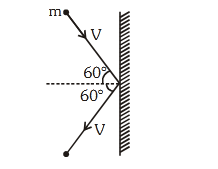
- Qstn #116A rigid ball of mass m strikes a rigid wall at 60° and
gets reflected without loss of speed as shown in the
figure below. The value of impulse imparted by the
wall on the ball will be :-
(1)mV/2
(2)mV/3
(3) mV
(4) 2mVdigAnsr: 3Ans : (3)
Sol. Impulse p m V m(2V cos60 )= ▵ = ▵ =
= mV
13
- Qstn #117A bullet of mass 10g moving horizontally with a
velocity of 400 ``ms^{-1}`` strikes a wooden block of mass
2 kg which is suspended by a light inextensible string
of length 5 m. As a result, the centre of gravity of
the block is found to rise a vertical distance of
10 cm. The speed of the bullet after it emerges out
horizontally from the block will be :-
(1) 120 ``ms^{-1}``
(2) 160 ``ms^{-1}``
(3) 100 ``ms^{-1}``
(4) 80 ``ms^{-1}``digAnsr: 1Ans : (1)
Sol.
2kg
2kg v1
v210gm
400 m/s
0.1 m
5m
Applying momentum conservation
1 2
10 10
400 0 2 v v
1000 1000
+ = +
&implies; 4 = 2v1 + 0.01v2 ......(1)
Applying work energy theorem for block
W = ▵KE
&implies; 2 × 10 × 0.1 =
1
2
× 2 × v12
&implies; v1 = 2 = 1.4 m/s
Putting the value of v1 in equation (1)
4 = 2 × 1.4 + 0.01 v2 &implies;v2 = 120 m/s
- Qstn #118Two identical balls A and B having velocities of
0.5 m/s and -0.3 m/s respectively collide elastically
in one dimension. The velocities of B and A after
the collision respectively will be :-
(1) -0.3 m/s and 0.5 m/s
(2) 0.3 m/s and 0.5 m/s
(3) -0.5 m/s and 0.3 m/s
(4) 0.5 m/s and -0.3 m/sdigAnsr: 4Ans : (4)
Sol. Since both bodies are identical and collision is elastic.
Therefore velocities will be interchanged after
collision.
vA = -0.3 m/s and vB = 0.5 m/s
- Qstn #119A particle moves from a point ``(-2\hat{i} + 5\hat{j})`` to
+ ``(4\hat{j} + 3\hat{k})`` when a force of ``(4\hat{i} + 3\hat{j})`` N is applied.
How much work has been done by the force ?
(1) 5 J
(2) 2 J
(3) 8 J
(4) 11 JdigAnsr: 1Ans : (1)
Sol. f i ˆˆ ˆs r r 2i j 3k= = +
ˆˆ ˆ ˆW F.s 4i 3j . 2i j 3k 8 3 5J = = + + = =