NEET-XII-Physics
24: Kinetic Theory of Gases
Note: Please signup/signin free to get personalized experience.
Note: Please signup/signin free to get personalized experience.
10 minutes can boost your percentage by 10%
Note: Please signup/signin free to get personalized experience.
- Qstn #1Calculate the volume of 1 mole of an ideal gas at STP.Ans : Here,
STP means a system having a temperature of 273 K and 1 atm pressure.
Pressure, P = 1.01325`` \times ``105 Pa
No of moles, n = 1 mol
Temperature, T = 273 K
Applying the equation of an ideal gas, we get
PV = nRT
⇒ V = `` \frac{RT}{P}``
⇒ V=`` \frac{8.314\times 273}{1.01325\times {10}^{5}}=0.0224{\,\mathrm{\,m\,}}^{3}``
- Qstn #2Find the number of molecules of an ideal gas in a volume of 1.000 cm3 at STP.Ans : Here,
Volume of ideal gas at STP = 22.4 L
Number of molecules in 22.4 L of ideal gas at STP = 6.022`` \times ``1023
Number of molecules in 22.4`` \times ``103 cm3 of ideal gas at STP = 6.022`` \times ``1023
Now,
Number of molecules in 1 cm3 of ideal gas at STP = `` \frac{6.022\times {10}^{23}}{22.4\times {10}^{3}}=2.688\times {10}^{19}``
- Qstn #3Find the number of molecules in 1 cm3 of an ideal gas at 0°C and at a pressure of 10-5 mm of mercury.Ans : Given:
Volume of ideal gas, V = 1 cm3 = 10-6 m3
Temperature of ideal gas, T = 0 °C = 273 K
Pressure of mercury, P = 10-8 m of Hg
Density of ideal gas, ρ = 13600 kgm-3
Pressure `` \left(P\right)`` is given by
P = ρgh
Here,
ρ = density of ideal gas
g = acceleration due to gravity,
Using the ideal gas equation, we get
`` n=\frac{PV}{RT}``
`` \Rightarrow n=\frac{\rho gh\times \,\mathrm{\,V\,}}{RT}``
`` \Rightarrow n=\frac{13600\times 9.8\times {10}^{-8}\times {10}^{-6}}{8.31\times 273}``
`` \Rightarrow n=5.87\times {10}^{-13}``
`` ``
`` ``
Number of molecules = N × n
= 6.023 × 1023 × 5.874 × 10-13
= 35.384 × 1010
= 3.538 × 10¹¹
- Qstn #4Calculate the mass of 1 cm3 of oxygen kept at STP.Ans : We know that 22.4 L of O2 contains 1 mol O2 at STP. Thus,
`` 22.4\times {10}^{3}{\,\mathrm{\,cm\,}}^{3}\,\mathrm{\,of\,}{\,\mathrm{\,O\,}}_{2}=1\,\mathrm{\,mol\,}{\,\mathrm{\,O\,}}_{2}``
`` 1{\,\mathrm{\,cm\,}}^{3}\,\mathrm{\,of\,}{\,\mathrm{\,O\,}}_{2}=\frac{1}{22.4\times {10}^{3}}\,\mathrm{\,mol\,}{\,\mathrm{\,O\,}}_{2}``
`` 1\,\mathrm{\,mol\,}\,\mathrm{\,of\,}{\,\mathrm{\,O\,}}_{2}=32\,\mathrm{\,g\,}``
`` \frac{1}{22.4\times {10}^{3}}\,\mathrm{\,mol\,}\,\mathrm{\,of\,}{\,\mathrm{\,O\,}}_{2}=\frac{32}{22.4\times {10}^{3}}=1.43\times {10}^{-3}\,\mathrm{\,g\,}``
`` =1.43\,\mathrm{\,mg\,}``
`` ``
- Qstn #5Equal masses of air are sealed in two vessels, one of volume V0 and the other of volume 2V0. If the first vessel is maintained at a temperature 300 K and the other at 600 K, find the ratio of the pressures in the two vessels.Ans : Let the pressure and temperature for the vessels of volume V0 and 2V0 be P1, T1 and P2 , T2, respectively.
Since the two vessels have the same mass of gas, n1 = n2 = n.
`` {T}_{1}=300\,\mathrm{\,K\,}``
`` {T}_{2}=600\,\mathrm{\,K\,}``
`` \,\mathrm{\,Using\,}\,\mathrm{\,the\,}\,\mathrm{\,equation\,}\,\mathrm{\,of\,}\,\mathrm{\,state\,}\,\mathrm{\,for\,}\,\mathrm{\,perfect\,}\,\mathrm{\,gas\,},\,\mathrm{\,we\,}\,\mathrm{\,get\,}``
`` PV=nRT``
`` \,\mathrm{\,For\,}\,\mathrm{\,the\,}\,\mathrm{\,vessel\,}\,\mathrm{\,of\,}\,\mathrm{\,volume\,}{V}_{\,\mathrm{\,o\,}}:``
`` {P}_{1}{V}_{o}=nR{T}_{1}...\left(1\right)``
`` \,\mathrm{\,For\,}\,\mathrm{\,the\,}\,\mathrm{\,vessel\,}\,\mathrm{\,of\,}\,\mathrm{\,volume\,}2{V}_{\,\mathrm{\,o\,}}:``
`` {P}_{2}\left(2{V}_{\,\mathrm{\,o\,}}\right)=nR{T}_{2}...\left(2\right)``
`` \,\mathrm{\,Dividing\,}\,\mathrm{\,eq\,}.\left(2\right)\,\mathrm{\,by\,}\,\mathrm{\,eq\,}.\left(1\right),\,\mathrm{\,we\,}\,\mathrm{\,get\,}``
`` \frac{2{P}_{2}}{{P}_{\mathit{1}}}=\frac{{T}_{\mathit{2}}}{{T}_{\mathit{1}}}=\frac{600}{300}=2``
`` \Rightarrow \frac{{P}_{\mathit{2}}}{{P}_{\mathit{1}}}=1``
`` \Rightarrow {P}_{\mathit{2}}\mathit{:}{P}_{\mathit{1}}=1:1``
`` ``
`` ``
`` ``
- Qstn #6An electric bulb of volume 250 cc was sealed during manufacturing at a pressure of 10-3 mm of mercury at 27°C. Compute the number of air molecules contained in the bulb. Avogadro constant = 6 × 10²³ mol-1, density of mercury = 13600 kg m-3 and g = 10 m s-2.Ans : Given:
Volume of electric bulb, V = 250 cc
Temperature at which manufacturing takes place, T = 27 + 273 = 300 K
Height of mercury, h = 10-3 mm
Density of mercury, `` \rho `` = 13600 kgm-3
Avogadro constant, N = 6 × 10²³ mol-1
Pressure `` \left(P\right)`` is given by
P = `` \rho gh``
Using the ideal gas equation, we get
`` PV=nRT``
`` PV=nRT``
`` \Rightarrow n=\frac{PV}{RT}``
`` \Rightarrow n=\frac{\rho ghV}{RT}``
`` \Rightarrow n=\frac{{10}^{-6}\times 13600\times 10\times 250\times {10}^{-6}}{8.314\times 300}``
`` ``
`` \,\mathrm{\,Now\,},\,\mathrm{\,number\,}\,\mathrm{\,of\,}\,\mathrm{\,molecules\,}=nN``
`` =\frac{{10}^{-6}\times 13600\times 10\times 250\times {10}^{-6}}{8.314\times 300}\times 6\times {10}^{23}``
`` =8\times {10}^{15}``
`` ``
- Qstn #7A gas cylinder has walls that can bear a maximum pressure of 1.0 × 10⁶ Pa. It contains a gas at 8.0 × 10⁵ Pa and 300 K. The cylinder is steadily heated. Neglecting any change in the volume, calculate the temperature at which the cylinder will break.Ans : Given:
Maximum pressure that the cylinder can bear, Pmax = 1.0 × 10⁶ Pa
Pressure in the gas cylinder, P1 = 8.0 × 10⁵ Pa
Temperature in the cylinder, T1 = 300 K
Let T2 be the temperature at which the cylinder will break.
Volume is constant. Thus, (Given)
V1= V2 = V
Applying the five variable gas equation, we get
`` \frac{{P}_{1}V}{{T}_{1}}=\frac{{P}_{2}V}{{T}_{2}}(\because {\,\mathrm{\,V\,}}_{1}={\,\mathrm{\,V\,}}_{2})``
`` \Rightarrow \frac{{P}_{1}}{{T}_{1}}=\frac{{P}_{2}}{{T}_{2}}``
`` \Rightarrow {T}_{2}=\frac{{P}_{2}\times {T}_{1}}{{P}_{1}}``
`` \Rightarrow {T}_{2}=\frac{1.0\times {10}^{6}\times 300}{8.0\times {10}^{5}}=375\,\mathrm{\,K\,}``
`` ``
- Qstn #82 g of hydrogen is sealed in a vessel of volume 0.02 m3 and is maintained at 300 K. Calculate the pressure in the vessel.Ans : Given:
Mass of hydrogen, m = 2 g
Volume of the vessel, V = 0.02 m3
Temperature in the vessel, T = 300 K
Molecular mass of the hydrogen, M = 2 u
No of moles, n = `` \frac{m}{M}=\frac{2}{2}``= 1 mole
Rydberg's constant, R = 8.3 J/Kmol
From the ideal gas equation, we get
PV = nRT
`` \Rightarrow P=\frac{nRT}{V}``
`` \Rightarrow P=\frac{1\times 8.3\times 300}{0.02}``
`` \Rightarrow ``P = 1.24 × 10⁵ Pa
- Qstn #9The density of an ideal gas is 1.25 × 10⁻³ g cm-3 at STP. Calculate the molecular weight of
the gas.Ans : Let:
m = Mass of the gas
M = Molecular mass of the gas
Now,
Density of ideal gas, `` \rho ``= 1.25 × 10⁻³ gcm-3 =1.25 kgm-3
Pressure, P = 1.01325 `` \times `` 105 Pa (At STP)
Temperature, T = 273 K (At STP)
Using the ideal gas equation, we get
`` PV=nRT...\left(1\right)``
`` n=\frac{m}{M}...\left(2\right)``
`` \therefore PV=\frac{m}{M}RT``
`` \Rightarrow M=\frac{m}{V}\frac{RT}{P}``
`` \Rightarrow M=\rho \frac{RT}{P}``
`` \Rightarrow M=1.25\times \frac{8.31\times 273}{{10}^{5}}``
`` \Rightarrow M=2.83\times {10}^{-2}``
`` =28.3\,\mathrm{\,g\,}-{\,\mathrm{\,mol\,}}^{-1}``
`` ``
`` ``
- Qstn #10The temperature and pressure at Simla are 15.0°C and 72.0 cm of mercury and at Kalka these are 35.0°C and 76.0 cm of mercury. Find the ratio of air density at Kalka to the air density at Simla.Ans : Here,
Temperature in Simla, T1= 15 + 273 = 288 K
Pressure in Simla, P1 = 0.72 m of Hg
Temperature in Kalka, T2= 35+273 = 308 K
Pressure in Kalka, P2 = 0.76 m of Hg
Let density of air at Simla and Kalka be `` \rho ``1 and `` \rho ``2, respectively. Then,
`` PV=\frac{\mathit{m}}{\mathit{M}}RT``
`` \Rightarrow \frac{\mathit{m}}{\mathit{V}}\mathit{=}\frac{\mathit{P}\mathit{M}}{\mathit{R}\mathit{T}}``
`` \Rightarrow \rho \mathit{=}\frac{\mathit{P}\mathit{M}}{\mathit{R}\mathit{T}}``
Thus,
`` {\rho }_{1}=\frac{{P}_{1}M}{\,\mathrm{\,R\,}{T}_{1}}``
`` {\rho }_{2}=\frac{{P}_{2}M}{\,\mathrm{\,R\,}{T}_{2}}``
Taking ratios, we get
`` \frac{{\rho }_{\mathit{1}}}{{\rho }_{2}}=\frac{{P}_{1}}{{T}_{1}}\times \frac{{T}_{2}}{{P}_{2}}``
`` \Rightarrow \frac{{\rho }_{1}}{{\rho }_{2}}=\frac{0.72}{288}\times \frac{308}{0.76}``
`` \Rightarrow \frac{{\rho }_{2}}{{\rho }_{\mathit{1}}}=0.987``
- Qstn #11Figure shows a cylindrical tube with adiabatic walls and fitted with a diathermic separator. The separator can be slid in the tube by an external mechanism. An ideal gas is injected into the two sides at equal pressures and equal temperatures. The separator remains in equilibrium at the middle. It is now slid to a position where it divides the tube in the ratio of 1:3. Find the ratio of the pressures in the two parts of the vessel.
Figure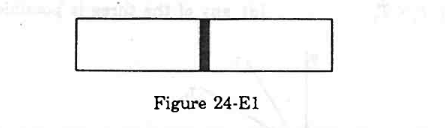 Ans : Since the separator initially divides the cylinder equally, the number of moles of gas are equal in the two parts. Thus,
n1 = n2= n
Volume of the first part = V
Volume of the second part =3V
It is given that the walls are diathermic. So, temperature of the two parts is equal. Thus,
T1 = T2 = T
Let pressure of first and second parts be P1 and P2, respectively.
`` \,\mathrm{\,For\,}\,\mathrm{\,first\,}\,\mathrm{\,part\,}:``
`` \,\mathrm{\,Applying\,}\,\mathrm{\,equation\,}\,\mathrm{\,of\,}\,\mathrm{\,state\,},\,\mathrm{\,we\,}\,\mathrm{\,get\,}``
`` {P}_{1}V=nRT...\left(1\right)``
`` ``
`` \,\mathrm{\,For\,}second\,\mathrm{\,part\,}:``
`` \,\mathrm{\,Applying\,}\,\mathrm{\,equation\,}\,\mathrm{\,of\,}\,\mathrm{\,state\,},\,\mathrm{\,we\,}\,\mathrm{\,get\,}``
`` {P}_{2}\left(3V\right)=nRT...\left(2\right)``
`` ``
`` \,\mathrm{\,Dividing\,}\,\mathrm{\,eq\,}.\left(1\right)\,\mathrm{\,by\,}\,\mathrm{\,eq\,}.\left(2\right),\,\mathrm{\,we\,}\,\mathrm{\,get\,}``
`` \frac{{P}_{1}V}{{P}_{2}\left(3V\right)}=1``
`` \Rightarrow \frac{{P}_{1}}{{P}_{2}}=\frac{3}{1}``
`` \Rightarrow {P}_{1}:{P}_{2}=3:1``
- Qstn #12Find the rms speed of hydrogen molecules in a sample of hydrogen gas at 300 K. Find the temperature at which the rms speed is double the speed calculated in the previous part.Ans : Here,
Temperature of hydrogen gas, T = 300 K
Molar mass of hydrogen, M0 = 2 g/mol=0.002 kg /mol
We know,
`` C=\sqrt{\frac{3RT}{{M}_{0}}}``
`` \Rightarrow C=\sqrt{\frac{3\times 8.3\times 300}{0.002}}``
`` \Rightarrow C=1932.6{\,\mathrm{\,ms\,}}^{-1}``
In the second case, let the required temperature be T.
Applying the same formula, we get
`` \sqrt{\frac{3\times 8.3T}{0.002}}=2\times 1932.6``
`` \Rightarrow T=1200\,\mathrm{\,K\,}``
`` ``
- Qstn #13A sample of 0.177 g of an ideal gas occupies 1000 cm3 at STP. Calculate the rms speed of the gas molecules.Ans : Here,
V = 10-3 m3
Density = 0.177 kgm-3
P = 105pa
`` C=\sqrt{\frac{3P}{\rho }}=\sqrt{\frac{3\times {10}^{5}}{0.177}}``
`` =1301.9{\,\mathrm{\,ms\,}}^{-1}``
- Qstn #14The average translational kinetic energy of air molecules is 0.040 eV (1 eV = 1.6 × 10⁻¹⁹ J). Calculate the temperature of the air. Boltzmann constant k = 1.38 × 10⁻²³ J K-1.Ans : We know from kinetic theory of gases that the average translational energy per molecule is `` \frac{3}{2}kT``.
Now,
Eavg= 0.040 eV = `` 0.040\times 1.6\times {10}^{-19}=6.4\times {10}^{-21}J``
`` 6.40\times {10}^{-21}=\frac{3}{2}\times 1.38\times {10}^{-23}\times T``
`` \Rightarrow T=\frac{2}{3}\times \frac{6.40\times {10}^{-21}}{1.38\times {10}^{-23}}=309.2K``
- Qstn #15Consider a sample of oxygen at 300 K. Find the average time taken by a molecule to travel a distance equal to the diameter of the earth.Ans : `` \,\mathrm{\,Here\,},``
`` {\,\mathrm{\,V\,}}_{\,\mathrm{\,avg\,}}=\frac{\sqrt{8\,\mathrm{\,RT\,}}}{\sqrt{\,\mathrm{\,\pi M\,}}}=\frac{\sqrt{8\times 8.83\times 300}}{\sqrt{3.14\times 0.032}}``
`` =445.25\,\mathrm{\,m\,}/\,\mathrm{\,s\,}``
`` ``
`` \,\mathrm{\,We\,}\,\mathrm{\,know\,},``
`` \,\mathrm{\,T\,}=\frac{\,\mathrm{\,Distance\,}}{\,\mathrm{\,Speed\,}}=\frac{6400000\times 2}{445.25}``
`` =\frac{28747.83h}{3600}=7.985h=8h``