NEET-XII-Physics
qstns with ansrs year:2022
Note: Please signup/signin free to get personalized experience.
Note: Please signup/signin free to get personalized experience.
10 minutes can boost your percentage by 10%
Note: Please signup/signin free to get personalized experience.
- Qstn #15Two resistors of resistance, `` 100 \,\Omega `` and `` 200 \,\Omega `` are connected in parallel in an electrical circuit. The ratio of the thermal energy developed in `` 100\, \Omega `` to that in `` 200\, \Omega `` in a given time is :
(A) `` 4: 1 ``
(B) `` 1: 2 ``
(C) `` 2: 1 ``
(D) `` 1: 4 ``digAnsr: CAns :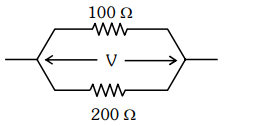
As both resistors are in parallel combination so potential drop `` ( V ) `` across both are same.
`` P =\frac{ V ^{2}}{ R } \Rightarrow P \propto \frac{1}{ R } ``
`` \frac{ P _{1}}{ P _{2}}=\frac{ R _{2}}{ R _{1}}=\frac{200}{100}=\frac{2}{1} ``
`` =2: 1 ``
- Qstn #16Two hollow conducting spheres of radii `` R_{1} `` and `` R_{2} `` `` \left(R_{1} > >R_{2}\right) `` have equal charges. The potential would be:
(A)dependent on the material property of the sphere
(B)more on bigger sphere
(C)more on smaller sphere
(D)equal on both the spheresdigAnsr: CAns : `` V =\frac{1}{4 \pi \epsilon_{0}} \cdot \frac{ Q }{ R } ``
`` \frac{1}{4 \pi \epsilon_{0}}= `` constant
`` Q = `` same (Given)
`` \therefore V \propto \frac{1}{ R } ``
`` \therefore `` Potential is more on smaller sphere.
- Qstn #17The angular speed of a fly wheel moving with uniform angular acceleration changes from `` 1200 \,rpm `` to `` 3120\, rpm `` in `` 16 `` seconds. The angular acceleration in `` rad / s ^{2} `` is :
(A) `` 104 \pi ``
(B) `` 2 \pi ``
(C) `` 4 \pi ``
(D) `` 12 \pi ``digAnsr: CAns : `` \omega =\omega_{0}+\alpha t ``
`` \alpha =\frac{\omega-\omega_{0}}{ t } ``
`` =\frac{(3120-1200)}{16 s } rpm ``
`` =\frac{1920}{16} \times \frac{2 \pi}{60} rad / s ^{2} ``
`` =4 \pi rad / s ^{2} ``
- Qstn #18When light propagates through a material medium of relative permittivity `` \epsilon_{ r } `` and relative permeability `` \mu_{ r ^{\prime}} `` the velocity of light, `` v `` is given by : ( `` c `` - velocity of light in vacuum)
(A) `` v=\frac{ c }{\sqrt{\epsilon_{ r } \mu_{ r }}} ``
(B) `` v= c ``
(C) `` v=\sqrt{\frac{\mu_{ r }}{\epsilon_{ r }}} ``
(D) `` v=\sqrt{\frac{\epsilon_{T}}{\mu_{r}}} ``digAnsr: AAns : `` n=\sqrt{\epsilon_{ r } u_{r}} ``
`` n=\frac{c}{v} \Rightarrow v=\frac{c}{n} ``
`` v=\left(\frac{c}{\sqrt{\epsilon_{r} \mu_{r}}}\right) ``
- Qstn #19A long solenoid of radius `` 1 \,mm `` has `` 100 `` turns per `` mm `` . If `` 1 \,A `` current flows in the solenoid, the magnetic field strength at the centre of the solenoid is :
(A) `` 6.28 \times 10^{-4} T ``
(B) `` 6.28 \times 10^{-2} T ``
(C) `` 12.56 \times 10^{-2} T ``
(D) `` 12.56 \times 10^{-4} T ``digAnsr: CAns : `` B =\mu_{0} ni =\mu_{0} \frac{ N }{\ell} i ``
`` \therefore B =4 \pi \times 10^{-7} \times \frac{100}{10^{-3}} \times 1 ``
`` =12.56 \times 10^{-2} T ``
- Qstn #20A shell of mass `` m `` is at rest initially. It explodes into three fragments having mass in the ratio `` 2: 2: 1 `` . If the fragments having equal mass fly off along mutually perpendicular directions with speed `` v `` , the speed of the third (lighter) fragment is :
(A) `` 3 \sqrt{2} v ``
(B) `` v ``
(C) `` \sqrt{2} v ``
(D) `` 2 \sqrt{2} v ``digAnsr: DAns :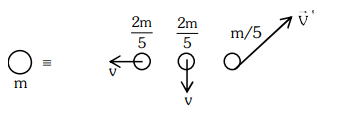
By conservation of momentum :
`` m(0)=\frac{2 m}{5}(-v \hat{i})+\frac{2 m}{5}(-v \hat{j})+\frac{m}{5} \vec{v}^{\prime} ``
`` \Rightarrow \vec{v}^{\prime}=2 v \hat{i}+2 v \hat{j} ``
`` \Rightarrow v^{\prime}=\sqrt{(2 v)^{2}+(2 v)^{2}} ``
`` =2 \sqrt{2} v ``
- Qstn #21As the temperature increases, the electrical resistance :
(A)decreases for conductors but increases for semiconductors
(B)increases for both conductors and semiconductors
(C)decreases for both conductors and semiconductors
(D)increases for conductors but decreases for semiconductorsdigAnsr: DAns : For conductors `` \alpha `` is (+)ve
For semiconductors & Insulators `` \alpha `` is (-)ve
- Qstn #22A biconvex lens has radii of curvature, `` 20\, cm `` each. If the refractive index of the material of the lens is `` 1.5 `` , the power of the lens is :
(A)infinity
(B) `` +2 D ``
(C) `` +20 D ``
(D) `` +5 D ``digAnsr: DAns : `` R _{1}= R _{2}=20\, cm =0.2\, m ``
`` \mu=\frac{3}{2} ``
`` P =\frac{1}{ f }=(\mu-1)\left(\frac{1}{ R _{1}}-\frac{1}{ R _{2}}\right) ``
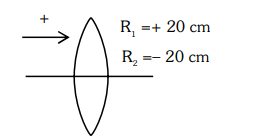
`` P =\left(\frac{3}{2}-1\right)\left(\frac{1}{0.2}+\frac{1}{0.2}\right) ``
`` P =\frac{1}{2}\left(\frac{2}{0.2}\right)=\frac{10}{2}=+5 D ``
- Qstn #23Given below are two statements : Statement I : Biot-Savart's law gives us the expression for the magnetic field strength of an infinitesimal current element (IdI) of a current carrying conductor only. Statement II : Biot-Savart's law is analogous to Coulomb's inverse square law of charge `` q `` , with the former being related to the field produced by a scalar source, Idl while the latter being produced by a vector source, `` q `` . In light of above statements choose the most appropriate answer from the options given below:
(A)Statement I is incorrect and Statement II is correct
(B)Both Statement I and Statement II are correct
(C)Both Statement I and Statement II are incorrect
(D)Statement I is correct and Statement II is incorrectdigAnsr: DAns : `` dB =\frac{\mu_{0}( Id \vec{\ell} \times \vec{r})}{4 \pi r ^{3}} ``
As per Biot Savart law, the expression for magnetic field depends on current carrying element `` Id \vec{\ell} `` , which is a vector quantity, therefore, statement-I is correct and statement-II is wrong.
- Qstn #24A square loop of side `` 1 \,m `` and resistance `` 1\, \Omega `` is placed in a magnetic field of `` 0.5\, T `` . If the plane of loop is perpendicular to the direction of magnetic field, the magnetic flux through the loop is :
(A)zero weber
(B) `` 2 `` weber
(C) `` 0.5 `` weber
(D) `` 1 `` weberdigAnsr: CAns : `` B=0.5 T ``
Angle between `` \vec{B}\, \& \,\vec{A} `` is zero
`` \phi = `` B.A. `` \cos 0 ``
`` =0.5 \times(1) \times 1 ``
`` =0.5 \,Wb ``
- Qstn #25An electric lift with a maximum load of `` 2000\, kg `` (lift+ passengers) is moving up with a constant speed of `` 1.5 \,ms ^{-1} `` . The frictional force opposing the motion is `` 3000\, N `` . The minimum power delivered by the motor to the lift in watts is : `` \left(g=10 \,ms ^{-2}\right) ``
(A)23500
(B)23000
(C)20000
(D)34500digAnsr: DAns : Constant velocity `` \Rightarrow a =0 ``
`` \Rightarrow T = W + f ``
`` =20000+3000 ``
`` =23000 \,N ``
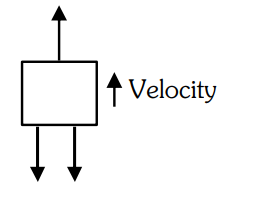
`` \Rightarrow `` Power `` = Tv ``
`` =23000 \times 1.5 ``
`` =34500 `` watts
- Qstn #26A light ray falls on a glass surface of refractive index `` \sqrt{3} `` , at an angle `` 60^{\circ} `` . The angle between the refracted and reflected rays would be:
(A) `` 120^{\circ} ``
(B) `` 30^{\circ} ``
(C) `` 60^{\circ} ``
(D) `` 90^{\circ} ``digAnsr: DAns :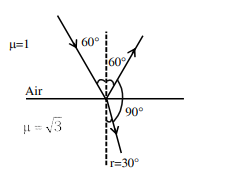
Method (i)
By Snell's law
`` 1 \sin 60^{\circ}=\sqrt{3} \sin r ``
`` \frac{\sqrt{3}}{2}=\sqrt{3} \sin r ``
`` \sin r=\frac{1}{2} ``
`` r=30^{\circ} ``
Angle between refracted and reflected ray is `` 90^{\circ} ``
Method (ii)
Because angle of incidence is Brewster's angle so that angle between reflected and refracted ray is `` 90^{\circ} ``
`` \tan i_{p}=\mu=\sqrt{3} ``
`` i_{p}=60^{\circ}= i ``
- Qstn #27A copper wire of length `` 10\, m `` and radius `` \left(10^{-2} / \sqrt{\pi}\right) m `` has electrical resistance of `` 10\, \Omega `` . The current density in the wire for an electric field strength of `` 10( V / m ) `` is :
(A) `` 10^{5} A / m ^{2} ``
(B) `` 10^{4} A / m ^{2} ``
(C) `` 10^{6} A / m ^{2} ``
(D) `` 10^{-5} A / m ^{2} ``digAnsr: AAns : Radius of wire `` =\frac{10^{-2}}{\sqrt{\pi}} ``
Cross sectional area `` A=\pi r ^{2}=10^{-4} m ^{2} ``
`` j =\frac{ i }{ A }=\left(\frac{ V }{ R }\right) \cdot \frac{1}{ A }=\frac{ E \ell}{ RA } R =\frac{\rho \ell}{ A } ``
`` j =\frac{10 \times 10}{10 \times 10^{-4}}=10^{5} A / m ^{2} ``
or
`` J =\sigma E \Rightarrow \frac{E}{\rho}=\frac{ E \ell}{ RA }=\frac{10 \times 10 \times \pi}{10 \times 10^{-4} \times \pi} ``
`` \Rightarrow 10^{5} A / m ^{2} ``
- Qstn #28
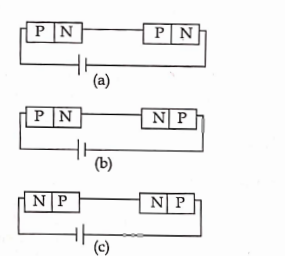 In the given circuits
(a),
(b) and
(c), the potential drop across the two p-n junctions are equal in :
In the given circuits
(a),
(b) and
(c), the potential drop across the two p-n junctions are equal in :
(A)Both circuits
(a) and
(c)
(B)Circuit
(a) only
(C)Circuit
(b) only
(D)Circuit
(c) onlydigAnsr: AAns : In
(a) &
(c) circuits, both the junctions are in same biasing conditions so offers equal resistances.
Since both are in series, therefore equal potential will drop across the junction.
- Qstn #29If the initial tension on a stretched string is doubled, then the ratio of the initial and final speeds of a transverse wave along the string is :
(A) `` 1: 2 ``
(B) `` 1: 1 ``
(C) `` \sqrt{2}: 1 ``
(D) `` 1: \sqrt{2} ``digAnsr: DAns : `` v \propto \sqrt{\text { Tension }} ``
`` \frac{ v _{ i }}{ v _{ f }}=\sqrt{\frac{ T _{ i }}{ T _{ f }}} ``
`` \frac{ v _{ i }}{ v _{ f }}=\sqrt{\frac{ T }{2 T }} ``
`` \frac{ v _{ i }}{ v _{ f }}=\sqrt{\frac{1}{2}}=\frac{1}{\sqrt{2}} ``