NEET-XII-Physics
qstns with ansrs year:2022
Note: Please signup/signin free to get personalized experience.
Note: Please signup/signin free to get personalized experience.
10 minutes can boost your percentage by 10%
Note: Please signup/signin free to get personalized experience.
- Qstn #30The ratio of the radius of gyration of a thin uniform disc about an axis passing through its centre and normal to its plane to the radius of gyration of the disc about its diameter is :
(A) `` 1: \sqrt{2} ``
(B) `` 2: 1 ``
(C) `` \sqrt{2}: 1 ``
(D) `` 4: 1 ``digAnsr: CAns :
`` k =\sqrt{\frac{ I }{ m }} ``
`` \Rightarrow \frac{ k _{1}}{ k _{2}}=\sqrt{\frac{ I _{1}}{ I _{2}}} ``
`` =\sqrt{\frac{ mR ^{2} / 2}{ mR ^{2} / 4}}=\sqrt{2}: 1 ``
- Qstn #31In a Young's double slit experiment, a student observes `` 8 `` fringes in a certain segment of screen when a monochromatic light of `` 600 \,nm `` wavelength is used. If the wavelength of light is changed to `` 400\, nm `` , then the number of fringes he would observe in the same region of the screen is :
(A)12
(B)6
(C)8
(D)9digAnsr: AAns : `` y=(n \lambda)\left(\frac{D}{d}\right) ``
`` n _{1} \lambda_{1}= n _{2} \lambda_{2} ``
`` (8) (600 \,nm )= n _{2}(400) ``
`` n _{2}=12 ``
- Qstn #32The angle between the electric lines of force and the equipotential surface is :
(A) `` 180^{\circ} ``
(B) `` 0^{\circ} ``
(C) `` 45^{\circ} ``
(D) `` 90^{\circ} ``digAnsr: DAns : Electric field is always perpendicular to EPS.
- Qstn #33A spherical ball is dropped in a long column of a highly viscous liquid. The curve in the graph shown, which represents the speed of the ball `` (v) `` as a function of time `` ( t ) `` is :
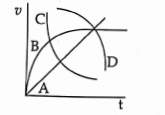
(A)D
(B)A
(C)B
(D)CdigAnsr: CAns : Initially speed is zero, then increases & after some time it becomes constant.
Acceleration (slope of `` v/t `` curve) of ball first decreases and after some time it becomes zero.
- Qstn #34Let `` T _{1} `` and `` T _{2} `` be the energy of an electron in the first and second excited states of hydrogen atom, respectively. According to the Bohr's model of an atom, the ratio `` T _{1}: T _{2} `` is :
(A) `` 9: 4 ``
(B) `` 1: 4 ``
(C) `` 4: 1 ``
(D) `` 4: 9 ``digAnsr: AAns : First excited state `` \Rightarrow n =2 ``
`` T _{1}=-13.6 \frac{ z ^{2}}{ n ^{2}}=-\frac{13.6}{4} eV ``
Second excited state `` \Rightarrow n =3 ``
`` T _{2}=-13.6 \frac{ z ^{2}}{ n ^{2}}=-\frac{13.6}{9} eV ``
`` T _{1}: T _{2}=\frac{1}{4}: \frac{1}{9}=9: 4 ``
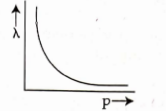
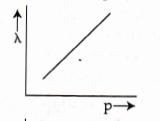
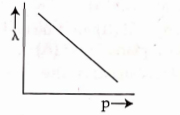
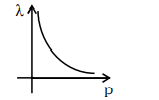
- Qstn #35The graph which shows the variation of the de Broglie wavelength `` (\lambda) `` of a particle and its associated momentum ( `` p ) `` is :
(A)
(B)
(C)
(D)
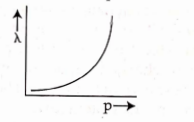 digAnsr: AAns : `` \lambda=\frac{ h }{ p } ``
Graph will be hyperbolic
- Qstn #36Two pendulums of length `` 121 \,cm `` and `` 100\, cm `` start vibrating in phase. At some instant, the two are at their mean position in the same phase. The minimum number of vibrations of the shorter pendulum after which the two are again in phase at the mean position is :
(A)8
(B)11
(C)9
(D)10digAnsr: BAns : `` ( n ) T _{\ell}=( n +1) T _{ s } ``
`` ( n ) 2 \pi \sqrt{\frac{1.21}{ g }}=( n +1) 2 \pi \sqrt{\frac{1}{ g }} ``
`` ( n )(1.1)=( n +1) ``
`` 0.1( n )=1 ``
`` n =10 ``
No. of oscillation of smaller one
`` = n +1 ``
`` =10+1 ``
`` =11 ``
- Qstn #37The volume occupied by the molecules contained in `` 4.5\, kg `` water at STP, if the intermolecular forces vanish away is :
(A) `` 5.6 \,m ^{3} ``
(B) `` 5.6 \times 10^{6} m ^{3} ``
(C) `` 5.6 \times 10^{3} m ^{3} ``
(D) `` 5.6 \times 10^{-3} m ^{3} ``digAnsr: AAns : `` V = `` (no. of moles) `` (22.4 `` litre)
`` =\frac{\text { mass }}{\text { molar mass }}\left(22.4 \times 10^{-3} m ^{3}\right. `` )
`` =\frac{4.5 \times 10^{3}}{18} \times 22.4 \times 10^{-3} m ^{3} ``
`` =5.6 \,m ^{3} ``
- Qstn #38A nucleus of mass number `` 189 `` splits into two nuclei having mass number `` 125 `` and `` 64 `` . The ratio of radius of two daughter nuclei respectively is :
(A) `` 25: 16 ``
(B) `` 1: 1 ``
(C) `` 4: 5 ``
(D) `` 5: 4 ``digAnsr: DAns : Nuclear Radius :
`` R = R _{0}( A )^{1 / 3} ``
`` \frac{ R (125)}{ R (64)}=\frac{ R _{0}(125)^{1 / 3}}{ R _{0}(64)^{1 / 3}}=\frac{5}{4} ``
- Qstn #39Given below are two statements : One is labelled as Assertion (A) and the other is labelled as Reason (R). Assertion (A):The stretching of a spring is determined by the shear modulus of the material of the spring. Reason (R): A coil spring of copper has more tensile strength than a steel spring of same dimensions. In the light of the above statements, choose the most appropriate answer from the options given below :
(A)(A) is false but (R) is true
(B)Both (A) and (R) are true and (R) is the correct explanation of (A)
(C)Both (A) and (R) are true and (R) is not the correct explanation of `` ( A ) ``
(D)(A) is true but (R) is falsedigAnsr: DAns : In stretching of a spring shape charges therefore shear modulus is used.
`` Y _{\text {copper }}< Y _{\text {steel }} ``
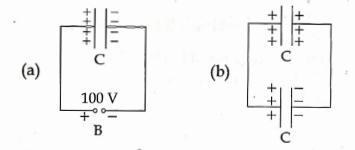
- Qstn #40A capacitor of capacitance `` C =900 \,pF `` is charged fully by `` 100\, V `` battery `` B `` as shown in figure (a). Then it is disconnected from the battery and connected to another uncharged capacitor of capacitance `` C =900 \,pF `` as shown in figure (b). The electrostatic energy stored by the system (b) is :
(A) `` 1.5 \times 10^{-6} J ``
(B) `` 4.5 \times 10^{-6} J ``
(C) `` 3.25 \times 10^{-6} J ``
(D) `` 2.25 \times 10^{-6} J ``digAnsr: DAns :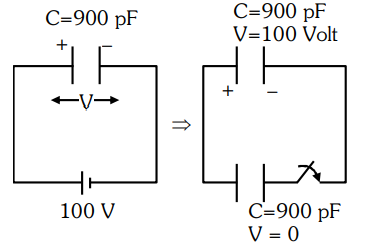
Common potential
`` V _{ C } =\frac{ C _{1} V _{1}+ C _{2} V _{2}}{ C _{1}+ C _{2}} ``
`` =\frac{ C \times 100+ C \times 0}{ C + C } ``
`` =50 `` Volt
Electrostatic energy stored
`` =2 \times \frac{1}{2} CV ^{2}= CV ^{2} ``
`` =900 \times 10^{-12} \times 50 \times 50 ``
`` =225 \times 10^{-8} J ``
`` =2.25 \times 10^{-6} J ``
- Qstn #41From Ampere's circuital law for a long straight wire of circular cross-section carrying a steady current, the variation of magnetic field in the inside and outside region of the wire is :
(A)a linearly decreasing function of distance upto the boundary of the wire and then a linearly increasing one for the outside region.
(B)uniform and remains constant for both the regions.
(C)a linearly increasing function of distance upto the boundary of the wire and then linearly decreasing for the outside region.
(D)a linearly increasing function of distance `` r `` upto the boundary of the wire and then decreasing one with `` 1 / r `` dependence for the outside region.digAnsr: DAns :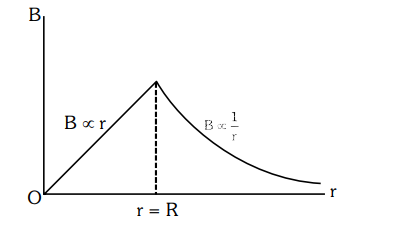
- Qstn #42The area of a rectangular field (in `` m ^{2} `` ) of lengt `` 55.3 \,m `` and breadth `` 25\, m `` after rounding off the value for correct significant digits is :
(A) `` 14 \times 10^{2} ``
(B) `` 138 \times 10^{1} ``
(C) `` 1382 ``
(D) `` 1382.5 ``digAnsr: AAns : Area `` = `` Length `` \times `` Breadth
`` =55.3 \times 25 ``
`` =1382.5 ``
`` =14 \times 10^{2} ``
Resultant should have `` 2 `` significant figures.
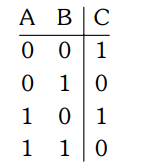
- Qstn #43The truth table for the given logic circuit is :
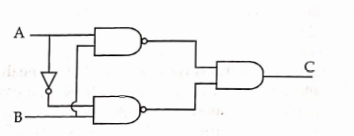
(A)
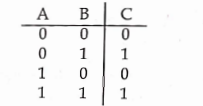
(B)
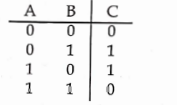
(C)
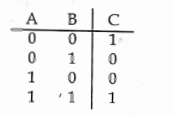
(D)
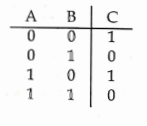 digAnsr: DAns :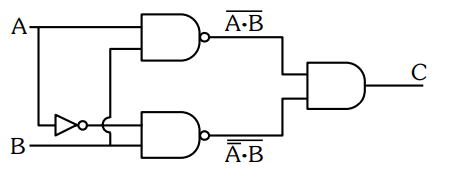
`` C=\overline{A \cdot B} \cdot \overline{\bar{A}} \cdot B ``
using De-Morgan Theorem
`` C=\overline{ A \cdot B +\overline{ A } \cdot B } ``
`` C =\overline{ B ( A +\overline{ A })}=\overline{ B } ``
Therefore
- Qstn #44Two transparent media `` A `` and `` B `` are separated by a plane boundary. The speed of light in those media are `` 1.5 \times 10^{8} m / s `` and `` 2.0 \times 10^{8} m / s `` , respectively The critical angle for a ray of light for these two media is :
(A) `` \tan ^{-1}(0.750) ``
(B) `` \sin ^{-1}(0.500) ``
(C) `` \sin ^{-1}(0.750) ``
(D) `` \tan ^{-1}(0.500) ``digAnsr: CAns : `` \mu=\frac{ C }{ u } \Rightarrow u \propto \frac{1}{\mu} ``
Critical angle
`` \operatorname{Sini}_{ c }=\frac{\mu_{ R }}{\mu_{ D }}=\frac{ u _{ D }}{ u _{ R }}=\frac{1.5}{2}=\frac{3}{4} ``
`` i _{ c }=\sin ^{-1}\left(\frac{3}{4}\right) ``
`` \sin \dot{i}_{ c }=\frac{\mu_{ R }}{\mu_{ D }}=\frac{ u _{ D }}{ u _{ R }} ``
`` i _{ c }=\sin ^{-1}\left(\frac{3}{4}\right) ``