ICSE-VIII-Mathematics
20: Area of Trapezium and a Polygon Class 8 Maths
Note: Please signup/signin free to get personalized experience.
Note: Please signup/signin free to get personalized experience.
10 minutes can boost your percentage by 10%
Note: Please signup/signin free to get personalized experience.
- Qstn #3The two parallel sides and the distance between them are in the ratio 3 : 4 : 2. If the area of the trapezium is 175 cm2, find its height.Ans : Let the two parallel sides and the distance between them be 3x, 4x, 2x cm respectively
Area = 1/2 (sum of parallel sides) x (distance between parallel sides)
= 1/2 (3x + 4x) × 2x = 175 (given)
⇒ 7x × x = 175
⇒ 7x2 = 175
⇒ x2 = 25
⇒ x = 5
Height i.e. distance between parallel sides = 2x = 2× 5 = 10 cm
- Qstn #4A parallelogram has sides of 15 cm and 12 cm; if the distance between the 15 cm sides is 6 cm; find the distance between 12 cm sides.Ans :
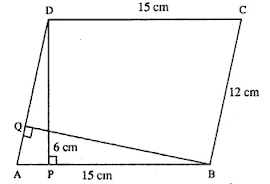 Base, AB = 15 cm
Distance between 15 cm sides
i.e., height DP = 6 cm
∴ Area of ∥gm = Base × Height
= AB × DP
= 15 × 6
= 90 cm2
Let BQ be distance 12 cm sides
∴ AD × BQ = area of ∥gm ABCD
∴ 12 × BQ = 90
BQ = 90/12
BQ = 15/2
= 7.5 cm
- Qstn #5A parallelogram has sides of 20 cm and 30 cm. If the distance between its shorter sides is 15 cm; find the distance between the longer sides.Ans :
 Let ABCD be the ∥gm in which BC = 30 cm and CD = 20 cm
Distance between shorter sides,
i.e., CQ = 15 cm
∴ area of ∥gm = AB × CQ
= 20 × 15
= 300 cm2
Again BC × AP = Area of ∥gm
30 × AP = 300
⇒ AP = 300/30
⇒ AP = 10 cm
∴ Distance between larger sides is = 10 cm
- Qstn #6The adjacent sides of a parallelogram are 21 cm and 28 cm. If its one diagonal is 35 cm; find the area of the parallelogram.Ans :
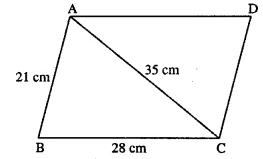
First we find area of ΔABC,
Sides are, a = 28 cm
B = 35 cm
And c = 21 cm
S = (a + b + c)/2
= (28 + 35 + 21)/2
= 84/2
= 42 cm
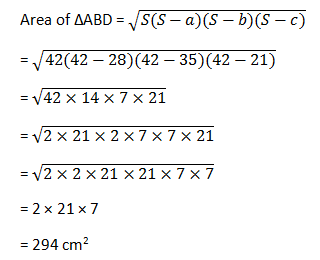 ∵ Diagonal of ∥gm divides it into two equal parts.
∴ area of ∥gm = 2 × area of ΔABC
= 2 × 294
= 588 cm2
- #7-iits area ;Ans : Diagonal of rhombus are 18 cm and 24 cm.
area of rhombus = 1/2 ×Product of diagonals
= 1/2 × 18 × 24
= 216 cm2
- #7-iilength of its sides.Ans : Diagonals of rhombus bisect each other at right angles.
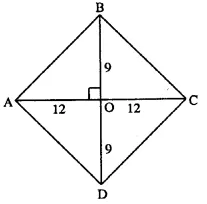
∴ OA = ½ × 24 = 12 cm OB =1/2 × 18 = 9 cm
In right ∠d ΔAOB
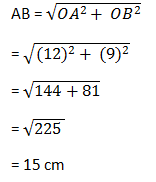 ∴ Side of rhombus = 15 cm
- #7-iiiits perimeter;Ans : Perimeter of rhombus = 4 × side
= 4 × 15
= 60 cm
(i) 216 cm2(ii) 15 cm(iii) 60 cm
- #8-iits another diagonalAns : Perimeter of rhombus = 40 cm
side = ¼ ×40 = 10 cm
One diagonal = 16 cm
Diagonals of rhombus bisect each other at right angles.
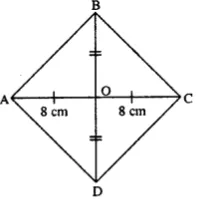
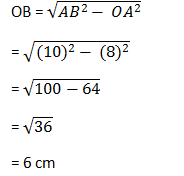
∴ Diagonal BD = 6 × 2 = 12 cm
- #8-iiareaAns : Area of rhombus = ½ × product of diagonals
= ½ × 12 × 16
= 96 cm2
∴ (i) 12 cm(ii) 96 cm2
- Qstn #9Each side of a rhombus is 18 cm. If the distance between two parallel sides is 12 cm, find its area.Ans : Each side of the rhombus = 18 cm
base of the rhombus = 18 cm
Distance between two parallel sides = 12 cm
Height = 12 cm
Area of the rhombus = base x height = 18× 12 = 216 cm2
- Qstn #10The length of the diagonals of a rhombus is in the ratio 4 : 3. If its area is 384 cm2, find its side.Ans : Let the lengths of the diagonals of rhombus are 4x, 3x.
∴ Area of the rhombus = ½ (Product of its diagonals)
= ½ (4x × 3x)
= 384 (given)
⇒ 6x2 = 384
⇒ x2 = 64
⇒ x = 8 cm
∴ Diagonals are 4 × 8 = 32 cm and 3(8) = 24 cm
∴ OC = 16 cm and OD = 12 cm
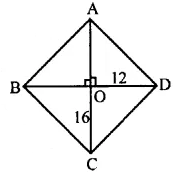
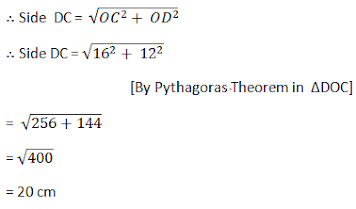 Hence, side of the rhombus = 20 cm
- Qstn #11A thin metal iron-sheet is rhombus in shape, with each side 10 m. If one of its diagonals is 16 m, find the cost of painting its both sides at the rate of ₹ 6 per m2.
Also, find the distance between the opposite sides of this rhombus.Ans : Side of rhombus shaped iron sheet = 10 m and one diagonals (AC) = 16 m
Join BD diagonal which bisects AC at O
The diagonals of a rhombus bisect each other at right angle
 ∴ AO = OC = 16/2 = 8 m
Now in right ΔAOB
AB2 = AO2 + BO2
⇒ (10)2 = (8)2 + BO2
⇒ 100 = 64 + BO2
⇒ BO2 = 100 - 64
= 36
= (6)2
∴ BO = 6 m
∴ BD = 2 × BO
= 2 × 6
= 12 m
Now, area of rhombus = (d1 × d2)/2
= (16 × 12)/2
= 96 m2
Rate of pairing = ₹ 6 per m2
∴ Total cost of painting both sides = 2 × 96 × 6
= ₹ 1152
Distance between two opposite sides = Area/Base
= 96/10
= 9.6 m
- Qstn #12The area of a trapezium is 279 sq.cm and the distance between its two parallel sides is 18 cm. If one of its parallel sides is longer than the other side by 5 cm, find the lengths of its parallel sides.Ans : Area of trapezium = 279 sq.cm
Distance between two parallel lines (h) = 18 cm
 ∴ Sum of parallel sides = (Area × 2)/Height
= (279 × 2)/18
= 31 m
Let shorter side, CD = x
Then longer side = x + 5
∴ x + x + 5 = 31
⇒ 2x = 31 - 5 = 26
⇒ x = 26/2 = 13
∴ Shorter side = 13 cm
And longer side = 13 + 5
= 18 cm