CBSE-XI-Physics
05: Newton's Laws of Motion
Note: Please signup/signin free to get personalized experience.
Note: Please signup/signin free to get personalized experience.
10 minutes can boost your percentage by 10%
Note: Please signup/signin free to get personalized experience.
- Qstn #18Suppose the ceiling in the previous problem is that of an elevator which is going up with an acceleration of 2.0 m/s2. Find the elongation.Ans : When the ceiling of the elevator is going up with an acceleration 'a', then a pseudo-force acts on the block in the downward direction.
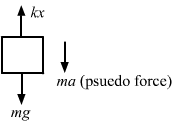
a = 2 m/s2
From the free-body diagram of the block,
kx = mg + ma
⇒ kx = 2g + 2a
= 2 × 9.8 + 2 × 2
= 19.6 + 4
`` \Rightarrow x=\frac{23.6}{100}=0.236\approx 0.24\,\mathrm{\,m \,}``
When 1 kg body is added,
total mass = (2 + 1) kg = 3 kg
Let elongation be x'.
∴ kx' = 3g + 3a = 3 × 9.8 + 6
`` \Rightarrow x\text{ ' }=\frac{35.4}{100}``
`` =0.354\approx 0.36\,\mathrm{\,m \,}``
So, further elongation = x' - x
= 0.36 - 0.24 = 0.12 m.
Page No 80:
- Qstn #19The force of buoyancy exerted by the atmosphere on a balloon is B in the upward direction and remains constant. The force of air resistance on the balloon acts opposite the direction of velocity and is proportional to it. The balloon carries a mass M and is found to fall to the earth’s surface with a constant velocity v. How much mass should be removed from the balloon so that it may rise with a constant velocity v?Ans : Let M be mass of the balloon.
Let the air resistance force on balloon be F .
Given that F ∝ v.
⇒ F = kv,
where k = proportionality constant.
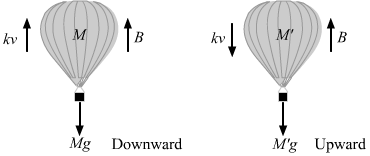
When the balloon is moving downward with constant velocity,
B + kv = Mg ...(i)
`` \Rightarrow M=\frac{B+kv}{g}``
Let the mass of the balloon be M' so that it can rise with a constant velocity v in the upward direction.
B = Mg + kv
`` \Rightarrow M\text{ ' }=\frac{B+kv}{g}``
∴ Amount of mass that should be removed = M - M'.
`` ∆M=\frac{B+kv}{g}-\frac{B-kv}{g}``
`` =\frac{B+kv-B+kv}{g}``
`` =\frac{2kv}{g}=\frac{2\left(Mg-B\right)}{g}``
`` =2\left\{M-\frac{B}{g}\right\}``
Page No 80:
- Qstn #20An empty plastic box of mass m is found to accelerate up at the rate of g/6 when placed deep inside water. How much sand should be put inside the box so that it may accelerate down at the rate of g/6?Ans : Let U be the upward force of water acting on the plastic box.
Let m be the initial mass of the plastic box.
When the empty plastic box is accelerating upward,
`` U-mg=\frac{mg}{6}``
`` \Rightarrow U=\frac{7mg}{6}``

`` \Rightarrow m=\frac{6U}{7g}....\left(i\right)``
Let M be the final mass of the box after putting some sand in it.
`` Mg-U=\frac{Mg}{6}``
`` \Rightarrow Mg-\frac{Mg}{6}=U``
`` \Rightarrow M=\frac{6U}{5g}....\left(ii\right)``
Mass added`` =\frac{6U}{5g}-\frac{6U}{7g}``
`` =\frac{6U\left(7-5\right)}{35g}``
`` =\frac{6U·2}{35g}``
From equation (i), `` m=\frac{6U}{7g}``
∴ Mass added`` =\frac{2}{5}m`` .
Page No 80:
- Qstn #21A force
F→=v→×A→is exerted on a particle in addition to the force of gravity, where
v→is the velocity of the particle and
A→is a constant vector in the horizontal direction. With what minimum speed, a particle of mass m be projected so that it continues to move without being defelected and with a constant velocity?Ans : For the particle to move without being deflected and with constant velocity, the net force on the particle should be zero.
`` \stackrel{\to }{F}+m\stackrel{\to }{g}=0``
`` \Rightarrow \left(\stackrel{\to }{v}\times \stackrel{\to }{A}\right)+\stackrel{\to }{mg}=0``
`` \Rightarrow \left(\stackrel{\to }{v}\times \stackrel{\to }{A}\right)=-\stackrel{\to }{mg}``
`` \left|vA\,\mathrm{\,sin \,}\theta \right|=\left|mg\right|``
`` \therefore v=\frac{mg}{A\,\mathrm{\,sin \,}\theta }``
v will be minimum when sinθ = 1.
⇒ θ = 90°
`` \therefore {v}_{min}=\frac{mg}{A}``
Page No 80:
- Qstn #22In a simple Atwood machine, two unequal masses m1 and m2 are connected by a string going over a clamped light smooth pulley. In a typical arrangement (figure 5-E7), m1 = 300 g and m2 = 600 g. The system is released from rest.
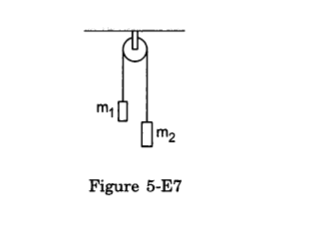 Ans : The masses of the blocks are m1 = 0.3 kg and m2 = 0.6 kg
The free-body diagrams of both the masses are shown below:
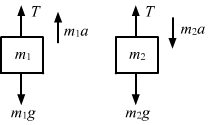
For mass m1,
T - m1g = m1a ...(i)
For mass m2,
m2g - T= m2a ...(ii)
Adding equations (i) and (ii), we get:
g(m2 - m1) = a(m1 + m2)
`` \Rightarrow a=g\left(\frac{{m}_{2}-{m}_{1}}{{m}_{1}+{m}_{2}}\right)``
`` =9.8\times \frac{0.6-0.3}{0.6+0.3}``
`` =3.266\,\mathrm{\,m \,}/{\,\mathrm{\,s \,}}^{2}``
- #22-aFind the distance travelled by the first block in the first two seconds;Ans : t = 2 s, a = 3.266 ms-2, u = 0
So, the distance travelled by the body,
`` \,\mathrm{\,S \,}=ut+\frac{1}{2}a{t}^{2}``
`` =0+\frac{1}{2}\left(3.266\right){2}^{2}=6.5\,\mathrm{\,m \,}``
- #22-bfind the tension in the string;Ans : From equation (i),
T = m1 (g + a)
= 0.3 (3.8 + 3.26) = 3.9 N
- #22-cfind the force exerted by the clamp on the pulley.
FigureAns : The force exerted by the clamp on the pulley,
F = 2T = 2 × 3.9 = 7.8 N
Page No 80:
- Qstn #23Consider the Atwood machine of the previous problem. The larger mass is stopped for a moment, 2.0 s after the system is set into motion. Find the time that elapses before the string is tight again.Ans : a = 3.26 m/s2, T = 3.9 N
After 2 s, velocity of mass m1,
v = u + at = 0 + 3.26 × 2
= 6.52 m/s upward
At this time, m2 is moving 6.52 m/s downward.
At time 2 s, m2 stops for a moment. But m1 is moving upward with velocity 6.52 m/s. It will continue to move till final velocity (at highest point) becomes zero.
Here, v = 0, u = 6.52 m/s
a = -g = - 9.8 m/s2
v = u + at = 6.52 + (-9.8)t
`` \Rightarrow t=\frac{6.52}{9.8}\approx \frac{2}{3}\,\mathrm{\,sec \,}``
After this time, the mass m1 also starts moving downward.
So, the string becomes tight again after `` \frac{2}{3}\,\mathrm{\,s \,}``.
Page No 80:
- Qstn #24Figure (5-E8) shows a uniform rod of length 30 cm and mass 3.0 kg. The strings shown in the figure are pulled by constant forces of 20 N and 32 N. Find the force exerted by the 20 cm part of the rod on the 10 cm part. All the surfaces are smooth and the strings and the pulleys are light.
Figure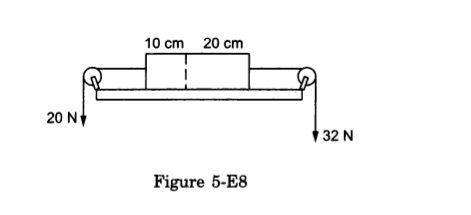 Ans : Mass per unit length`` =\frac{3}{30}\,\mathrm{\,kg \,}/\,\mathrm{\,cm \,}`` = 0.10 kg/cm
Mass of the 10 cm part, m1 = 1 kg
Mass of the 20 cm part, m2 = 2 kg
Let F = contact force between them.
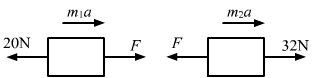
From the free-body diagram,
`` {m}_{1}a=F-20...\left(\,\mathrm{\,i \,}\right)``
`` {m}_{2}a=32-F...\left(\,\mathrm{\,ii \,}\right)``
`` \,\mathrm{\,Adding \,}\,\mathrm{\,both \,}\,\mathrm{\,the \,}\,\mathrm{\,equation \,}\text{ s },\,\mathrm{\,we \,}\,\mathrm{\,get \,}:``
`` a=\frac{12}{{m}_{1}+{m}_{2}}=\frac{12}{3}=4\,\mathrm{\,m \,}/{\,\mathrm{\,s \,}}^{2}``
So, contact force,
F = 20 + 1a
F = 20 + 4 = 24 N
Page No 81:
- Qstn #25Consider the situation shown in figure (5-E9). All the surfaces are frictionless and the string and the pulley are light. Find the magnitude of acceleration of the two blocks.
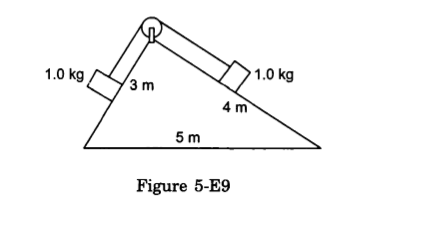 Ans : Mass of each block is 1 kg, `` \,\mathrm{\,sin \,}{\,\mathrm{\,\theta \,}}_{1}=\frac{4}{5}``, `` \,\mathrm{\,sin \,}{\,\mathrm{\,\theta \,}}_{2}=\frac{3}{5}``.
The free-body diagrams for both the boxes are shown below:
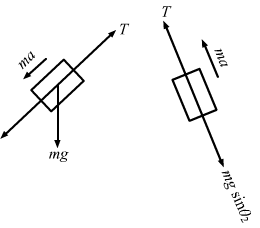
mgsinθ1 - T = ma ...(i)
T - mgsinθ2 = ma ...(ii)
Adding equations (i) and (ii),we get:
mg(sinθ1 - sinθ2) = 2ma
⇒ 2a = g (sinθ1 - sinθ2)
`` \Rightarrow a=\frac{g}{5}\times \frac{1}{2}``
`` =\frac{g}{10}``
Page No 81:
- Qstn #26A constant force F = m2g/2 is applied on the block of mass m1 as shown in figure (5-E10). The string and the pulley are light and the surface of the table is smooth. Find the acceleration of m1.
Figure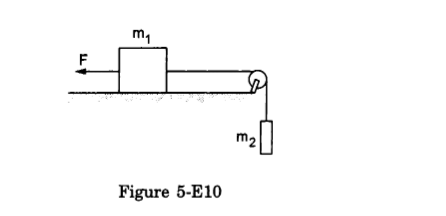 Ans : The free-body diagrams for both the blocks are shown below:
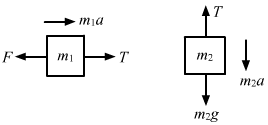
From the free-body diagram of block of mass m1,
m1a = T - F ...(i)
From the free-body diagram of block of mass m2,
m2a = m2g - T ...(ii)
Adding both the equations, we get:
`` a\left({m}_{1}+{m}_{2}\right)={m}_{2}g-\frac{{m}_{2}g}{2}\left[\,\mathrm{\,because \,}F=\frac{{m}_{2}g}{2}\right]``
`` \Rightarrow a=\frac{{m}_{2}g}{2\left({m}_{1}+{m}_{2}\right)}``
So, the acceleration of mass m1,
`` a=\frac{{m}_{2}g}{2\left({m}_{1}+{m}_{2}\right)},\,\mathrm{\,towards \,}\text{ the }\,\mathrm{\,right \,}.``
Page No 81:
- Qstn #27In figure (5-E11), m1 = 5 kg, m2 = 2 kg and F = 1 N. Find the acceleration of either block. Describe the motion of m1 if the string breaks but F continues to act.
Figure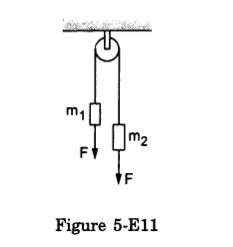 Ans : Let the acceleration of the blocks be a.
The free-body diagrams for both the blocks are shown below:

From the free-body diagram,
m1a = m1g + F - T ...(i)
Again, from the free-body diagram,
m2a = T - m2g - F ...(ii)
Adding equations (i) and (ii), we have:
`` a=g\frac{{m}_{1}-{m}_{2}}{{m}_{1}+{m}_{2}}``
`` ``
`` \Rightarrow a=\frac{3g}{7}=\frac{29.4}{7}``
`` =4.2\,\mathrm{\,m \,}/{\,\mathrm{\,s \,}}^{2}``
Hence, acceleration of the block is 4.2 m/s2.
After the string breaks, m1 moves downward with force F acting downward. Then,
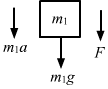
m1a = F + m1g
5a = 1 + 5g
`` \Rightarrow a=\frac{5g+1}{5}``
`` =g+0.2\,\mathrm{\,m \,}/{\,\mathrm{\,s \,}}^{2}``
Page No 81:
- Qstn #28Let m1 = 1 kg, m2 = 2 kg and m3 = 3 kg in figure (5-E12). Find the accelerations of m1, m2 and m3. The string from the upper pulley to m1 is 20 cm when the system is released from rest. How long will it take before m1 strikes the pulley?
Figure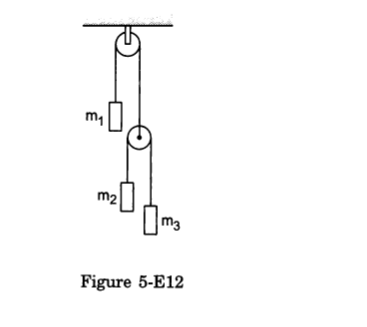 Ans : The free-body diagram for mass m1 is shown below:
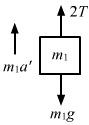
(Figure 1)
The free-body diagram for mass m2 is shown below:
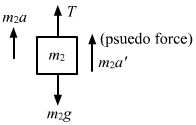
(Figure 2)
The free-body diagram for mass m3 is shown below:
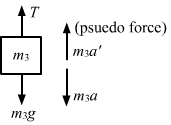
(Figure 3)
Suppose the block m1 moves upward with acceleration a1 and the blocks m2 and m3 have relative acceleration a2 due to the difference of weight between them.
So, the actual acceleration of the blocks m1, m2 and m3 will be a1, (a1 - a2) and (a1 + a2), as shown.
From figure 2, T - 1g - 1a1 = 0 ...(i)
From figure 3, `` \frac{T}{2}-2g-2\left({a}_{1}-{a}_{2}\right)=0...\left(\,\mathrm{\,ii \,}\right)``
From figure 4, `` \frac{T}{2}-3g-3\left({a}_{1}+{a}_{2}\right)=0...\left(\,\mathrm{\,iii \,}\right)``
From equations (i) and (ii), eliminating T, we get:
1g + 1a2 = 4g + 4 (a1 + a2)
5a2 - 4a1 = 3g ...(iv)
From equations (ii) and (iii), we get:
2g + 2(a1 - a2) = 3g - 3 (a1 - a2)
5a1 + a2 = g ...(v)
Solving equations (iv) and (v), we get:
`` {a}_{1}=\frac{2g}{29}``
`` \,\mathrm{\,and \,}{a}_{2}=g-5{a}_{1}``
`` \Rightarrow {a}_{2}=g-\frac{10g}{29}=\frac{19g}{29}``
`` \,\mathrm{\,So \,},{a}_{1}-{a}_{2}=\frac{2g}{29}-\frac{19g}{29}=-\frac{17g}{29}``
`` \,\mathrm{\,and \,}{a}_{1}+{a}_{2}=\frac{2g}{29}+\frac{19g}{29}=\frac{21g}{29}``
So, accelerations of m1, m2 and m3 are `` \frac{19g}{29}\left(\,\mathrm{\,up \,}\right),\frac{17g}{29}\left(\,\mathrm{\,down \,}\right)\,\mathrm{\,and \,}\frac{21g}{29}\left(\,\mathrm{\,down \,}\right)`` , respectively.
Now, u = 0, s = 20 cm = 0.2 m
`` {a}_{2}=\frac{19g}{29}``
`` \therefore s=ut+\frac{1}{2}a{t}^{2}``
`` \Rightarrow 0.2=\frac{1}{2}\times \frac{19}{29}g{t}^{2}``
`` \Rightarrow t=0.25\,\mathrm{\,s \,}``
Page No 81:
- Qstn #29In the previous problem, suppose m2 = 2.0 kg and m3 = 3.0 kg. What should be the mass m, so that it remains at rest?Ans :
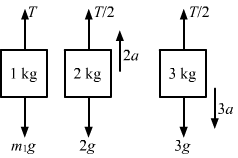
For m1 to be at rest, a1 = 0.
T - m1g = 0
T = m1g ...(i)
For mass m2,
T/2 - 2g = 2a
T = 4a + 4g ...(ii)
For mass m3,
3g - T/2= 2a
T = 6g - 6a ...(ii)
From equations (ii) and (iii), we get:
3T - 12g = 12g - 2T
T = 24g/5= 4.08g
Putting the value of T in equation (i), we get:
m1 = 4.8kg
Page No 81: