CBSE-XI-Physics
05: Newton's Laws of Motion
- #19The force of buoyancy exerted by the atmosphere on a balloon is B in the upward direction and remains constant. The force of air resistance on the balloon acts opposite the direction of velocity and is proportional to it. The balloon carries a mass M and is found to fall to the earth’s surface with a constant velocity v. How much mass should be removed from the balloon so that it may rise with a constant velocity v?Ans : Let M be mass of the balloon.
Let the air resistance force on balloon be F .
Given that F ∝ v.
⇒ F = kv,
where k = proportionality constant.
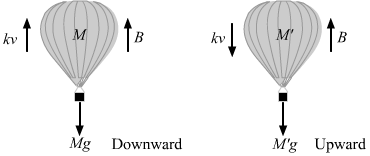
When the balloon is moving downward with constant velocity,
B + kv = Mg ...(i)
`` \Rightarrow M=\frac{B+kv}{g}``
Let the mass of the balloon be M' so that it can rise with a constant velocity v in the upward direction.
B = Mg + kv
`` \Rightarrow M\text{ ' }=\frac{B+kv}{g}``
∴ Amount of mass that should be removed = M - M'.
`` ∆M=\frac{B+kv}{g}-\frac{B-kv}{g}``
`` =\frac{B+kv-B+kv}{g}``
`` =\frac{2kv}{g}=\frac{2\left(Mg-B\right)}{g}``
`` =2\left\{M-\frac{B}{g}\right\}``
Page No 80: