NEET-XII-Physics
neet 2020 questions with solutions year:2020
Note: Please signup/signin free to get personalized experience.
Note: Please signup/signin free to get personalized experience.
10 minutes can boost your percentage by 10%
Note: Please signup/signin free to get personalized experience.
- Qstn #1For which one of the following, Bohr model is not valid?
(A)Hydrogen atom
(B)Singly ionised helium atom `` (He^+) ``
(C)Deuteron atom
(D)Singly ionised neon atom `` (Ne^+) ``
digAnsr: DAns : Bohr model is applicable for only single electron species. Singly ionised neon atom has more than one electron in orbit. Hence, Bohr model is not valid
- Qstn #2The ratio of contributions made by the electric field and magnetic field components to the intensity of an electromagnetic wave is : (c = speed of electromagnetic waves)
(A)c : 1
(B)1 : 1
(C)1 : c
(D) `` 1 : c^2 ``
digAnsr: BAns : In an electromagnetic wave, half of the intensity is provided by the electric field and half by the magnetic field. Hence, required ratio should be `` 1 : 1 ``
- Qstn #3The Brewsters angle `` i_b `` for an interface should be:
(A) `` 0°< i b < 30° ``
(B) `` 30°< i_b < 45° ``
(C) `` 45°< i_b < 90° ``
(D) `` i_b = 90° ``
digAnsr: CAns : `` \mu=tan\,i_{b} ``
`` 1<\,\mu<\,\infty ``
`` 1<\,tan\,i_{b}<\,\infty ``
`` tan^{-1}\left(1\right)<\,i_{b}<\,tan^{-1}\left(\infty\right) ``
`` 45^{\circ}<\,i_{b}<\,90^{\circ} ``
- Qstn #4A cylinder contains hydrogen gas at pressure of 249 kPa and temperature `` 27^\circ\,C `` . Its density is : `` (R = 8.3\,J\,mol^{-1}K^{-1} `` )
(A) `` 0.5 \,kg/m^3 ``
(B) `` 0.2 \,kg/m^3 ``
(C) `` 0.1 \,kg/m^3 ``
(D) `` 0.02 \,kg/m^3 ``
digAnsr: BAns : We can express, an ideal gas equation as
`` \frac{P}{\rho}=\frac{R.T}{Mw} ``
`` \Rightarrow \rho=\frac{pMw}{RT} ``
`` =\frac{249 \times 10^{3}\times 2 \times 10^{-3}}{8.314 \times 300} ``
`` =0.199 ``
`` \Rightarrow \rho=0.2 kg/m^{3} ``
- Qstn #5A ray is incident at an angle of incidence `` i `` on one surface of a small angle prism(with angle of prism A) and emerges normally from the opposite surface. If the refractive index of the material of the prism is `` \mu `` . then the angle of incidence is nearly equal to:
(A) `` \frac {A}{2\mu} ``
(B) `` \frac {2A}{\mu} ``
(C) `` \mu A ``
(D) `` \frac {\mu \,A}{2} ``
digAnsr: CAns : Light ray emerges from another surface normally, hence e(angle of emergence) = 0
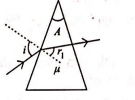
`` \Rightarrow r_{2}=0 ``
`` r_{1}+r_{2}=A ``
`` \Rightarrow r_{1}=A ``
Applying Snell’s law on first surface,
`` 1. sin\,i=\mu\,sin\,r_{1} ``
For small angle , `` sin\,\theta\, \approx\,\theta `` Hence,
`` i=\mu\,A ``
- Qstn #6Two cylinders `` A `` and `` B `` of equal capacity are connected to each other via a stop clock. A contains an ideal gas at standard temperature and pressure. `` B `` is completely evacuated. The entire system is thermally insulated. The stop clock is suddenly opened. The process is:
(A)isothermal
(B)adiabatic
(C)isochoric
(D)isobaric
digAnsr: BAns : The entire system is completely insulated and the free expansion of the gas will take place, the temperature of the gas will remain constant. So the process will be adiabatic.
- Qstn #7The energy equivalent of 0.5 g of a substance is:
(A) `` 4.5 \times 10^{16} J ``
(B) `` 4.5 \times 10^{13} J ``
(C) `` 1.5 \times 10^{13} J ``
(D) `` 0.5 \times 10^{13} J ``
digAnsr: BAns : From mass-energy equivalence,
`` E=mc^{2} ``
`` =0.5\times 10^{-3}\times 9\times 10^{16} ``
`` =4.5 \times 10^{13}\,J ``
- Qstn #8A body weighs 72 N on the surface of the earth. What is the gravitational force on it, at a height equal to half the radius of the earth?
(A)48 N
(B)32 N
(C)30 N
(D)24 N
digAnsr: BAns : `` w_{s}=mg_{s}=72\,N ``
`` w_{h}=mg_{h}=\frac{mg_{s}}{\left(1+\frac{h}{R}\right)^{2}} ``
`` =\frac{72\,N}{\left(1+\frac{R /2}{2}\right)} ``
`` =\frac{72}{9 /4} ``
`` w_{h}=32\,N ``
- Qstn #9The solids which have negative temperature coefficient of resistance are :
(A)metals
(B)insulators only
(C)semiconductors only
(D)insulators and semiconductors
digAnsr: DAns : For metals temperature coefficient of resistance is positive while for insulators and semiconductors, temperature coefficient of resistance is negative
- Qstn #10The phase difference between displacement and acceleration of a particle in a simple harmonic motion is:
(A) `` \pi `` rad
(B) `` \frac {3\pi}{2} `` rad
(C) `` \frac {\pi}{2} `` rad
(D) `` zero ``
digAnsr: AAns : Displacement (x) of SHM
`` x=A\,sin \left(\omega t+\phi\right) \dots(i) ``
`` \frac{dx}{dt}=A\,\omega\,cos(\omega\,t+\phi) ``
Acceleration ``
(a)=\frac{d^{2}x}{dt^{2}} ``
`` \Rightarrow a=-\omega^{2}\,A\,sin(\omega\,t+\phi) ``
`` \Rightarrow a=\omega^{2}\,A\,sin(\omega\,t+\phi+\pi)\dots(ii) ``
from (1) & (2), phase difference between displacement and acceleration is `` \pi ``
- Qstn #11A screw gauge has least count of 0.01 mm and there are 50 divisions in its circular scale.
The pitch of the screw gauge is:
(A)0.01 mm
(B)0.25 mm
(C)0.5 mm
(D)1.0 mm
digAnsr: CAns : L.C. `` =\frac{\text{Pitch}}{\text{Number of division on circular scale}} ``
`` \Rightarrow 0.01\,mm=\frac{\text{pitch}}{50} ``
`` \Rightarrow `` pitch `` =0.5\,mm ``
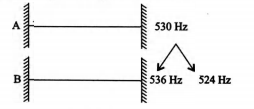
- Qstn #12In a guitar, two strings A and B made of same material are slightly out of tune and produce beats of frequency `` 6\,Hz `` . When tension in B is slightly decreased, the be at frequency increases to `` 7\,Hz `` . If the frequency of A is `` 530\,Hz `` , the original frequency of B will be :
(A)523 Hz
(B)524 Hz
(C)536 H z
(D)537 H z
digAnsr: BAns : It is given, the difference of `` f_{A} `` and `` f_{B} `` is `` 6\,HZ ``
Guitar string i.e. string is fixed from both ends
Frequency `` \propto \sqrt{\text{Tension}} ``
If tension in B slightly decrease then frequency of B decreases
If B is 536 Hz, as the frequency decreases, beats with A also decreases
If B is 524 Hz, as the frequency decreases, beats with A increases
If tension decreases, `` f_{B} `` decreases and becomes `` f'_{B} ``
Now, difference of `` f_{A} `` and `` f'_{B}=7\,Hz `` (increases)
So, `` f_{A}=f_{B} ``
`` f_{A}-f_{B}=6\,Hz ``
`` f_{A}=530\,Hz ``
`` f_{B}=524\,Hz `` (original)
- Qstn #13Two particles of mass `` 5\,kg `` and `` 10\,kg `` respectively are attached to the two ends of a rigid rod of length 1m with negligible mass.
The centre of mass of the system from the `` 5\,kg `` particle is nearly at a distance of :
(A)33 cm
(B)50 cm
(C)67 cm
(D)80 cm
digAnsr: CAns : Let position of centre of mass be `` {(x_{c.m}, 0)} ``
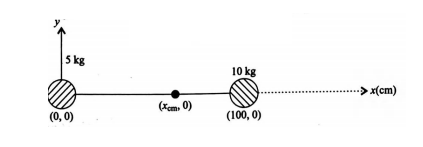
`` x_{cm}=\frac{m_{1}x_{1}+m_{2}x_{2}}{m_{1}+m_{2}} ``
`` =\frac{5 \times 0+100 \times 10}{5+10} ``
`` =\frac{200}{2} ``
`` =66.66\,cm ``
`` x_{cm}=67\,cm ``
- Qstn #14Find the torque about the origin when a force of `` 3 \,\hat{j}\, N `` acts on a particle whose position vector is `` 2\, \hat {k}\, m `` .
(A) `` 6 \hat{i}\, Nm ``
(B) `` 6 \hat{j} \,Nm ``
(C) `` -6 \hat{i} \,Nm ``
(D) `` 6 \hat{k} Nm ``
digAnsr: CAns : Given: `` \vec{F}=3 \hat{j}\,N `` ,
`` \vec{r}=2\hat{k} ``
We know, `` \vec{\tau}=\vec{r}\times\vec{F}=2\hat{k}\times3\hat{j} ``
`` =6\left(\hat{k} \times\hat{j}\right)=6\left(-\hat{i}\right) ``
`` \vec{\tau}=-6 \hat{i}\,Nm ``