NEET-XII-Physics
Question Set with answers year:2021
Note: Please signup/signin free to get personalized experience.
Note: Please signup/signin free to get personalized experience.
10 minutes can boost your percentage by 10%
Note: Please signup/signin free to get personalized experience.
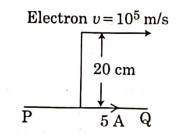
- Qstn #1An infinitely long straight conductor carries a current of `` 5\, A `` as shown. An electron is moving with a speed of `` 10^{5} m / s `` parallel to the conductor. The perpendicular distance between the electron and the conductor is `` 20\, cm `` at an instant. Calculate the magnitude of the force experienced by the electron at that instant.
(A) `` 4 \times 10^{-20} N ``
(B) `` 8 \pi \times 10^{-20} N ``
(C) `` 4 \pi \times 10^{-20} N ``
(D) `` 8 \times 10^{-20} N ``digAnsr: D:
- Qstn #2A body is executing simple harmonic motion with frequency `` 'n' `` , the frequency of its potential energy is:
(A)n
(B)2 n
(C)3 n
(D)4 ndigAnsr: B:
- Qstn #3A radioactive nucleus `` { }_{Z}^{ A } X `` undergoes spontaneous decay in the sequence
`` { }_{ Z }^{ A } X \rightarrow _{z-1} B \rightarrow _{Z -3} C \rightarrow _{Z -2} D `` , where `` Z `` is the atomic number of element `` X `` . The possible decay particles in the sequence are :
(A) `` \alpha, \beta^{-}, \beta^{+} ``
(B) `` \alpha, \beta^{+}, \beta^{-} ``
(C) `` \beta^{+}, \alpha, \beta^{-} ``
(D) `` \beta^{-}, \alpha, \beta^{+} ``digAnsr: C:
- Qstn #4The escape velocity from the Earth's surface is `` v `` . The escape velocity from the surface of another planet having a radius, four times that of Earth and same mass density is :
(A)v
(B)2 v
(C)3 v
(D)4 vdigAnsr: D:
- Qstn #5The half-life of a radioactive nuclide is `` 100 `` hours. The fraction of original activity that will remain after `` 150 `` hours would be :
(A) `` 1 / 2 ``
(B) `` \frac{1}{2 \sqrt{2}} ``
(C) `` \frac{2}{3} ``
(D) `` \frac{2}{3 \sqrt{2}} ``digAnsr: B:
- Qstn #6A convex lens `` 'A' `` of focal length `` 20\, cm `` and a concave lens `` 'B' `` of focal length `` 5\, cm `` are kept along the same axis with a distance `` 'd' `` between them. If a parallel beam of light falling on `` 'A' `` leaves `` 'B' `` as a parallel beam, then the distance `` 'd' `` in cm will be :
(A)25
(B)15
(C)50
(D)30digAnsr: B:
- Qstn #7A capacitor of capacitance `` 'C' `` , is connected across an ac source of voltage `` V `` , given by `` V = V _{0} \sin \omega t ``
The displacement current between the plates of the capacitor, would then be given by:
(A) `` I _{ d }= V _{0} \omega C \cos \omega t ``
(B) `` I_{d}=\frac{V_{0}}{\omega C} \cos \omega t ``
(C) `` I _{ d }=\frac{ V _{0}}{\omega C } \sin \omega t ``
(D) `` I _{ d }= V _{0} \omega C \sin \omega t ``digAnsr: A:
- Qstn #8A small block slides down on a smooth inclined plane, starting from rest at time `` t=0 . `` Let `` S_{n} `` be the distance travelled by the block in the interval `` t = n -1 `` to `` t = n . `` Then, the ratio `` \frac{ S _{ n }}{ S _{ n +1}} `` is :
(A) `` \frac{2 n-1}{2 n} ``
(B) `` \frac{2 n-1}{2 n+1} ``
(C) `` \frac{2 n+1}{2 n-1} ``
(D) `` \frac{2 n}{2n -1} ``digAnsr: B:
- Qstn #9A particle is released from height `` S `` from the surface of the Earth. At a certain height its kinetic energy is three times its potential energy. The height from the surface of earth and the speed of the particle at that instant are respectively :
(A) `` \frac{ S }{4}, \frac{3 gS }{2} ``
(B) `` \frac{ S }{4}, \frac{\sqrt{3 gS }}{2} ``
(C) `` \frac{ S }{2}, \frac{\sqrt{3 gS }}{2} ``
(D) `` \frac{ S }{4}, \sqrt{\frac{3 gS }{2}} ``digAnsr: D:
- Qstn #10In a potentiometer circuit a cell of EMF `` 1.5\, V `` gives balance point at `` 36\, cm `` length of wire. If another cell of EMF `` 2.5\, V `` replaces the first cell, then at what length of the wire, the balance point occurs ?
(A)60 cm
(B)21.6 cm
(C)64 cm
(D)62 cmdigAnsr: A:
- Qstn #11For a plane electromagnetic wave propagating in `` x `` -direction, which one of the following combination gives the correct possible directions for electric field (E) and magnetic field (B) respectively?
(A) `` \hat{j}+\hat{k}, \hat{j}+\hat{k} ``
(B) `` -\hat{j}+\hat{k},-\hat{j}-\hat{k} ``
(C) `` \hat{j}+\hat{k},-\hat{j}-\hat{k} ``
(D) `` -\hat{j}+\hat{k},-\hat{j}+\hat{k} ``digAnsr: B:
- Qstn #12Polar molecules are the molecules:
(A)having zero dipole moment
(B)acquire a dipole moment only in the presence of electric field due to displacement of charges
(C)acquire a dipole moment only when magnetic field is absent
(D)having a permanent electric dipole momentdigAnsr: D:
- Qstn #13The velocity of a small ball of mass `` M `` and density `` d `` , when dropped in a container filled with glycerine becomes constant after some time. If the density of glycerine is `` \frac{d}{2} `` , then the viscous force acting on the ball will be:
(A) `` \frac{ Mg }{2} ``
(B) `` Mg ``
(C) `` \frac{3}{2} Mg ``
(D) `` 2 Mg ``digAnsr: A:
- Qstn #14Match Column - I and Column - II and choose the correct match from the given choices.
Column I Column II A Root mean square speed of gas molecules P `` \frac{1}{3} nm \bar{v}^{2} `` B Pressure exerted by ideal gas Q `` \sqrt{\frac{3 RT }{ M }} `` C Average kinetic energy of a molecule R `` \frac{5}{2} RT `` D Total internal energy of 1 mole of a diatomic gas S `` \frac{3}{2} k _{ B } T ``
(A)(A) - (R), (B) - (P), (C) - (S), (D) - (Q)
(B)(A) - (Q), (B) - (R), (C) - (S), (D) - (P)
(C)(A) - (Q), (B) - (P), (C) - (S), (D) - (R)
(D)(A) - (R), (B) - (Q),(C)-(P), (D) - (S)digAnsr: C: