NEET-XII-Physics
Question Set with answers year:2021
Note: Please signup/signin free to get personalized experience.
Note: Please signup/signin free to get personalized experience.
10 minutes can boost your percentage by 10%
Note: Please signup/signin free to get personalized experience.
- Qstn #15Water falls from a height of `` 60\, m `` at the rate of `` 15\, kg / s `` to operate a turbine. The losses due to frictional force are `` 10 \% `` of the input energy. How much power is generated by the turbine? `` \left(g=10\, m / s ^{2}\right) ``
(A)10.2 kW
(B)8.1 kW
(C)12.3 kW
(D)7.0 kWdigAnsr: B:
- Qstn #16A lens of large focal length and large aperture is best suited as an objective of an astronomical telescope since:
(A)a large aperture contributes to the quality and visibility of the images.
(B)a large area of the objective ensures better light gathering power.
(C)a large aperture provides a better resolution.
(D)all of the above.digAnsr: D:
- Qstn #17The electron concentration in an `` n `` -type semiconductor is the same as hole concentration in a `` p `` -type semiconductor. An external field (electric) is applied across each of them. Compare the currents in them.
(A)current in n-type = current in p-type
(B)current in p-type > current in n-type
(C)current in n-type > current in p-type
(D)No current will flow in p-type, current will only flow in n-typedigAnsr: C:
- Qstn #18A nucleus with mass number `` 240 `` breaks into two a fragments each of mass number `` 120 `` , the binding energy per nucleon of unfragmented nuclei is `` 7.6\, MeV `` while that of fragments is `` 8.5\, MeV `` . The total gain in the Binding Energy in the process is :
(A)0.9 MeV
(B)9.4 MeV
(C)804 MeV
(D)216 MeVdigAnsr: D:
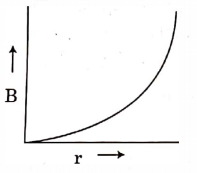
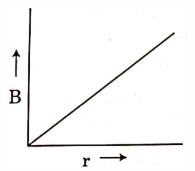
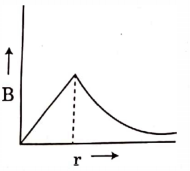
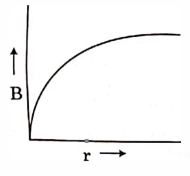
- Qstn #19A thick current carrying cable of radius `` 'R' `` carries current `` 'I' `` uniformly distributed across its cross-section. The variation of magnetic field `` B ( r ) `` due to the cable with the distance `` 'r' `` from the axis of the cable is represented by :
(A)
(B)
(C)
(D)
 digAnsr: C:
- Qstn #20Two charged spherical conductors of radius `` R _{1} `` and `` R _{2} `` are connected by a wire. Then the ratio of surface charge densities of the spheres `` \left(\sigma_{1} / \sigma_{2}\right) `` is
(A) `` \frac{R_{1}}{R_{2}} ``
(B) `` \frac{R_{2}}{R_{1}} ``
(C) `` \sqrt{\left(\frac{ R _{1}}{ R _{2}}\right)} ``
(D) `` \frac{ R _{1}^{2}}{ R _{2}^{2}} ``digAnsr: B:
- Qstn #21If `` E `` and `` G `` respectively denote energy and gravitational constant, then `` \frac{ E }{ G } `` has the dimensions of:
(A) `` \left[ M ^{2}\right]\left[ L ^{-1}\right]\left[ T ^{0}\right] ``
(B) `` [ M ]\left[ L ^{-1}\right]\left[ T ^{-1}\right] ``
(C) `` [ M ]\left[ L ^{0}\right]\left[ T ^{0}\right] ``
(D) `` \left[ M ^{2}\right]\left[ L ^{-2}\right]\left[ T ^{-1}\right] ``digAnsr: A:
- Qstn #22A spring is stretched by `` 5\, cm `` by a force `` 10\, N `` . The time period of the oscillations when a mass of `` 2\, kg `` is suspended by it is :
(A)0.0628 s
(B)6.28 s
(C)3.14 s
(D)0.628 sdigAnsr: D:
- Qstn #23Column - I gives certain physical terms associated with flow of current through a metallic conductor. Column - II gives some mathematical relations involving electrical quantities. Match Column - I and Column - II with appropriate relations.
Column I Column II A Drift Velocity P `` \frac{ m }{ ne ^{2} \rho} `` B Electrical Resistivity Q `` ne v_{ d } `` C Relaxation Period R `` \frac{ e E }{ m } \tau `` D Current Density S `` \frac{ E }{ J } ``
(A)(A)-(R), (B)-(S), (C)-(P), (D)-(Q)
(B)(A)-(R), (B)-(S), (C)-(Q), (D)-(P)
(C)(A)-(R), (B)-(P), (C)-(S), (D)-(Q)
(D)(A)-(R), (B)-(Q), (C)-(S), (D)-(P)digAnsr: A:
- Qstn #24A dipole is placed in an electric field as shown. In which direction will it move ?
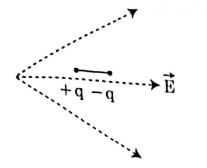
(A)towards the left as its potential energy will increase.
(B)towards the right as its potential energy will decrease.
(C)towards the left as its potential energy will decrease.
(D)towards the right as its potential energy will increase.digAnsr: BAns : `` \left| E _{1}\right|>\left| E _{2}\right| `` as field lines are closer at charge `` + q `` ,
so net force on the dipole acts towards right side.
A system always moves to decrease it's potential energy.
- Qstn #25Consider the following statements (A) and (B) and identify the correct answer.
(A) A zener diode is connected in reverse bias, when used as a voltage regulator.
(B) The potential barrier of p-n junction lies between `` 0.1\, V `` to `` 0.3\, V `` .
(A)(A) and (B) both are correct
(B)(A) and (B) both are incorrect
(C)(A) is correct and (B) is incorrect
(D)(A) is incorrect but (B) is correctdigAnsr: C:
- Qstn #26A screw gauge gives the following readings when used to measure the diameter of a wire
Main scale reading : `` 0\, mm ``
Circular scale reading : `` 52 `` divisions
Given that `` 1\, mm `` on main scale corresponds to `` 100 `` divisions on the circular scale. The diameter of the wire from the above data is :
(A)0.52 cm
(B)0.026 cm
(C)0.26 cm
(D)0.052 cmdigAnsr: D:
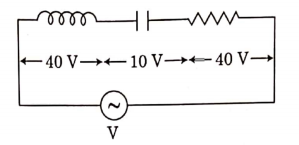
- Qstn #27An inductor of inductance `` L `` , a capacitor of capacitance `` C `` and a resistor of resistance ' `` R `` ' are connected in series to an ac source of potential difference ' `` V `` ' volts as shown in figure. Potential difference across `` L , C `` and `` R `` is `` 40 V `` , `` 10\, V `` and `` 40 V `` , respectively. The amplitude of current flowing through LCR series circuit is `` 10 \sqrt{2} A `` . The impedance of the circuit is :
(A) `` 4 \sqrt{2} \Omega ``
(B) `` 5 / \sqrt{2} \Omega ``
(C) `` 4\, \Omega ``
(D) `` 5\, \Omega ``digAnsr: DAns : `` I_{0}=10 \sqrt{2} A ``
`` I _{ RMS }=\frac{ I _{0}}{\sqrt{2}}=10 A ``
`` V _{ RMS }=\sqrt{ V _{ R }^{2}+\left( V _{ L }- V _{ C }\right)^{2}} ``
`` =\sqrt{(40)^{2}+(40-10)^{2}} ``
`` =50 V ``
`` Z =\frac{ V _{ RMS }}{ I _{ RMS }}=\frac{50 V }{10 V }=5 \Omega ``
- Qstn #28A parallel plate capacitor has a uniform electric field ' `` \vec{ E } `` ' in the space between the plates. If the distance between the plates is `` 'd' `` and the area of each plate is ' `` A `` ', the energy stored in the capacitor is : `` \left(\varepsilon_{0}=\right. `` permittivity of free space)
(A) `` \frac{1}{2} \varepsilon_{0} E ^{2} ``
(B) `` \varepsilon_{0} EAd ``
(C) `` \frac{1}{2} \varepsilon_{0} E ^{2} Ad ``
(D) `` \frac{ E ^{2} Ad }{\varepsilon_{0}} ``digAnsr: C:
- Qstn #29An electromagnetic wave of wavelength ' `` \lambda `` ' is incident on a photosensitive surface of negligible work function. If ' `` m `` ' mass is of photoelectron emitted from the surface has de-Broglie wavelength `` \lambda_{ d } `` , then :
(A) `` \lambda=\left(\frac{2 m }{ hc }\right) \lambda_{ d }{ }^{2} ``
(B) `` \lambda_{ d }=\left(\frac{2 mc }{ h }\right) \lambda^{2} ``
(C) `` \lambda=\left(\frac{2 mc }{ h }\right) \lambda_{ d }{ }^{2} ``
(D) `` \lambda=\left(\frac{2 h }{ mc }\right) \lambda_{ d }{ }^{2} ``digAnsr: C: