NEET-XII-Physics
01: Electric Charges And Fields
- #31It is now believed that protons and neutrons (which constitute nuclei of ordinary matter) are themselves built out of more elementary units called quarks. A proton and a neutron consist of three quarks each. Two types of quarks, the so called ‘up’ quark (denoted by u) of charge (+2/3) e, and the ‘down’ quark (denoted by d) of charge (-1/3) e, together with electrons build up ordinary matter. (Quarks of other types have also been found which give rise to different unusual varieties of matter.) Suggest a possible quark composition of a proton and neutron.
Ans : A proton has three quarks. Let there be n up quarks in a proton, each having a charge of .
.
Charge due to n up quarks
Number of down quarks in a proton = 3 - n
Each down quark has a charge of .
.
Charge due to (3 - n) down quarks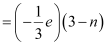
Total charge on a proton = + e
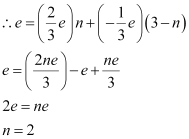
Number of up quarks in a proton, n = 2
Number of down quarks in a proton = 3 - n = 3 - 2 = 1
Therefore, a proton can be represented as ‘uud’.
A neutron also has three quarks. Let there be n up quarks in a neutron, each having a charge of .
.
Charge on a neutron due to n up quarks
Number of down quarks is 3 - n,each having a charge of .
.
Charge on a neutron due to down quarks =
Total charge on a neutron = 0
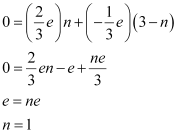
Number of up quarks in a neutron, n = 1
Number of down quarks in a neutron = 3 - n = 2
Therefore, a neutron can be represented as ‘udd’.