NEET-XII-Chemistry
01: Haloalkanes and Haloarenes
- #9-iCH3Br or CH3I
() (CH3)3CCl or CH3ClAns : In the SN2 mechanism, the reactivity of halides for the same alkyl group increases in the order. This happens because as the size increases, the halide ion becomes a better leaving group.
R-F << R-Cl < R-Br < R-I
Therefore, CH3I will react faster than CH3Br in SN2 reactions with OH-.
()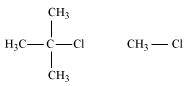
The SN2 mechanism involves the attack of the nucleophile at the atom bearing the leaving group. But, in case of (CH3)3CCl, the attack of the nucleophile at the carbon atom is hindered because of the presence of bulky substituents on that carbon atom bearing the leaving group. On the other hand, there are no bulky substituents on the carbon atom bearing the leaving group in CH3Cl. Hence, CH3Cl reacts faster than (CH3)3CCl in SN2 reaction with OH-.
- #9-ii(CH3)3CCl or CH3ClAns :
The SN2 mechanism involves the attack of the nucleophile at the atom bearing the leaving group. But, in case of (CH3)3CCl, the attack of the nucleophile at the carbon atom is hindered because of the presence of bulky substituents on that carbon atom bearing the leaving group. On the other hand, there are no bulky substituents on the carbon atom bearing the leaving group in CH3Cl. Hence, CH3Cl reacts faster than (CH3)3CCl in SN2 reaction with OH-.