ICSE-VIII-Mathematics
16: Understanding Shapes (Including Polygons) Class 8 Maths
Note: Please signup/signin free to get personalized experience.
Note: Please signup/signin free to get personalized experience.
10 minutes can boost your percentage by 10%
Note: Please signup/signin free to get personalized experience.
- Qstn #10In quadrilateral PQRS, ∠P : ∠Q : ∠R : ∠S = 3 : 4 : 6 : 7.
Calculate each angle of the quadrilateral and then prove that PQ and SR are parallel to each other (i) Is PS also parallel to QR? (ii) Assign a special name to quadrilateral PQRS.Ans : ∵ ∠P : ∠Q + ∠R : ∠S = 3 : 4 : 5 : 6
Let ∠P = 3x
∠Q = 4x
∠R = 6x
∠S = 7x
∴ ∠P + ∠Q + ∠R + ∠S = 360˚
⇒ 3x + 4x + 6x + 7x = 360˚
⇒ 20x = 360˚
⇒ x = 18˚
∴ ∠P = 3x = 3 × 18 = 54˚
∠Q = 4x = 4 × 18 = 72˚
∠R = 6x = 6 × 18 = 108˚
∠S = 7x = 7 × 18 = 126˚
∠Q + ∠R = 72˚ + 108˚ = 180˚
Or ∠P + ∠S = 54˚ + 126 ˚ = 180˚
Hence PQ ∥ SR
As ∠P + ∠Q = 72˚ + 54˚ = 126˚
Which is ≠ 180˚
∴ PS and QR are not parallel.
(ii) PQRS is a trapezium as its one pair of opposite side is parallel.
- Qstn #11Use the information given in the following figure to find the value of x.
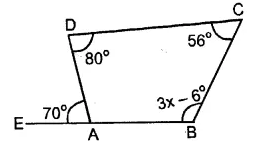 Ans : Take A, B, C, D as the vertices of Quadrilateral and BA is produced to E (say).
Since ∠EAD = 70°
∠DAB = 180° - 70° = 110°
[EAB is a straight line and AD stands on it ∠EAD + ∠DAB = 180°]
110° + 80° + 56° + 3x - 6° = 360°
[sum of interior angles of a quadrilateral = 360°]
3x = 360° - 110° - 80° - 56° + 6°
⇒ 3x = 360° - 240° = 120°
⇒ x = 40°
- Qstn #12The following figure shows a quadrilateral in which sides AB and DC are parallel. If ∠A : ∠D = 4 : 5, ∠B = (3x - 15)° and ∠C = (4x + 20)°, find each angle of the quadrilateral ABCD.
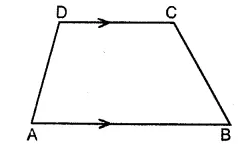 Ans : Let ∠A = 4x
∠D = 5x
Since ∠A + ∠D = 180° [AB || DC]
4x + 5x = 180°
⇒ 9x = 180°
⇒ x = 20°
∠A = 4 (20) = 80°,
∠D = 5 (20) = 100°
Again ∠B + ∠C = 180° [ AB || DC]
3x - 15° + 4x + 20° = 180°
⇒ 7x = 180° - 5°
⇒ 7x = 175°
⇒ x = 25°
∠B = 75° - 15° = 60°
and ∠C = 4(25) + 20 = 100° + 20° = 120°
- Qstn #13Use the following figure to find the value of x
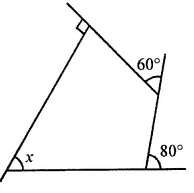 Ans : The sum of exterior angles of a quadrilateral
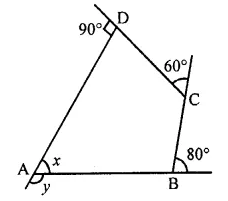
y + 80° + 60° + 90° = 360°
⇒ y + 230° = 360°
⇒ y = 360° - 230° = 130°
At vertex A,
∠y + ∠x = 180° (Linear pair)
x = 180° - 130°
⇒ x = 50°
- Qstn #14ABCDE is a regular pentagon. The bisector of angle A of the pentagon meets the side CD in point M. Show that ∠AMC = 90°.Ans :
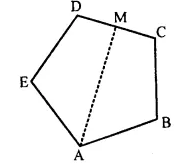
Given: ABCDE is a regular pentagon.
The bisector ∠A of the pentagon meets the side CD at point M.
To prove: ∠AMC = 90°
Proof:We know that, the measure of each interior angle of a regular pentagon is 108°.
∠BAM = 1/2 x 108° = 54°
Since, we know that the sum of a quadrilateral is 360°
In quadrilateral ABCM, we have
∠BAM + ∠ABC + ∠BCM + ∠AMC = 360°
⇒ 54° + 108° + 108° + ∠AMC = 360°
⇒ ∠AMC = 360° - 270°
⇒ ∠AMC = 90°
- Qstn #15In a quadrilateral ABCD, AO and BO are bisectors of angle A and angle B respectively. Show that:
∠AOB = 1/2 (∠C + ∠D)Ans : Given: AO and BO are the bisectors of ∠A and ∠B respectively.
∠1 = ∠4 and ∠3 = ∠5 ...(i)
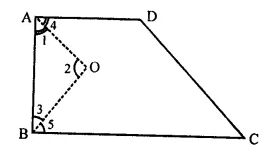
To prove: ∠AOB = 1/2 (∠C + ∠D)
Proof:In quadrilateral ABCD
∠A + ∠B + ∠C + ∠D = 360°
1/2 (∠A + ∠B + ∠C + ∠D) = 180° ...(ii)
Now in ∆AOB
∠1 + ∠2 + ∠3 = 180° ...(iii)
Equating equation (ii) and equation (iii), we get
∠1 + ∠2 + ∠3 = ∠A + ∠B + 1/2 (∠C + ∠D)
⇒ ∠1 + ∠2 + ∠3 = ∠1 + ∠3 + 1/2 (∠C + ∠D)
⇒ ∠2 = 1/2 (∠C + ∠D)
⇒ ∠AOB = 1/2 (∠C + ∠D)
Hence proved.