NEET-XII-Chemistry
04: Chemical Kinetics
- #15The experimental data for decomposition of N2O5

in gas phase at 318K are given below:
-
t(s)
0 400 800 1200 1600 2000 2400 2800 3200 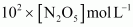
1.63 1.36 1.14 0.93 0.78 0.64 0.53 0.43 0.35
() Find the half-life period for the reaction.
() Draw a graph between log [N2O5] and t.
() What is the rate law?
() Calculate the rate constant.
() Calculate the half-life period from k and compare it with (ii).
() Find the half-life period for the reaction.
() Draw a graph between log [N2O5] and t.
() What is the rate law?
() Calculate the rate constant.
() Calculate the half-life period from k and compare it with (ii).Ans : null ()
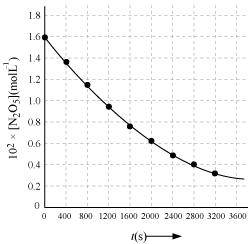
() Time corresponding to the concentration, is the half life. From the graph, the half life is obtained as 1450 s.
()-
t(s)


0
1.63
- 1.79
400
1.36
- 1.87
800
1.14
- 1.94
1200
0.93
- 2.03
1600
0.78
- 2.11
2000
0.64
- 2.19
2400
0.53
- 2.28
2800
0.43
- 2.37
3200
0.35
- 2.46
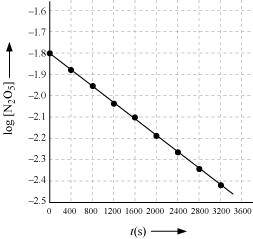
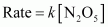
() The given reaction is of the first order as the plot, v/s t, is a straight line. Therefore, the rate law of the reaction is
() From the plot, v/s t, we obtain
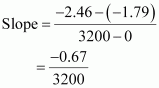
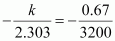
Again, slope of the line of the plot v/s t is given by
 .
.
Therefore, we obtain,

() Half-life is given by,
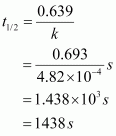
This value, 1438 s, is very close to the value that was obtained from the graph.
() Time corresponding to the concentration, is the half life. From the graph, the half life is obtained as 1450 s.
()-
t(s)
0
1.63
- 1.79
400
1.36
- 1.87
800
1.14
- 1.94
1200
0.93
- 2.03
1600
0.78
- 2.11
2000
0.64
- 2.19
2400
0.53
- 2.28
2800
0.43
- 2.37
3200
0.35
- 2.46
() The given reaction is of the first order as the plot, v/s t, is a straight line. Therefore, the rate law of the reaction is
() From the plot, v/s t, we obtain
Again, slope of the line of the plot v/s t is given by
.
Therefore, we obtain,
() Half-life is given by,
This value, 1438 s, is very close to the value that was obtained from the graph.
-
- #15-iPlot [N2O5] against t.
() Find the half-life period for the reaction.
() Draw a graph between log [N2O5] and t.
() What is the rate law?
() Calculate the rate constant.
() Calculate the half-life period from k and compare it with (ii).Ans :
() Time corresponding to the concentration, is the half life. From the graph, the half life is obtained as 1450 s.
()-
t(s)
0
1.63
- 1.79
400
1.36
- 1.87
800
1.14
- 1.94
1200
0.93
- 2.03
1600
0.78
- 2.11
2000
0.64
- 2.19
2400
0.53
- 2.28
2800
0.43
- 2.37
3200
0.35
- 2.46
() The given reaction is of the first order as the plot, v/s t, is a straight line. Therefore, the rate law of the reaction is
() From the plot, v/s t, we obtain
Again, slope of the line of the plot v/s t is given by
.
Therefore, we obtain,
() Half-life is given by,
This value, 1438 s, is very close to the value that was obtained from the graph.
-
- #15-iiFind the half-life period for the reaction.Ans : Time corresponding to the concentration, is the half life. From the graph, the half life is obtained as 1450 s.
- #15-iiiDraw a graph between log [N2O5] and t.Ans :
-
t(s)
0
1.63
- 1.79
400
1.36
- 1.87
800
1.14
- 1.94
1200
0.93
- 2.03
1600
0.78
- 2.11
2000
0.64
- 2.19
2400
0.53
- 2.28
2800
0.43
- 2.37
3200
0.35
- 2.46
-
- #15-ivWhat is the rate law?Ans : The given reaction is of the first order as the plot, v/s t, is a straight line. Therefore, the rate law of the reaction is
- #15-vCalculate the rate constant.Ans : From the plot, v/s t, we obtain
Again, slope of the line of the plot v/s t is given by
.
Therefore, we obtain,
- #15-viCalculate the half-life period from k and compare it with (ii).Ans : Half-life is given by,
This value, 1438 s, is very close to the value that was obtained from the graph.