NEET-XI-Biology
10: Cell Cycle and Cell Division
Note: Please signup/signin free to get personalized experience.
Note: Please signup/signin free to get personalized experience.
10 minutes can boost your percentage by 10%
No item to list.
Note: Please signup/signin free to get personalized experience.
- #7-cchiasmata
Draw a diagram to illustrate your answer.
Ans : Chiasmata
Chiasmata is the site where two non-sister chromatids of homologous chromosomes have crossed over. It represents the site of cross-over. It is formed during the diplotene stage of prophase I of meiosis.

- Qstn #8How does cytokinesis in plant cells differ from that in animal cells?
Ans :Cytokinesis in plant cells
Cytokinesis is animal cells
(i)
The division of the cytoplasm takes place by cell plate formation. (i)
The division of the cytoplasm takes place by cleavage. (ii)
Cell plate formation starts at the centre of the cell and grows outward, toward the lateral walls. (ii)
Cleavage starts at the periphery and then moves inward, dividing the cell into two parts.
- Qstn #9Find examples where the four daughter cells from meiosis are equal in size and where they are found unequal in size.
Ans : (a) Spermatogenesis or the formation of sperms in human beings occurs by the process of meiosis. It results in the formation of four equal-sized daughter cells.
(b) Oogenesis or the formation of ovum in human beings occurs by the process of meiosis. It results in the formation of four daughter cells which are unequal in size.
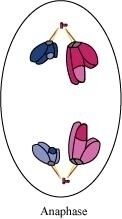
- Qstn #10Distinguish anaphase of mitosis from anaphase I of meiosis.
Ans :Anaphase of mitosis
Anaphase I of meiosis
Anaphase is the stage during which the centromere splits and the chromatids separate. The chromosomes move apart, toward the opposite poles. These chromosomes are genetically identical. During anaphase I, the homologous chromosomes separate, while the chromatids remain attached at their centromeres.Hence, in anaphase I, the chromosomes of each bivalent pair separate, while the sister chromatids remain together. 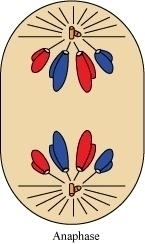
- Qstn #11List the main differences between mitosis and meiosis.
Ans :Mitosis
Meiosis
1.
In mitotic division, a single division results in two daughter cells. 1.
Meiotic division involves two successive divisions - meiosis I and meiosis II. These divisions result in four daughter cells. 2.
Mitosis is known as equational division. This is because the daughter cells have the same diploid number of chromosomes as the parent. 2.
Meiosis I is known as reductional division. This is because the chromosome number is reduced to half.Meiosis II is known as equational division. This is because the sister chromatids separate and the chromosome number remains the same. 3.
Prophase is short and does not comprise any phase. 3.
Prophase I is very long and comprises 5 phases -leptotene, zygotene, pachytene, diplotene, and diakinesis. 4.
There is no pairing of chromosomes, crossing-over, or chiasmata-formation during prophase. 4.
In the zygotene stage of prophase, the pairing of chromosomes occurs. During pachytene, the crossing-over occurs. The chiasmata are formed in the diplotene stage. 5.
Synaptonemal complex is not formed. 5.
Synaptonemal complex is formed during the zygotene stage of prophase I. 6.
Anaphase involves the separation of the chromatids of each chromosome. 6.
During anaphase I, the homologous chromosomes separate, while the chromatids remain attached at their centromeres.During anaphase II, the chromatids separate as a result of the splitting of the centromere. 7.
Mitosis plays a significant role in the healing, repair, and growth of a cell. 7.
Meiosis brings about variation and maintains the chromosome number from generation to generation.
- Qstn #12What is the significance of meiosis?
Ans : Meiosis is the process involving the reduction in the amount of genetic material. It comprises two successive nuclear and cell divisions, with a single cycle of DNA replication. As a result, at the end of meiosis II, four haploid cells are formed.
Significance of meiosis
1. Meiosis maintains the chromosome number from generation to generation. It reduces the chromosome number to half so that the process of fertilisation restores the original number in the zygote.
2. Variations are caused by the cross-over and the random distribution of homologous chromosomes between daughter cells. Variations play an important role in evolution.
3. Chromosomal mutations are brought about by the introduction of certain abnormalities. These chromosomal mutations may be advantageous for an individual.
- Qstn #13-ihaploid insects and lower plants where cell-division occurs, andAns : In some insects and lower plants, fertilization is immediately followed by zygotic meiosis, which leads to the production of haploid organisms. This type of life cycle is known as haplontic life cycle.
- Qstn #13-iisome haploid cells in higher plants where cell-division does not occur.Ans : The phenomenon of polyploidy can be observed in some haploid cells in higher plants in which cell division does not occur. Polyploidy is a state in which cells contain multiple pairs of chromosomes than the basic set. Polyploidy can be artificially induced in plants by applying colichine to cell culture.
- Qstn #14Can there be mitosis without DNA replication in S phase?
Ans : Mitotic cell division cannot take place without DNA replication in S phase. Two important events take place during S phase - one is the synthesis or duplication of DNA and the other is the duplication of the centriole. DNA duplication is important as it maintains the chromosome number in the daughter cells. Mitosis is an equational division. Therefore, the duplication of DNA is an important step.
- Qstn #15Can there be DNA replication without cell division?
Ans : There can be DNA replication without cell division. During cell division, the parent cell gets divided into two daughter cells. However, if there is a repeated replication of DNA without any cell division, then this DNA will keep accumulating inside the cell. This would increase the volume of the cell nucleus, thereby causing cell expansion. An example of DNA duplication without cell division is commonly observed in the salivary glands of Drosophila. The chromosome undergoing repeated DNA duplication is known as polytene chromosome.
- Qstn #16Analyse the events during every stage of cell cycle and notice how the following two parameters change
Ans : During meiosis, the number of chromosomes and the amount of DNA in a cell change.
- Qstn #16-iNumber of chromosomes (N) per cell
() Amount of DNA content (C) per cellAns : Number of chromosomes (N) per cell
During anaphase I of the meiotic cycle, the homologous chromosomes separate and start moving toward their respective poles. As a result, the bivalents get divided into two sister chromatids and receive half the chromosomes present in the parent cell. Therefore, the number of chromosomes reduces in anaphase I.
() Amount of DNA content (C) per cell
During anaphase II of the meiotic cycle, the chromatids separate as a result of the splitting of the centromere. It is the centromere that holds together the sister chromatids of each chromosome. As a result, the chromatids move toward their respective poles. Therefore, at each pole, a haploid number of chromosomes and a haploid amount of DNA are present.
During mitosis, the number of chromosomes remains the same. The DNA duplicated in the S phase gets separated in the two daughter cells during anaphase. As a result, the DNA content (C) of the two newly-formed daughter cells remains the same.
- Qstn #16-iiAmount of DNA content (C) per cellAns : Amount of DNA content (C) per cell
During anaphase II of the meiotic cycle, the chromatids separate as a result of the splitting of the centromere. It is the centromere that holds together the sister chromatids of each chromosome. As a result, the chromatids move toward their respective poles. Therefore, at each pole, a haploid number of chromosomes and a haploid amount of DNA are present.
During mitosis, the number of chromosomes remains the same. The DNA duplicated in the S phase gets separated in the two daughter cells during anaphase. As a result, the DNA content (C) of the two newly-formed daughter cells remains the same.