NEET-XII-Physics
pp year:2018
- Qstn #1An em wave is propagating in a medium with a
velocity``\vec{V}``= V``\hat{i}``.
The instantaneous oscillating electric field
of this em wave is along +y axis. Then the
direction of oscillating magnetic
field of the em wave will be along :-
(1) -z direction
(2) +z direction
(3) -y direction
(4) -x directiondigAnsr: 2Ans : (2)
Sol. = ˆ ˆ ˆV E B , = ˆˆ ˆi j k
∴ = ˆB̂ k , +z direction
- Qstn #2The refractive index of the material of a prism
is ``\sqrt2`` and the angle of the prism is 30°. One of the
two refracting surfaces of the prism is made a mirror
inwards, by silver coating. A beam of
monochromatic light entering the prism from the
other face will retrace its path (after reflection from
the silvered surface) if its angle of incidence on the
prism is :-
(1) 60°
(2) 45°
(3) 30°
(4) zerodigAnsr: 2Ans : (2)
Sol.
30°
r =30°1
µ = 2
i
r =0°2
r2 = 0, r1 = A = 30°
sin i = 2 sin30 = =
1 1
2
2 2
i = 45°
- Qstn #3The magnetic potential energy stored in a
certain inductor is 25 mJ, when the current
in the inductor is 60 mA. This inductor is
of inductance :-
(1) 0.138 H
(2) 138.88 H
(3) 1.389 H
(4) 13.89 HdigAnsr: 4Ans : (4)
Sol. = 2
1
PE LI
2
= 3 3 2
1
25 10 L(60 10 )
2
L = 13.89 H
- Qstn #4An object is placed at a distance of 40 cm
from a concave mirror of focal length 15 cm.
If the object is displaced through a distance
of 20 cm towards the mirror, the displacement
of the image will be:-
(1) 30 cm away from the mirror
(2) 36 cm away from the mirror
(3) 30 cm towards the mirror
(4) 36 cm towards the mirrordigAnsr: 2Ans : (2)
Sol. (i)
object
40 cm
f = 15 cm
0
= =
+
1
uf ( 40)( 15)
v
u f 40 15
= =
600
24cm
25
(ii)
/////////////////////////////
object
20 cm
f = 15 cm
= =
+
2
uf ( 20) ( 15)
v
u f 20 15
= -60 cm
Displacement of image = v2 - v1 = -36 cm
= 36 cm away from the mirror.
- Qstn #5In the combination of the following gates the
output Y can be written in terms of inputs A
and B as :-
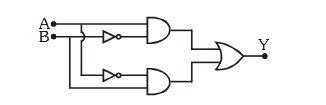
(1)`` \bar {A.B} ``
(2) A . ``\bar B`` + ``\bar A . B``
(3) `` \bar {A.B} ``+ A.B
(4) ``\bar {A+B}``digAnsr: 2Ans : (2)
Sol. A
B
A
B
A
B
A.B
A.B
A.B + A.B
PHYSICS
2
NEET(UG)-2018
- Qstn #6In the circuit shown in the figure, the input
voltage``V_i`` is 20 V, ``V_{BE}`` = 0 and
``V_{CE}`` = 0. The values of ``I_B``, ``I_C``
and ``\beta`` are given by :-
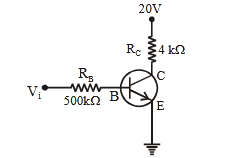
(1) ``I_B``= 40 ``\mu A``, ``I_C``= 10 mA, ``\beta``= 250
(2) ``I_B``= 25 ``\mu A``, ``I_C``= 5 mA, ``\beta``= 200
(3) ``I_B``= 20 ``\mu A``, ``I_C``= 5 mA, ``\beta``= 250
(4) ``I_B``= 40 ``\mu A``, ``I_C``= 5 mA, ``\beta``= 125digAnsr: 4Ans : (4)
Sol. Vi = IBRB + VBE
20 = IB × (500 × 10
3) + 0
= =
B 3
20
I 40µA
500 10
= +CC C C CEV I R V
20 = IC × (4 × 10
3) + 0
IC = 5 × 10
-3 = 5 mA
= = =
3
C
6
B
I 5 10
125
I 40 10
- Qstn #7In a p-n junction diode, change in temperature
due to heating :-
(1) affects only reverse resistance
(2) affects only forward resistance
(3) does not affect resistance of p-n junction
(4) affects the overall V - I characteristics
of p-n junctiondigAnsr: 4Ans : (4)
Sol. Affects the overall V - I characteristics of p-n
junction
- Qstn #8A small sphere of radius 'r' falls from rest in a
viscous liquid. As a result, heat is produced due to
viscous force. The rate of production of heat when
the sphere attains its terminal velocity, is
proportional to :-
(1) ``r^3``
(2) ``r^2``
(3) ``r^5``
(4) ``r^4``digAnsr: 3Ans : (3)
Sol. Rate of heat produced
= v T
dQ
F V
dt
=
2
T
2r
V ( )g
9
= 6rVT × VT ∴ VT r
2
2T
dQ
rV
dt
VT r
2
5
dQ
r
dt
- Qstn #9A sample of 0.1 g of water at 100°C and
normal pressure (1.013 x ``10^5`` ``Nm^{-2}``)
requires 54 cal of heat energy to convert
to steam at ``100^o``C. If the volume of the
steam produced is 167.1 cc, the change in
internal energy of the sample, is :-
(1) 104.3 J
(2) 208.7 J
(3) 42.2 J
(4) 84.5 JdigAnsr: 2Ans : (2)
Sol. ▵Q = 54 cal = 54 × 4.18 joule = 225.72 joule
▵W = P[Vsteam - Vwater] [For water 0.1 gram=0.1 cc]
= 1.013 × 10⁵[167.1 × 10⁻⁶ - 0.1 × 10⁻⁶] joule
= 1.013 × 167 × 10-1 = 16.917 joule
By FLOT
&implies; ▵U = ▵Q - ▵W = 225.72 - 16.917
▵U = 208.8 joule
- Qstn #10Two wires are made of the same material
and have the same volume. The first wire
has cross-sectional area A and the second
wire has cross-sectional area 3A. If the
length of the first wire is increased by
``\triangle l`` on applying a force F,
how much force is needed to stretch the
second wire by the same amount ?
(1) 9F
(2) 6F
(3) 4F
(4) FdigAnsr: 1Ans : (1)
Sol. =
▵
F
Y
A
V = A so =
V
A
▵ ▵
= =
2YA YA
F
V
=
2
1 1
2 2
F A
F A &implies;
= =
2
2
F A 1
F 3A 9
F2 = 9F
- Qstn #11The power radiated by a black body is P and
it radiates maximum energy at wavelength ``\lambda _0``.
If the temperature of the black body is now
changed so that it radiates maximum energy at
wavelength ``\frac{3}{4}````\lambda _0``
, the power radiated by it becomes nP. The
value of n is :-
(1)``\frac{3}{4}``
(2)``\frac{4}{3}``
(3)``\frac{256}{81}``
(4)``\frac{81}{256}``digAnsr: 3Ans : (3)
Sol. P = AT4 &implies; P T4
According to Wein's law
m
1
T
&implies;
4
m
1
P &implies;
=
1
2
4
m2
1 m
P
P
&implies;
=
4
2 0
1
0
P
3P
4
&implies; = &implies; =
nP 256 256
n
P 81 81
3
CODE - PP
- Qstn #12A set of 'n' equal resistors, of value 'R' each,
are connected in series to a battery of emf 'E'
and internal resistance 'R'. The current drawn is I.
Now, the 'n' resistors are connected in parallel
to the same battery. Then the current drawn from
battery becomes 10 I. The value of 'n' is :-
(1) 10
(2) 11
(3) 20
(4) 9digAnsr: 1Ans : (1)
Sol. =
+
E
I
nR R
..... (1)
= =
+
+
E nE
10I
R R nRR
n
.....(2)
From (1) & (2),
=
+ +
E E
n 10
R nR nR R
n = 10
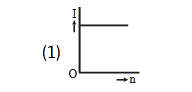
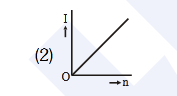
- Qstn #13A battery consists of a variable number 'n' of
identical cells (having internal resistance 'r' each)
which are connected in series. The terminals of
the battery are short-circuited and the current I
is measured. Which of the graphs shows the
correct relationship between I and n ?
(1)
(2)
(3)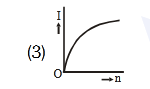
(4)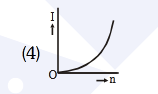 digAnsr: 1Ans : (1)
Sol. = = =
nE E
I constant
nr r
- Qstn #14A carbon resistor (47 ``\pm``4.7) ``k\Omega `` is to be
marked with rings of different colours for its
identification. The colour code sequence will be :-
(1) Violet - Yellow - Orange - Silver
(2) Yellow - Violet - Orange - Silver
(3) Yellow - Green - Violet - Gold
(4) Green - Orange - Violet - GolddigAnsr: 2Ans : (2)
Sol. = 3R (47 4.7) 10
= 3R 47 10 10%
As per color code, 3 - Orange, 4 - Yellow, 7 - Violet,
10% - Silver