ICSE-X-Physics
Previous Year Paper year:2012
- #4-b [2]Differentiate between heat capacity and specific heat capacity.Ans :
(i) Specific heat capacity is defined on unit mas's but heat capacity is defined on entire mass.
(ii) Specific heat capacity depends on the mass of the body but heat capacity does not depend on the mass of the body.
- #4-c [2]A hot solid of mass 60 g at 100°C is placed in 150 g of water at 20°C. The
final steady temperature recorded is 25°C. Calculate the specific heat capacity
of the solid. [Specific heat capacity of water = ``\pu{4200 J //{kg °C} }`` ]
Ans :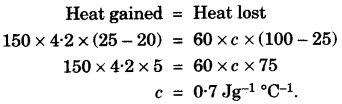
- #4-d [2]
- #4-d-iWhat is the value of the speed of gamma radiations in air or vacuum?Ans : Speed of gamma radiations in air = 3 x 10⁸ ms-1.
- #4-d-iiName a material which exhibits fluorescence when cathode rays fall
on it.Ans : Zinc Sulphide
- #4-e [2]Give any two important sources of background radiation.Ans : Two sources of background radiation: K - 40 and C - 14
- # [40]Section : IIAttempt any four questions from this Section
- #5
- #5-a [3]
- #5-a-iWhich of the following remains constant in uniform circular motion:
Speed or Velocity or both?Ans : Speed remains constant.
- #5-a-iiName the force required for uniform circular motion. State its
direction.Ans : Centripetal force directed towards the centre of the circle.
- #5-b [3]
- #5-b-iState the class of levers and the relative positions of load (L),
effort (E) and fulcrum (F) in each of the following cases.
1. l A bottle opener
2. Sugar tongs.Ans :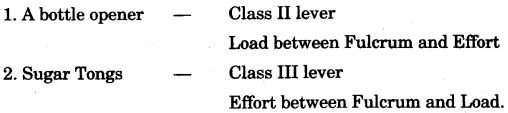
- #5-b-iiWhy is less effort needed to lifl a load over an inclined plane as
compared to lifting the load directly?Ans : Less effort is required because mechanical advantage increases.
- #5-c [3]