ICSE-X-Physics
Previous Year Paper year:2012
- #5-c-iA moving body weighing ``\pu{400 N}`` possesses ``\pu{500 J}`` of kinetic energy.
Calculate the velocity with which the body is moving. (``g = 10 m//s^2``)Ans :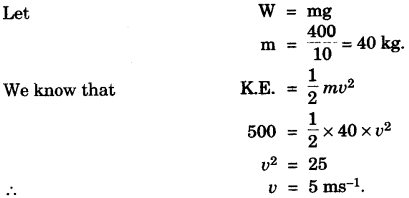
- #5-c-iiUnder what condition will a set of gears produce
l. a gain in speed
2. a gain in torque.
Ans : (1) For gain in speed: No. of teeth in driving wheel is greater than no. of teeth in driven wheel.
(2) For gain in torque: No. of teeth in driven wheel is greater than no. of teeth in driving wheel.
- #6
- #6-a [3]
- #6-a-iWhat is meant by the term .critical angle'?Ans : Critical angle is the angle of incidence in the denser medium corresponding to which the angle of refraction in the rarer medium is 90°.
- #6-a-iiHow is it related to the refractive index of the medium?Ans : aμg = cosec ic where ic in the critical angle.
- #6-a-iiiDoes the depth of a tank of water appear to change or remain the same
when viewed 'normally from above?Ans : Depth remain the same. Apparent depth = Actual depth.
- #6-b [3]A ray of light PQ is incident normally on the hypotenuse of a right angled
prism ABC as shown in the diagram given below:
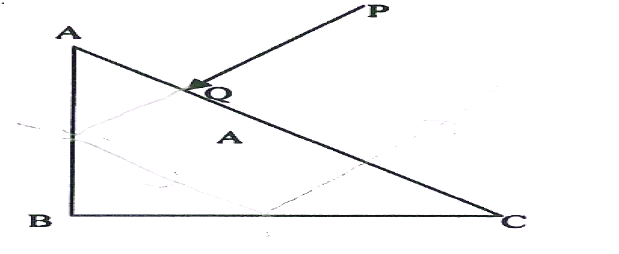
- #6-b-iCopy the diagram and complete the path of the ray PQ till it emerges
from the prism.Ans :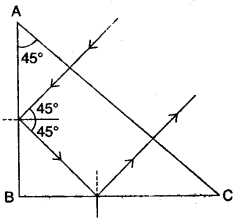
- #6-b-iiWhat is the value of the angle: of deviation of the ray?Ans : Angle of deviation (.) = 180°
- #6-b-iiiName an instrument where this action of the prism is used.Ans : Prism binocular.
- #6-c [4]A converging lens is used to obtain an image of an object placed in front of it.
The inverted image is formed between ``F_2`` and ``2F_2`` of the lens.
- #6-c-iWhere is the object placed?Ans : Object is beyond 2F1.
- #6-c-iiDraw a ray diagram to illustrate the formation of the image obtained.
Ans :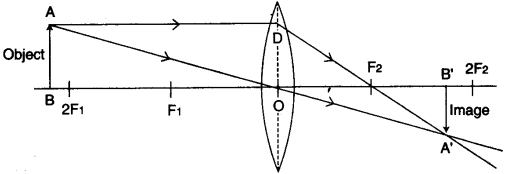
- #7