ICSE-X-Geography
04: Soils in India Class 10 Geography
Note: Please signup/signin free to get personalized experience.
Note: Please signup/signin free to get personalized experience.
10 minutes can boost your percentage by 10%
Note: Please signup/signin free to get personalized experience.
- Qstn #2How we define Soil from agricultural point of view?Ans : Soil is the thin layer of loose mixture of small rock
particles and rotting organic matter that covers much of the world’s land
surface. It supports all forests, grasslands and crops from which all living
creatures on earth derive their food.
- Qstn #3What are the different types of Soil according to their Zones?Ans : Types of Zonal Soils:
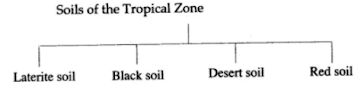 Different Types of Soil:
Eight major types according to Indian Council of
Agricultural Research (ICAR).
- Alluvial soils
- Black soils
- Red soils
- Laterite soils
- Desert soils
- Mountain soils
- Saline and Alkaline soils
- Peaty and Marshy soils
- Qstn #4Alluvial Soils are also called ‘Riverine Soils’. Why?Ans : The chief region of Alluvial Soils in India is the
Indo-Gangetic plain, where Alluvial Soils have been deposited mostly by rivers.
The coastal belts are the areas of alluvium. The deltaic alluvium on the
eastern coast has also been deposited by river- channels. Therefore, Alluvial
Soils are rightly called Riverine Soils.
- Qstn #5How is the Alluvial Soil found in the Ganga plain different from that found in the Godavari valley?Ans : The Alluvial Soil of the Ganga plain is formed due to the
deposition of alluvium which is brought from the Himalayan region. These are
light in colour. The Alluvial Soil of the Godavari valley is formed due to the
deposition of alluvium brought mainly from the Deccan trap region which is
volcanic in origin. It is dark in colour.
- Qstn #6How is Alluvial soil formed? Why is this soil agriculturally important?Ans : Alluvial soils are formed by the sediments brought by the
rivers. The rivers deposit very fine silt called ‘alluvium’ in their plains
during the course of their journey starting from its source in the mountains
and ending till its mouth.
This soil is agriculturally very important because it is
a mixture of sand, clay and silt (loamy) which makes it very fertile. It is
rich in potash and lime. It is light and porous therefore easily tillable. It
is suitable for growing large variety of Rabi and Kharif crops.
- #7
- #7-iWhat is Black Soil?Ans : It is Black in colour therefore it is called Black
Soil. These Soils are also called Regur Soil. These are formed in situ, i.e.,
formed where they are found. These Soils have originated from solidification of
basic lava spread over large areas of Deccan Plateau during volcanic activity.
- #7-iiGive any two characteristics or features of the Soil found most suitable for growing cotton and sugarcane in Maharashtra.Ans : Two characteristics or features of the Black Soil
which is most suitable for growing cotton and sugarcane in Maharashtra are:
- It is fine grained, rich in iron, lime and calcium.
- It retains moisture and becomes exceedingly sticky.
- Qstn #8How is Black Soil formed?Ans : Black Soil is formed as a result of denudation of
lava-flow rocks. They contain large quantities of lime, potash, aluminium,
magnesium. They are deficient in phosphorus, nitrogen and organic matter. Black
Soil is highly retentive of moisture, and become sticky when wet.
- Qstn #9What are the other names of Black Soil? Where are they found?Ans : Black Soil is also known as ‘Regur Soil’ or ‘Black Cotton
Soil’. Black Soil is found in Gujrat, Maharashtra, parts of Madhya Pradesh,
South Uttar Pradesh, North-west Orissa and the western parts of Andhra Pradesh.
- #10
- #10-iExplain the origin of the Black Soil. Name two States in India, which have Black Soil.Ans : Black Soil is formed by weathering of volcanic rocks.
It is found in Maharashtra and M.-P.
- #10-iiMention any two advantages of the Black Soil.Ans : It retains moisture for a long time, is rich in
lime, potash and calcium.
- Qstn #11Where is Red Soil found?Ans : Red Soil is found in Tamil Nadu, Karnataka, South-eastern
Maharashtra, parts of Andhra Pradesh and Orissa. They are also found in the
southern districts of Uttar Pradesh, Madhya Pradesh and eastern Rajasthan.
- Qstn #12What are mineral deficiencies of Red Soil? How can they be corrected?Ans : The Red Soils are generally poor in nitrogen, phosphoric
acid and humus. They become reasonably fertile when fertilizers are added to
it.