NEET-XII-Physics
20: dispersion and Spectra
Note: Please signup/signin free to get personalized experience.
Note: Please signup/signin free to get personalized experience.
10 minutes can boost your percentage by 10%
Note: Please signup/signin free to get personalized experience.
- Qstn #8Three thin prisms are combined as shown in figure. The refractive indices of the crown glass for red, yellow and violet rays are μr, μy and μv respectively and those for the flint glass are μ’r, μ’y and μ’v respectively. Find the ratio A‘/A for whichAns : For the crown glass, we have:
Refractive index for red rays = μr
Refractive index for yellow rays = μy
Refractive index for violet rays = μv
For the flint glass, we have:
Refractive index for red rays = μ'r
Refractive index for yellow rays = μ'y
Refractive index for violet rays = μ'v
Let δcy and δfy be the angles of deviation produced by the crown and flint prisms for the yellow light.
Total deviation produced by the prism combination for yellow rays:
δy = δcy - δfy
= 2δcy - δfy
=2(μcy + 1)A - (μfy - 1)A'
Angular dispersion produced by the combination is given by
δv - δr = [(μvc - 1)A - (μvf - 1)A' + (μvc - 1)A - `` \left[\left({\mu }_{rc}-1\right)A-\left({\mu }_{rf}-1\right)A\text{'}+\left({\mu }_{rc}-1\right)A\right]``
Here,
μvc = Refractive index for the violet colour of the crown glass
μvf = Refractive index for the violet colour of the flint glass
`` {\mu }_{rc}`` = Refractive index for the red colour of the crown glass
`` {\mu }_{rf}`` = Refractive index for the red colour of the flint glass
On solving, we get:
δv - δr = 2(μvc -1)A - (μvf - 1)A'
- #8-athere is no net angular dispersion, andAns : For zero angular dispersion, we have:
δt - δt = 0 = 2(μvc -1)A - (μvf - 1)A'
`` \Rightarrow \frac{A\text{'}}{A}=\frac{2({\mu }_{\,\mathrm{\,vf\,}}-1)}{({\mu }_{vc}-1)}``
`` =\frac{2({\mu }_{r}-{\mu }_{r})}{({\mu }_{r}-\mu )}``
- #8-bthere is no net deviation in the yellow ray.
FigureAns : For zero deviation in the yellow ray, δy = 0.
⇒ 2(μcy - 1)A = (μfy - 1)A
`` \Rightarrow \frac{A\text{'}}{A}=\frac{2({\mu }_{\,\mathrm{\,cy\,}}-1)}{({\mu }_{\,\mathrm{\,fy\,}}-1)}``
`` =\frac{2({\mu }_{y}-1)}{(\mu {\text{'}}_{y}-1)}``
Page No 442:
Page No 443:
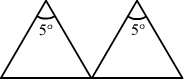
- Qstn #9A thin prism of crown glass (μr = 1.515, μv = 1.525) and a thin prism of flint glass (μr = 1.612, μv = 1.632) are placed in contact with each other. Their refracting angles are 5.0° each and are similarly directed. Calculate the angular dispersion produced by the combination.Ans :
For crown glass, we have:
Refractive index for red colour, μcr = 1.515
Refractive index for violet colour, μcv = 1.525
For flint glass, we have:
Refractive index for red colour, μfr = 1.612
Refractive index for violet colour,μfv = 1.632
Refracting angle, A = 5°
Let:
δc = Angle of deviation for crown glass
δf = Angle of deviation for flint glass
As prisms are similarly directed and placed in contact with each other, the total deviation produced `` \left(\delta \right)`` is given by
δ = δc + δf
= (`` {\mu }_{c}`` - 1)A + (`` {\mu }_{f}`` - 1)A
= (`` {\mu }_{c}`` + `` {\mu }_{f}`` - 2)A
For violet light, δv = (μcv + μfv - 2)A
For red light, δr = (μcr + μfr - 2)A
Now, we have:
Angular dispersion of the combination:
δv - δr = (μcv + μfv - 2)A - (μcr + μfr - 2)A
= (μcv + μfv - μcr - μfr) A
= (1.525 + 1.632 - 1.515 - 1.612)5
= 0.15°
So, the angular dispersion produced by the combination is 0.15°.
Page No 443:
- Qstn #10A thin prism of angle 6.0°, ω = 0.07 and μy = 1.50 is combined with another thin prism having ω = 0.08 and μy = 1.60. The combination produces no deviation in the mean ray.Ans : Given:
For the first prism,
Angle of prism, A' = 6°
Angle of deviation, ω' = 0.07
Refractive index for yellow colour, μ'y = 1.50
For the second prism,
Angle of deviation, ω = 0.08
Refractive index for yellow colour, μy= 1.60
Let the angle of prism for the second prism be A.
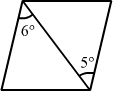
The prism must be oppositely directed, as the combination produces no deviation in the mean ray.
- #10-aFind the angle of the second prism.Ans : The deviation of the mean ray is zero.
Thus, we have:
δy = (μy - 1)A - (μ'y - 1)A' = 0
`` \therefore `` (1.60 - 1)A = (1.50 - 1)A'
⇒ A = `` \frac{0.50\times 6°}{0.60}=5°``
- #10-bFind the net angular dispersion produced by the combination when a beam of white light passes through it.Ans : Net angular dispersion on passing a beam of white light:
(μy - 1)ωA - (μy - 1)ω'A'
⇒ (1.60 - 1)(0.08)(5°) - (1.50 - 1)(0.07)(6°)
⇒ 0.24° - 0.21° = 0.03°
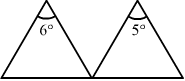
- #10-cIf the prisms are similarly directed, what will be the deviation in the mean ray?Ans : For the prisms directed similarly, the net deviation in the mean ray is given by
δy = (μy - 1)A + (μy - 1)A'
= (1.60 - 1)5° + (1.50 - 1)6°
= 3° + 3° = 6°
- #10-dFind the angular dispersion in the situation described in
(c).Ans : For the prisms directed similarly, angular dispersion is given by
δv - δr = (μy - 1)ωA - (μy - 1)ω'A'
= 0.24° + 0.21°
= 0.45°
Page No 443:
- Qstn #11The refractive index of a material M1 changes by 0.014 and that of another material M2 changes by 0.024 as the colour of the light is changed from red to violet. Two thin prisms, one made of M1(A = 5.3°) and the other made of M2(A = 3.7°) are combined with their refracting angles oppositely directed.Ans : If μ'v and μ'r are the refractive indices of material M1, then we have:
μ'v - μ'r = 0.014
If μv and μr are the refractive indices of material M2, then we have:
μv - μr = 0.024
Now,
Angle of prism for M1, A' = 5.3°
Angle of prism for M2, A = 3.7°
- #11-aFind the angular dispersion produced by the combination.Ans : When the prisms are oppositely directed, angular dispersion `` \left({\delta }_{1}\right)`` is given by
δ1 = (μv - μr)A - (μ'v - μ'r)A'
On substituting the values, we get:
δ1 = 0.024 × 3.7° - 0.014 × 5.3°
= 0.0146°
So, the angular dispersion is 0.0146°.
- #11-bThe prisms are now combined with their refracting angles similarly directed. Find the angular dispersion produced by the combination.Ans : When the prisms are similarly directed, angular dispersion`` \left({\delta }_{2}\right)`` is given by
δ2 = (μv - μr)A + (μ'v - μ'r)A'
On substituting the values, we get:
δ2 = 0.024 × 3.7° + 0.014 × 5.3°
= 0.163°
So, the angular dispersion is 0.163°.