NEET-XII-Physics
14: Some Mechanical Properties of Matter
- #30-athe viscous force exerted by the glycerine on the sphere when the speed of the sphere is 1 cm s-1, (b) the hydrostatic force exerted by the glycerine on the sphere and (c) the terminal velocity with which the sphere will move down without acceleration. Density of glycerine = 1260 kg m-3 and its coefficient of viscosity at room temperature = 8.0 poise.Ans : Viscous force exerted by glycerine on the sphere F = 6πηrv
⇒ F= 6 × (3.14) × (0.8) × 10-3 × (10-2)
= 1.50 × 10⁻⁴ N (b) Let V be the volume of the sphere.
Hydrostatic force exerted by glycerin on the sphere `` F\text{'}=V\sigma g``
`` \Rightarrow F\text{'}=\frac{4}{3}\pi {r}^{2}\sigma g``
`` =\left(\frac{4}{3}\right)\times \left(3.14\right)\times \left({10}^{-6}\right)\times 1260\times 10``
`` =5.275\times {10}^{-5}\,\mathrm{\,N\,}`` (c) Let the terminal velocity of the sphere be v'.
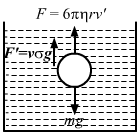
The forces acting on the drops are
(i) The weight mg acting downwards
(ii) The force of buoyance, i.e., `` \frac{4}{3}\pi {r}^{3}\sigma g`` acting upwards
(iii) The force of viscosity, i.e., 6πηrv' acting upwards
From the free body diagram:
`` 6\pi \eta rv\text{'}+\frac{4}{3}\pi {r}^{3}\sigma g=mg``
`` \Rightarrow v=\frac{mg-{\displaystyle \frac{4}{3}}\pi {r}^{2}\sigma g}{6\pi \eta r}``
`` =\frac{50\times {10}^{-3}-{\displaystyle \frac{4}{3}}\times 3.14\times {10}^{-6}\times 1260\times 10}{6\times 3.14\times 0.8\times {10}^{-3}}``
`` =\frac{500-{\displaystyle \frac{4}{3}}\times 3.14\times {10}^{-3}\times 1260\times 10}{6\times 3.14\times 0.8}``
`` =2.3\,\mathrm{\,cm\,}/s``
Page No 301:
- #30-bthe hydrostatic force exerted by the glycerine on the sphere andAns : Let V be the volume of the sphere.
Hydrostatic force exerted by glycerin on the sphere `` F\text{'}=V\sigma g``
`` \Rightarrow F\text{'}=\frac{4}{3}\pi {r}^{2}\sigma g``
`` =\left(\frac{4}{3}\right)\times \left(3.14\right)\times \left({10}^{-6}\right)\times 1260\times 10``
`` =5.275\times {10}^{-5}\,\mathrm{\,N\,}``
- #30-cthe terminal velocity with which the sphere will move down without acceleration. Density of glycerine = 1260 kg m-3 and its coefficient of viscosity at room temperature = 8.0 poise.Ans : Let the terminal velocity of the sphere be v'.
The forces acting on the drops are
(i) The weight mg acting downwards
(ii) The force of buoyance, i.e., `` \frac{4}{3}\pi {r}^{3}\sigma g`` acting upwards
(iii) The force of viscosity, i.e., 6πηrv' acting upwards
From the free body diagram:
`` 6\pi \eta rv\text{'}+\frac{4}{3}\pi {r}^{3}\sigma g=mg``
`` \Rightarrow v=\frac{mg-{\displaystyle \frac{4}{3}}\pi {r}^{2}\sigma g}{6\pi \eta r}``
`` =\frac{50\times {10}^{-3}-{\displaystyle \frac{4}{3}}\times 3.14\times {10}^{-6}\times 1260\times 10}{6\times 3.14\times 0.8\times {10}^{-3}}``
`` =\frac{500-{\displaystyle \frac{4}{3}}\times 3.14\times {10}^{-3}\times 1260\times 10}{6\times 3.14\times 0.8}``
`` =2.3\,\mathrm{\,cm\,}/s``
Page No 301: