NEET-XII-Physics
14: Some Mechanical Properties of Matter
Note: Please signup/signin free to get personalized experience.
Note: Please signup/signin free to get personalized experience.
10 minutes can boost your percentage by 10%
Note: Please signup/signin free to get personalized experience.
- #Section : i
- Qstn #1The ratio stress/strain remain constant for small deformation of a metal wire. When the deformation is made larger, will this ratio increase or decrease?Ans : The ratio of stress to strain will decrease.
Beyond the elastic limit, the body loses its ability to restore completely when subjected to stress. Thus, there occurs more strain for a given stress. At some points, however, the body undergoes strain without the application of stress. So, the ratio of stress to strain decreases.
Page No 297:
- Qstn #2When a block a mass M is suspended by a long wire of length L, the elastic potential potential energy stored in the wire is
12× stress × strain × volume. Show that it is equal to
12Mgl, where l is the extension. The loss in gravitational potential energy of the mass earth system is Mgl. Where does the remaining
12Mgl energy go?Ans : Let the CSA of the wire be A.
`` \,\mathrm{\,Stress\,}=\frac{\,\mathrm{\,Force\,}}{\,\mathrm{\,Area\,}}=\frac{Mg}{A}``
`` \,\mathrm{\,Strain\,}=\frac{l}{L}``
`` \,\mathrm{\,Volume\,}=AL``
`` \,\mathrm{\,We\,}\,\mathrm{\,need\,}\,\mathrm{\,to\,}\,\mathrm{\,calculate\,}\,\mathrm{\,the\,}\,\mathrm{\,elastic\,}\,\mathrm{\,potential\,}\,\mathrm{\,energy\,}\,\mathrm{\,stored\,}\,\mathrm{\,in\,}\,\mathrm{\,the\,}\,\mathrm{\,wire\,}\,\mathrm{\,which\,}\,\mathrm{\,is\,}\,\mathrm{\,given\,}\,\mathrm{\,to\,}\,\mathrm{\,be\,}\,\mathrm{\,equal\,}\,\mathrm{\,to\,}\frac{1}{2}\times \,\mathrm{\,Stress\,}\times \,\mathrm{\,Strain\,}\times \,\mathrm{\,Volume\,}.``
`` \,\mathrm{\,Elastic\,}\,\mathrm{\,potential\,}\,\mathrm{\,energy\,}=\frac{1}{2}\times \,\mathrm{\,Stress\,}\times \,\mathrm{\,Strain\,}\times \,\mathrm{\,Volume\,}``
`` =\frac{1}{2}\times \frac{Mg}{A}\times \frac{l}{L}\times AL``
`` =\frac{1}{2}Mgl``
The other `` \frac{1}{2}Mgl`` is converted into kinetic energy of the mass.
When the mass leaves its initial point on the spring, it acquires a velocity as it moves down. The velocity reaches its maximum at the end point. The spring oscillates. Finally, when the kinetic energy is dissipated into heat, the spring comes to rest.
Page No 297:
- Qstn #3When the skeleton of an elephant and the skeleton of a mouse are prepared in the same size, the bones of the elephant are shown thicker than those of the mouse. Explain why the bones of an elephant are thicker than proportionate. The bones are expected to withstand the stress due to the weight of the animal.Ans : The elephant has a greater weight than a mouse, but the material that makes their bones is the same. This means that in order to sustain an elephant's weight, one's bones need to suffer less stress. Stress = Force/area. A greater cross-sectional area reduces stress on the bones. This is why an elephant's bones are thicker.
Page No 297:
- Qstn #4The yield point of a typical solid is about 1%. Suppose you are lying horizontally and two persons are pulling your hands and two persons are pulling your legs along your own length. How much will be the increase in your length if the strain is 1%? Do you think your yield point is 1% or much less than that?Ans : Let my length = L
Let the increase in length = l
Strain
`` =\frac{l}{L}=\frac{1}{100}``
`` \Rightarrow l=\frac{L}{100}``
`` \,\mathrm{\,So\,},\,\mathrm{\,the\,}\,\mathrm{\,increase\,}\,\mathrm{\,in\,}\,\mathrm{\,length\,}\,\mathrm{\,will\,}\,\mathrm{\,be\,}\frac{L}{100}.``
Yes, the yield point is much less than the 1% strain because the human body consists of joints and not one uniform solid structure.
Page No 297:
- Qstn #5When rubber sheets are used in a shock absorber, what happens to the energy of vibration?Ans : The energy of vibration dissipates as heat from the shock absorber.
Page No 297:
- Qstn #6If a compressed spring is dissolved in acid, what happened to the elastic potential energy of the spring?Ans : When a compressed spring dissolves in an acid, the acid molecules leave the sold lattice of the spring faster than the uncompressed spring. This in turn increases the kinetic energy of the solution. As a result, the temperature of the acid also increases. However, this temperature increase will be very small because the mechanical energy content in the spring is lesser than its chemical energy content.
Page No 297:
- Qstn #7A steel blade placed gently on the surface of water floats on it. If the same blade is kept well inside the water, it sinks. Explain.Ans : It floats because of the surface tension of water. The surface of water behaves like a stretched membrane. When a blade is placed on the water surface, it's unable to pierce the stretched membrane of water due to its low weight and remains floating.
However, if the blade is placed below the surface of water, it no longer experiences the surface tension and sinks to the bottom as the density of the blade is greater than that of water.
Page No 297:
- Qstn #8When some wax is rubbed on a cloth, it becomes waterproof. Explain.Ans : A liquid wets a surface when the angle of contact of the liquid with the surface is small or zero. Due to its fibrous nature, cloth produces capillary action when in contact with water. This makes clothes have very small contact angles with water. When wax is rubbed over cloth, the water does not wet the cloth because wax has a high contact angle with water.
Page No 297:
- Qstn #9The contact angle between pure water and pure silver is 90°. If a capillary tube made of silver is dipped at one end in pure water, will the water rise in the capillary?Ans : No, the water will neither rise nor fall in the silver capillary.
`` \,\mathrm{\,According\,}\,\mathrm{\,to\,}\,\mathrm{\,Jurin\,}\text{'}\,\mathrm{\,s\,}\,\mathrm{\,law\,},\,\mathrm{\,the\,}\,\mathrm{\,level\,}\,\mathrm{\,of\,}\,\mathrm{\,water\,}\,\mathrm{\,inside\,}\,\mathrm{\,a\,}\,\mathrm{\,capillary\,}\,\mathrm{\,tube\,}\,\mathrm{\,is\,}\,\mathrm{\,given\,}\,\mathrm{\,by\,}``
$$ \,\mathrm{\,h\,}=\frac{2\,\mathrm{\,Tcos\theta \,}}{\,\mathrm{\,r\rho g\,}}$$
$$ \,\mathrm{\,Here\,},\,\mathrm{\,\theta \,}={90}^{0}$$
$$ \Rightarrow \,\mathrm{\,h\,}=\frac{2\,\mathrm{\,Tcos\,}{90}^{0}}{\,\mathrm{\,r\rho g\,}}$$
`` \Rightarrow \,\mathrm{\,h\,}=0``
Thus, the water level neither rises nor falls.
- Qstn #10It is said that a liquid rises or is depressed in capillary due to the surface tension. If a liquid neither rises nor depresses in a capillary, can we conclude that the surface tension of the liquid is zero?Ans : No, we cannot conclude the surface tension to be zero solely by the fact that the liquid neither rises nor falls in a capillary.
The height of the liquid inside a capillary tube is given by `` h=\frac{2T\,\mathrm{\,cos\,}\theta }{r\rho g}``
`` ``. From the equation, we see that the height (h) of the liquid may also be zero if the contact angle `` \theta `` between the liquid and the capillary tube is `` {90}^{0}\,\mathrm{\,or\,}{270}^{0}``.
Page No 297:
- Qstn #11The contact angle between water and glass is 0°. When water is poured in a glass to the maximum of its capacity, the water surface is convex upward. The angle of contact in such a situation is more than 90°. Explain.Ans : When water is poured in a glass, it reaches the brim and rises further. The edge of the glass lies below the water level. In this case, the force of attraction due to molecules of the glass surface is not perpendicular to the solid. Here, the contact angle can be greater than the standard contact angle for a pair of substances.
Page No 297:
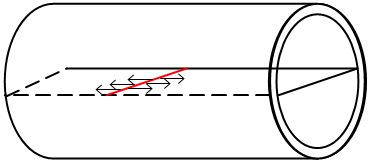
- Qstn #12A uniform vertical tube of circular cross section contains a liquid. The contact angle is 90°. Consider a diameter of the tube lying in the surface of the liquid. The surface to the right of this diameter pulls the surface on the left of it. What keeps the surface on the left in equilibrium?Ans : As the angle of contact is 0, there is no force between the surface of the tube and the liquid. The diameter of the liquid surface is pulled on both sides by equal and opposite forces of surface tension. This results in no net force remaining on the surface of the liquid. Hence, the liquid stays in equilibrium.
Page No 297:
- Qstn #13When a glass capillary tube is dipped at one end in water, water rises in the tube. The gravitational potential energy is thus increased. Is it a violation of conservation of energy?Ans : No, it does not violate the principle of conservation of energy.
There is a force of attraction between glass and water, which is why the liquid rises in the tube. However, when water and glass are not in contact, there exists a potential energy in the system. When they are brought into contact, this potential energy is first converted into kinetic energy, which lets the liquid rush upwards in the tube, and then into gravitational potential energy. Therefore, energy is not created in the process.
Page No 297: