NEET-XII-Physics
13: Fluid Mechanics
Note: Please signup/signin free to get personalized experience.
Note: Please signup/signin free to get personalized experience.
10 minutes can boost your percentage by 10%
Note: Please signup/signin free to get personalized experience.
- #Section : i
- Qstn #1Is it always true that the molecules of a dense liquid are heavier than the molecules of a lighter liquid?Ans : Density is defined as mass per unit volume. It tells how closely packed are the molecules inside an object. When molecules are tightly packed, we say that the object is dense; when molecules are far apart, we say that the object is light.
The density of a liquid depends on the mass of the molecules that make up the liquid and the closeness of the molecules of the liquid. It is not always true that the molecules of a dense liquid are heavier than the molecules of a lighter liquid.
For example, alcohol is less dense than oil. Alcohol molecules are mostly carbon and hydrogen atoms, so they are similar to oil. But they also contain an oxygen atom, which makes them a little heavy. For this reason, you might think that alcohol is denser than oil. But because of their shape and size, alcohol molecules do not pack as efficiently as oil molecules. This property of molecules makes alcohol less dense than oil.
Page No 270:
- Qstn #2If someone presses a pointed needle against your skin, you are hurt. But if someone presses a rod against your skin with the same force, you easily tolerate. Explain.Ans : We know that pressure is the application of force over a particular area. In mathematical terms, pressure is equal to force divided by area; that is, with more force comes more pressure and with more area comes less pressure. An iron rod has more surface area than the pointed tip of a needle. That is why the pointed needle exerts more pressure than the iron rod (with the same force) when pressed against our skin.
Page No 270:
- Qstn #3In the derivation of P1 - P2 = ρgz, it was assumed that the liquid is incompressible. Why will this equation not be strictly valid for a compressible liquid?Ans : In case of an incompressible liquid, the density is independent of the variations in pressure and always remains constant. But it is not so in case of a compressible liquid. Thus, the given equation will not be strictly valid for a compressible liquid.
Page No 270:
- Qstn #4Suppose the density of air at Madras is ρo and atmospheric pressure is P0. If we go up, the density and the pressure both decrease. Suppose we wish to calculate the pressure at a height 10 km above Madras. If we use the equation Po - P = ρogz, will we get a pressure more than the actual or less than the actual? Neglect the variation in g. Does your answer change if you also consider the variation in g?Ans : Using the equation Po - P = ρogz, we get:
P = Po - ρogz
The pressure calculated by using this equation will be more than the actual pressure because density at a height of 10 km above Madras will be less than ρo.
Yes, the answer will change if we also consider the variation in g. Because g decreases with height, it will have the same effect on pressure as that of density.
Page No 270:
- Qstn #5The free surface of a liquid resting in an inertial frame is horizontal. Does the normal to the free surface pass through the centre of the earth? Think separately if the liquid is
a) at the equator
(b) at a pole
(c) somewhere else.Ans : Yes, the normal to the free surface of the liquid passes through the centre of the Earth. Because of the gravitational force, the free surface of the liquid takes the shape of the surface of the Earth. Also, because the gravitational force is directed towards the centre of the Earth, the normal to the free surface also passes through the centre of the Earth (in all cases).
Page No 270:
- Qstn #6A barometer tube reads 76 cm of mercury. If the tube is gradually inclined keeping the open end immersed in the mercury reservoir, will the length of mercury column be 76 cm, more than 76 cm or less than 76 cm?Ans : The length of the mercury column will be more than 76 cm. The pressure depends on the height of the highest point of the mercury from the ground and not on the length of the liquid column.
`` \,\mathrm{\,Suppose\,}:``
`` l=\,\mathrm{\,Length\,}\,\mathrm{\,of\,}\,\mathrm{\,the\,}\,\mathrm{\,mercury\,}\,\mathrm{\,column\,}``
`` \theta =\,\mathrm{\,Angle\,}\,\mathrm{\,at\,}\,\mathrm{\,which\,}\,\mathrm{\,the\,}\,\mathrm{\,tube\,}\,\mathrm{\,is\,}\,\mathrm{\,inclined\,}\,\mathrm{\,with\,}\,\mathrm{\,the\,}\,\mathrm{\,vertical\,}``
`` \,\mathrm{\,Given\,}:``
`` h=76\,\mathrm{\,cm\,}``
`` l\,\mathrm{\,cos\,}\theta =h``
`` \,\mathrm{\,or\,},l=\frac{h}{\,\mathrm{\,cos\,}\theta }``
`` \therefore l>h``
`` ``
`` ``
`` ``
`` ``
Or,
l > 76 cm
Page No 270:
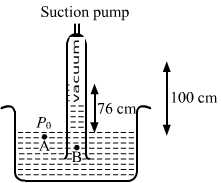
- Qstn #7A one meter long glass tube is open at both ends. One end of the tube is dipped into a mercury cup, the tube is kept vertical and the air is pumped out of the tube by connecting the upper end to a suction pump. Can mercury be pulled up into the pump by this process?Ans : No, mercury cannot be pulled up into the pump by this process. The level up to which mercury can rise is 76 cm (to maintain equal pressure at points A and B).
Page No 270:
- Qstn #8A satellite revolves round the earth. Air pressure inside the satellite is maintained at 76 cm of mercury. What will be the height of mercury column in a barometer tube 1 m long placed in the satellite?Ans : Pressure at point A is 76 cm of mercury. Therefore, mercury will rise to full length of the tube, i.e., 1 m, to maintain equal pressure at points A and B. Inside the satellite, `` {\,\mathrm{\,g\,}}_{\,\mathrm{\,effective\,}}=0``, so the pressure due to height of the mercury column will be zero.

Page No 270:
- Qstn #9Consider the barometer shown in figure. If a small hole is made at a point P in the barometer tube, will the mercury come out from this hole?
figureAns : Two pressures are acting upon point P:
(1) Pressure due to mercury level above point P equals to P1 (say)
(2) Atmospheric pressure = P0 (inwards)
And,
P0 > P1
As the inward pressure is more, the mercury will not come out of the hole.
Page No 271:
- Qstn #10Is Archimedes’ principle valid in an elevator accelerating up ? In a car accelerating on a level road?Ans : Archimedes' principle is not valid in case of an elevator accelerating upwards, but it is valid for a car accelerating on a level road.
According to Archimedes' principle,
Buoyant force, B = Weight of the substituted liquid
Or,
B = mg
The above principle is satisfied in case of a car accelerating on a level road.
In case of an elevator, the buoyant force will be as below:
B = mg + ma (If the elevator is going upwards with an acceleration a)
Thus, Archimedes' principle is not valid in this case.
Page No 271:
- Qstn #11Why is it easier to swim in sea water than in fresh water?Ans : Whether an object sinks or floats in a liquid depends upon the density of the two. We know that sea water has dissolved salts in it, which increase its density. So, sea water exerts more buoyancy force (in the upward direction) on the swimmer than that exerted by fresh water. This helps the person to swim easily in sea water compared to fresh water.
Page No 271:
- Qstn #12A glass of water has an ice cube floating in water. The water level just touches the rim of the glass. Will the water overflow when the ice melts?Ans : The water of mass equal to the mass of the ice cube will take less volume compared to the ice cube. The water will not overflow when the ice melts because the ice will displace the space it would take if it were in a liquid state.
Page No 271:
- Qstn #13A ferry boat loaded with rocks has to pass under a bridge. The maximum height of the rocks is slightly more than the height of the bridge so that the boat just fails to pass under the bridge. Should some of the rocks be removed or some more rocks be added?Ans : Some rocks should be added to increase the force acting in the downward direction. It will help the boat to pass under the bridge. If some rocks are removed, the upthrust of water on the boat will be greater than the weight of the boat. So, the boat will rise in water and will fail to pass under the bridge.
Page No 271: