NEET-XII-Physics
04: The Forces
Note: Please signup/signin free to get personalized experience.
Note: Please signup/signin free to get personalized experience.
10 minutes can boost your percentage by 10%
Note: Please signup/signin free to get personalized experience.
- Qstn #5A monkey is sitting on a tree limb. The limb exerts a normal force of 48 N and a frictional force of 20 N. Find the magnitude of the total force exerted by the limb on the monkey.Ans : Given: The limb of the tree exerts a normal force of 48 N and a frictional force of 20 N.
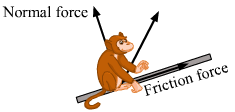
So, resultant magnitude of the force if given by
`` R=\sqrt{\left({48}^{2}+{20}^{2}\right)}``
`` =\sqrt{2304+400}``
`` =\sqrt{2704}=52\,\mathrm{\,N \,}``
∴ The magnitude of the total force exerted by the limb on the monkey is 52 N.
- Qstn #6A body builder exerts a force of 150 N against a bullworker and compresses it by 20 cm. Calculate the spring constant of the spring in the bullworker.Ans : Force exerted by the body builder against the bullworker = 150 N
Compression in the bullworker, x = 20 cm = 0.2 m
∴ Total force exerted, f = kx = 150
Here, k is the spring constant of the spring in the bullworker.
`` \therefore k=\frac{150}{0.2}=\frac{1500}{2}=750\,\mathrm{\,N \,}/\,\mathrm{\,m \,}``
Hence, the spring constant of the spring in the bullworker is 750 N/m.
- Qstn #7A satellite is projected vertically upwards from an earth station. At what height above the earth’s surface will the force on the satellite due to the earth be reduced to half its value at the earth station? (Radius of the earth is 6400 km.)Ans : Let h be the height, M be the Earth's mass, R be the Earth's radius and m be the satellite's mass
.
Force on the satellite due to the earth when it is at the Earth's surface, `` {F}_{1}=\frac{\,\mathrm{\,GM \,}m}{{\,\mathrm{\,R \,}}^{2}}``
Force on the satellite due to the earth when it is at height h above the Earth's surface, `` {F}_{2}=\frac{\,\mathrm{\,GM \,}m}{{\left(\,\mathrm{\,R \,}\mathit{+}h\right)}^{2}}``
According to question, we have:
`` \frac{{F}_{1}}{{F}_{2}}=\frac{{\left(R+h\right)}^{2}}{{R}^{2}}``
`` \Rightarrow 2=\frac{{\left(R+h\right)}^{2}}{{R}^{2}}``
`` \,\mathrm{\,Taking \,}\,\mathrm{\,squareroot \,}\,\mathrm{\,on \,}\,\mathrm{\,both \,}\,\mathrm{\,sides \,},\,\mathrm{\,we \,}\,\mathrm{\,get \,}:``
`` \sqrt{2}=1+\frac{h}{R}``
`` \Rightarrow h=\left(\sqrt{2}-1\right)R``
`` =0.414\times 6400=2649.6\,\mathrm{\,km \,}\approx 2650\,\mathrm{\,km \,}``
- Qstn #8Two charged particles placed at a separation of 20 cm exert 20 N of Coulomb force on each other. What will be the force of the separation is increased to 25 cm?Ans : Two charged particles placed at a separation of 20 cm exert 20 N of Coulomb force on each other.
So, `` {F}_{1}=\frac{1}{4\,\mathrm{\,\pi \,}{\in }_{0}}·\frac{{q}^{2}}{{r}_{1}^{2}}``
Also, `` {F}_{2}=\frac{1}{4\,\mathrm{\,\pi \,}{\in }_{0}}·\frac{{q}^{2}}{{r}_{2}^{2}}``
According to the question, we have:
`` \frac{{F}_{2}}{{F}_{1}}=\frac{{r}_{1}^{2}}{{r}_{2}^{2}}``
`` =\frac{20\times 20}{25\times 25}=\frac{16}{25}``
`` \therefore {F}_{2}=\frac{16}{25}\times {F}_{1}``
- Qstn #9The force with which the earth attracts an object is called the weight of the object. Calculate the weight of the moon from the following data : The universal constant of gravitation G = 6.67 × 11-11 N-m2/kg2, mass of the moon = 7.36 × 10²² kg, mass of the earth = 6 × 1024 kg and the distance between the earth and the moon = 3.8 × 10⁵ km.Ans : The force between the Earth and the Moon is given by `` F=\frac{\,\mathrm{\,G \,}Mm}{{r}^{2}}``.
Here, M is the mass of the earth; m is the mass of the moon and r is the distance between Earth and Moon.
On substituting the values, we get:
`` F=\frac{6.67\times {10}^{-11}\times 7.36\times {10}^{22}\times 6\times {10}^{24}}{3.8\times 3.8\times {10}^{16}}``
`` =\frac{6.67\times 7.36\times {10}^{35}}{(3.8{)}^{2}\times {10}^{16}}``
`` =20.3\times {10}^{19}=2.03\times {10}^{20}``
`` \approx 2.0\times {10}^{20}\,\mathrm{\,N \,}``
`` ``
∴ The weight of the moon is `` 2.0\times {10}^{20}\,\mathrm{\,N \,}``.
- Qstn #10Find the ratio of the magnitude of the electric force to the gravitational force acting between two protons.Ans : Charge of the proton, q = `` 1.6\times {10}^{-19}\,\mathrm{\,C \,}``
Mass of the proton = `` 1.67\times {10}^{-27}\,\mathrm{\,kg \,}``
Let the distance between two protons be r.
Coulomb force (electric force) between the protons is given by
`` {f}_{e}=\frac{1}{4\,\mathrm{\,\pi \,}{\in }_{0}}\times \frac{{q}^{2}}{{r}^{2}}``
`` =\frac{9\times {10}^{9}\times (1.6{)}^{2}\times {10}^{-38}}{{r}^{2}}``
Gravitational force between the protons is given by
`` {f}_{g}=\frac{\,\mathrm{\,G \,}{m}^{2}}{{r}^{2}}``
`` =\frac{6.67\times {10}^{-11}\times (1.67\times {10}^{-27}{)}^{2}}{{r}^{2}}``
On dividing `` {f}_{e}\,\mathrm{\,by \,}{f}_{g}``, we get:
`` \frac{{f}_{e}}{{f}_{g}}=\frac{1}{4\,\mathrm{\,\pi \,}{\in }_{0}}\times \frac{{q}^{2}}{{r}^{2}}\times \frac{{r}^{2}}{\,\mathrm{\,G \,}{m}^{2}}``
`` =\frac{9\times {10}^{9}\times 1.6\times 1.6\times {10}^{-38}}{6.67\times {10}^{-11}\times 1.67\times 1.67\times {10}^{-54}}``
`` =\frac{9\times (1.6{)}^{2}\times {10}^{-29}}{6.67\times (1.67{)}^{2}\times {10}^{-65}}``
`` =1.24\times {10}^{36}``
- Qstn #11The average separation between the proton and the electron in a hydrogen atom in ground state is 5.3 × 10⁻¹¹ m. (
a) Calculate the Coulomb force between them at this separation.
(b) When the atom goes into its first excited state the average separation between the proton and the electron increases to four times its value in the ground state. What is the Coulomb force in this state?Ans : Average separation between the proton and the electron of a Hydrogen atom in ground state, r = 5.3 × 10⁻¹¹ m
(a) Coulomb force when the proton and the electron in a hydrogen atom in ground state
`` F=9\times {10}^{9}\times \frac{{q}_{1}{q}_{2}}{{r}_{2}}``
`` =\frac{9\times {10}^{9}\times {\left(1.6\times {10}^{-19}\right)}^{2}}{{\left(5.3\times {10}^{-11}\right)}^{2}}=8.2\times {10}^{-8}\,\mathrm{\,N \,}``
(b) Coulomb force when the average distance between the proton and the electron becomes 4 times that of its ground state
`` \,\mathrm{\,Coulomb \,}\,\mathrm{\,force \,},F=\frac{1}{4\,\mathrm{\,\pi \,}{\in }_{0}}=\frac{{q}_{1}{q}_{2}}{{\left(4r\right)}^{2}}``
`` =\frac{9\times {10}^{9}\times {\left(1.6\times {10}^{-19}\right)}^{2}}{16\times {\left(5.3\right)}^{2}\times {10}^{-22}}``
`` =\frac{9\times {\left(1.6\right)}^{2}}{10\times {\left(5.3\right)}^{2}}\times {10}^{-7}``
`` =0.0512\times {10}^{-7}``
`` =5.1\times {10}^{-9}\,\mathrm{\,N \,}``
- Qstn #12The geostationary orbit of the earth is at a distance of about 36000 km from the earth’s surface. Find the weight of a 120-kg equipment placed in a geostationary satellite. The radius of the earth is 6400 km.Ans : The geostationary orbit of the Earth is at a distance of about 36000 km.
We know that the value acceleration due to gravity above the surface of the Earth is given by `` g\text{ ' }=\frac{\,\mathrm{\,G \,}m}{{\left(R+h\right)}^{2}}``.
At h = 36000 km, we have:
`` g\text{ ' }=\frac{\,\mathrm{\,G \,}m}{{\left(36000+6400\right)}^{2}}``
At the surface, we have:
`` g=\frac{\,\mathrm{\,G \,}m}{{\left(6400\right)}^{2}}``
`` \therefore \frac{g\text{ ' }}{g}=\frac{6400\times 6400}{42400\times 42400}``
`` =\frac{256}{106\times 106}=0.0228``
`` \Rightarrow g\text{ ' }=0.0227\times 9.8=0.223\left[\,\mathrm{\,Taking \,}g=9.8\,\mathrm{\,m \,}/{\,\mathrm{\,s \,}}^{2}\,\mathrm{\,at \,}\,\mathrm{\,the \,}\,\mathrm{\,surface \,}\,\mathrm{\,of \,}\,\mathrm{\,the \,}\,\mathrm{\,earth \,}\right]``
For a 120 kg equipment placed in a geostationary satellite, its weight will be
mg' = 120 × 0.233
`` \Rightarrow ``26.76 ≈ 27 N