NEET-XII-Physics
31: Capacitors
- #24-a, (b) and (c) figure (31-E13) are identical. Find the capacitance between the points A and B of the assembly.
FigureA B (b) and (c) figure (31-E13) are identical. Find the capacitance between the points A and B of the assembly.
FigureA BAns : , (b) and (c) are identical, as all of them form a bridge circuit. In that circuit, capacitors of 1 µF and 2 µF are connected to terminal A and the 5 µF capacitor and capacitors of 3 µF and 6 µF are connected to terminal B and the 5 µF capacitor.
For the given situation, it can be observed that the bridge is in balance; thus, no current will flow through the 5 µF capacitor.
So to simplify the circuit, 5 µF capacitor can be removed from the circuit.
Now, 1 µF and 3 µF capacitors are in series.
And 2 µF and 6 µF capacitors are also in series combination.
These two combination are in parallel with each other.
The equivalent capacitance can be calculated as:
`` {C}_{\,\mathrm{\,eq\,}}=\frac{1\times 3}{1+3}+\frac{2\times 6}{2+6}``
`` =\frac{3}{4}+\frac{12}{8}=\frac{9}{4}\,\mathrm{\,\mu F\,}=2.25\mu F``
∴ Ceq = 2.25 µF
Thus, parts
(a),
(b) and
(c) are identical.
And,
Ceq = 2.25 µF
Page No 167: (b) and (c) are identical, as all of them form a bridge circuit. In that circuit, capacitors of 1 µF and 2 µF are connected to terminal A and the 5 µF capacitor and capacitors of 3 µF and 6 µF are connected to terminal B and the 5 µF capacitor.
For the given situation, it can be observed that the bridge is in balance; thus, no current will flow through the 5 µF capacitor.
So to simplify the circuit, 5 µF capacitor can be removed from the circuit.
Now, 1 µF and 3 µF capacitors are in series.
And 2 µF and 6 µF capacitors are also in series combination.
These two combination are in parallel with each other.
The equivalent capacitance can be calculated as:
`` {C}_{\,\mathrm{\,eq\,}}=\frac{1\times 3}{1+3}+\frac{2\times 6}{2+6}``
`` =\frac{3}{4}+\frac{12}{8}=\frac{9}{4}\,\mathrm{\,\mu F\,}=2.25\mu F``
∴ Ceq = 2.25 µF
Thus, parts
(a),
(b) and
(c) are identical.
And,
Ceq = 2.25 µF
Page No 167:
- #24-bandAns : and
- #24-cfigure (31-E13) are identical. Find the capacitance between the points A and B of the assembly.
FigureA B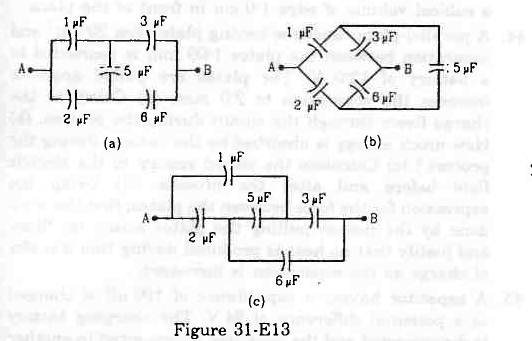 Ans : are identical, as all of them form a bridge circuit. In that circuit, capacitors of 1 µF and 2 µF are connected to terminal A and the 5 µF capacitor and capacitors of 3 µF and 6 µF are connected to terminal B and the 5 µF capacitor.
For the given situation, it can be observed that the bridge is in balance; thus, no current will flow through the 5 µF capacitor.
So to simplify the circuit, 5 µF capacitor can be removed from the circuit.
Now, 1 µF and 3 µF capacitors are in series.
And 2 µF and 6 µF capacitors are also in series combination.
These two combination are in parallel with each other.
The equivalent capacitance can be calculated as:
`` {C}_{\,\mathrm{\,eq\,}}=\frac{1\times 3}{1+3}+\frac{2\times 6}{2+6}``
`` =\frac{3}{4}+\frac{12}{8}=\frac{9}{4}\,\mathrm{\,\mu F\,}=2.25\mu F``
∴ Ceq = 2.25 µF
Thus, parts
(a),
(b) and
(c) are identical.
And,
Ceq = 2.25 µF
Page No 167: