NEET-XII-Physics
P1 year:2019
Note: Please signup/signin free to get personalized experience.
Note: Please signup/signin free to get personalized experience.
10 minutes can boost your percentage by 10%
Note: Please signup/signin free to get personalized experience.
- Qstn #31α-particle consists of :
(1) 2 protons and 2 neutrons only
(2) 2 electrons, 2 protons and 2 neutrons
(3) 2 electrons and 4 protons only
(4) 2 protons onlydigAnsr: 1Ans : ( 1 )
Sol. α-particle is nucleus of Helium which has two
protons and two neutrons.
- Qstn #32The speed of a swimmer in still water is
20 m/s. The speed of river water is 10 m/s and
is flowing due east. If he is standing on the
south bank and wishes to cross the river along
the shortest path the angle at which he should
make his strokes w.r.t. north is given by :
(1) 30° west
(2) 0°
(3) 60° west
(4) 45° westdigAnsr: 1Ans : ( 1 )
Sol.
SR
RG
V 20 m/s
V 10 m/s
=
=
V
SG
N
S
W E
V
SR
V
RG
= +
SG SR RGV V V
=
RG
SR
V
sin
V
= 10sin
20
= 1sin
2
= 30° west9
- Qstn #33A particle moving with velocity ``\vec{V}``
is acted by three forces shown by the vector
triangle PQR.
The velocity of the particle will :
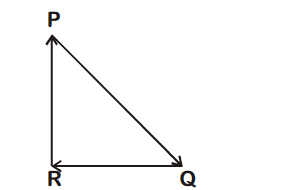
(1) Increase
(2) Decrease
(3) Remain constant
(4) Change according to the smallest force ``\vec{QR}``digAnsr: 3Ans : ( 3 )
Sol.
P
R Q
As forces are forming closed loop in same
order
So, =netF 0
&implies; =dvm 0
dt
&implies; =v constant
- Qstn #34Two particles A and B are moving in uniform
circular motion in concentric circles of radii
``r_A`` and ``r_B`` with speed ``v_A`` and ``v_B``
respectively. Their time period of rotation is
the same. The ratio of
angular speed of A to that of B will be :
(1) ``r_A : r_B``
(2)``v_A : v_B``
(3)``r_B : r_A``
(4) 1 : 1digAnsr: 4Ans : ( 4 )
Sol.
rA
r
B
T
A
= T
B
= T
ω =
A
A
2
T
ω =
B
B
2
T
ω
= = =
ω
A B
B A
T T
1
T T
- Qstn #35A block of mass 10 kg is in contact against the
inner wall of a hollow cylindrical drum of
radius 1 m. The coefficient of friction between
the block and the inner wall of the cylinder is
0.1. The minimum angular velocity needed for
the cylinder to keep the block stationary when
the cylinder is vertical and rotating about its
axis, will be : (g = ``10m/s^2`` )
(1) ``\sqrt10`` rad/s
(2)``\frac {10}{2\pi} rad/s``
(3) 10 rad/s
(4) 10 ``\pi`` rad/sdigAnsr: 3Ans : ( 3 )
Sol.
N mrω2
f
L
mg
For equilibrium of the block limiting friction
f
L
≥ mg
&implies; μN ≥ mg
&implies; μmrω2 ≥ mg
ω≥
μ
g
r
ω =
μmin
g
r
ω =
min
10
0.1 1
= 10 rad/s
- Qstn #36Two parallel infinite line charges with linear
charge densities +``\lambda`` C/m and -``\lambda`` C/m are
placed at a distance of 2R in free space. What
is the electric field mid-way between the two
line charges?
(1) Zero
(2)``\frac{2\lambda}{\pi\varepsilon _0 R}`` N/C
(3)``\frac{\lambda}{\pi\varepsilon _0 R}``N/C
(4)``\frac{\lambda}{2\pi\varepsilon _0 R}``N/CdigAnsr: 3Ans : ( 3 )
Sol. -
-
-
-
-
-
-
-
-
-
+
+
+
+
+
+
+
+
-+
(1)(2)
R E2
E
1
X-X
Electric field due to line charge (1)
=
1
0
ˆE i N /C
2 R
Electric field due to line charge (2)
=
2
0
ˆE i N /C
2 R
= +
net 1 2
E E E
=
+
0 0
ˆ ˆi i
2 R 2 R
=
0
î N /C
R
- Qstn #37Two point charges A and B, having charges +Q
and -Q respectively, are placed at certain
distance apart and force acting between them
is F. If 25% charge of A is transferred to B,
then force between the charges becomes :
(1) F
(2)``\frac {9F}{16}``
(3)``\frac {16F}{9}``
(4)``\frac {4F}{3}``digAnsr: 2Ans : ( 2 )
Sol.
A B
r
+Q -Q
2
2
kQ
F
r
=
If 25% of charge of A transferred to B then
= = = + =
A B
Q 3Q Q 3Q
q Q and q Q
4 4 4 4
r
q
A
q
B
A B
1 2
kq q
F
r
=
2
1 2
3Q
k
4
F
r
=
1 2
9 kQ
F
16 r
=
1
9F
F
16
=
- Qstn #38A small hole of area of cross-section 2`` mm^2`` is
present near the bottom of a fully filled open
tank of height 2 m. Taking g = 10 m/``s^2``, the rate
of flow of water through the open hole would
be nearly
(1) 12.6 × ``10^{-6} m^3/s``
(2) 8.9 × ``10^{-6} m^3/s``
(3) 2.23 × ``10^{-6} m^3/s``
(4) 6.4 × ``10^{-6} m^3/s``digAnsr: 1Ans : ( 1 )
Sol.
2 m
a = 2 mm
2
Rate of flow liquid
= =Q au a 2gh
= 6 22 10 m 2 10 2 m/s
= 2 × 2 × 3.14 × 10-6 m3/s
= 12.56 × 10⁻⁶ m3/s
= 12.6 × 10⁻⁶ m3/s
- Qstn #39
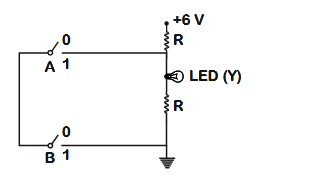
The correct Boolean operation represented by
the circuit diagram drawn is :
(1) AND
(2) OR
(3) NAND
(4) NORdigAnsr: 3Ans : ( 3 )
Sol. From the given logic circuit LED will glow,
when voltage across LED is high.
R
+6 V
B
A
Truth Table
A
0
0
1
1
B
0
1
0
1
Y
1
1
1
0
This is out put of NAND gate.
- Qstn #40In which of the following processes, heat is
neither absorbed nor released by a system?
(1) Isothermal
(2) Adiabatic
(3) Isobaric
(4) IsochoricdigAnsr: 2Ans : ( 2 )
Sol. In adiabatic process, there is no exchange of
heat.
- Qstn #41A 800 turn coil of effective area
0.05 ``m^2 ``is kept perpendicular to a magnetic
field 5 × ``10^{-5}`` T. When the plane of the coil
is rotated by 90° around any of its coplanar axis in
0.1 s, the emf induced in the coil will be:
(1) 2 V
(2) 0.2 V
(3) 2 × ``10^{-3} V
(4) 0.02 VdigAnsr: 4Ans : ( 4 )
Sol. Magnetic field B = 5 × 10⁻⁵ T
Number of turns in coil N = 800
Area of coil A = 0.05 m2
Time taken to rotate ▵t = 0.1 s
Initial angle
1
= 0°
Final angle
2
= 90°
Change in magnetic flux ▵
= NBAcos90° - BAcos0°
= - NBA
= - 800 × 5 × 10-5 × 0.05
= - 2 × 10⁻³ weber
▵=
▵
e -
t
= =
3( )2 10 Wb
0.02 V
0.1 s
- Qstn #42The radius of circle, the period of revolution,
initial position and sense of revolution are
indicated in the fig.
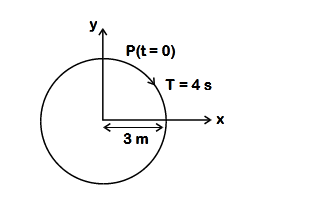
y - projection of the radius vector of rotating
particle P is :
(1) y(t) = -3 cos2``\pi``t, where y in m
(2) y(t) = 4 sin``\frac {(\Pi t)}{2}``, where y in m
(3) y(t) = 3 cos``\frac {(3\Pi t)}{2}``, where y in m
(4)3 cos``\frac {(\Pi t)}{2}``, where y in mdigAnsr: 4Ans : ( 4 )
Sol. At t = 0, y displacement is maximum, so
equation will be cosine function.
y
P t = 0
T = 4 s
x
T = 4 s
ω = = =2 2 rad/s
T 4 2
y = a cosωt
=y 3cos t
2
12
- Qstn #43A parallel plate capacitor of capacitance 20 μF
is being charged by a voltage source whose
potential is changing at the rate of 3 V/s. The
conduction current through the connecting
wires, and the displacement current through
the plates of the capacitor, would be,
respectively.
(1) Zero, 60 μA
(2) 60 μA, 60 μA
(3) 60 μA, zero
(4) Zero, zerodigAnsr: 2Ans : ( 2 )
Sol. Capacitance of capacitor C = 20 μF
= 20 × 10-6 F
Rate of change of potential
=
dV
3 v/s
dt
q = CV
=dq dVC
dt dt
i
c
= 20 × 10-6 × 3
= 60 × 10-6 A
= 60 μA
As we know that i
d
= i
c
= 60 μA
- Qstn #44In an experiment, the percentage of error
occurred in the measurement of physical
quantities A, B, C and D are 1%, 2%, 3% and 4%
respectively. Then the maximum percentage of
error in the measurement X,
where X =``\frac {A^2B^{\frac12}}{C^{\frac12}D^3}`` will be
(1) (``\frac{3}{13}``)%
(2) 16%
(3) - 10%
(4) 10%digAnsr: 2Ans : ( 2 )
Sol. Given
=
1
2 2
1
33
A B
x
C D
% error,
▵ ▵ ▵ = + x A 1 B100 2 100
x A 2 B
▵ ▵+ + 1 c D100 100 3 100
3 c D
= + + + 1 12 1% 2% 3% 3 4%
2 3
= + + +2% 1% 1% 12%
= 16%
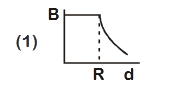
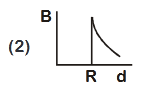
- Qstn #45A cylindrical conductor of radius R is carrying
a constant current. The plot of the magnitude
of the magnetic field. B with the distance d
from the centre of the conductor, is correctly
represented by the figure :
(1)
(2)
(3)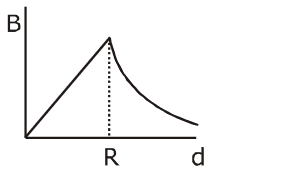
(4)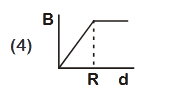 digAnsr: 3Ans : ( 3 )
Sol.
d
B
R dO
Inside (d < R)
Magnetic field inside conductor
μ=
0
2
i
B d
2 R
or B = Kd ...(i)
Straight line passing through origin
At surface (d = R)
μ=
0 i
B
2 R
...(ii)
Maximum at surface
Outside (d > R)
μ=
0 i
B
2 d
or 1B (Hyperbolic)
d13