NEET-XII-Physics
11: Dual Nature Of Radiation And Matter
- #20-aEstimate the speed with which electrons emitted from a heated emitter of an evacuated tube impinge on the collector maintained at a potential difference of 500 V with respect to the emitter. Ignore the small initial speeds of the electrons. The specific charge of the electron, i.e., its e/m is given to be 1.76 × 10¹¹ C kg-1.
(b) Use the same formula you employ in (a) to obtain electron speed for an collector potential of 10 MV. Do you see what is wrong? In what way is the formula to be modified?
(b) Use the same formula you employ in (a) to obtain electron speed for an collector potential of 10 MV. Do you see what is wrong? In what way is the formula to be modified?Ans : Potential difference across the evacuated tube, V = 500 V
Specific charge of an electron, e/m = 1.76 × 10¹¹ C kg-1
The speed of each emitted electron is given by the relation for kinetic energy as:
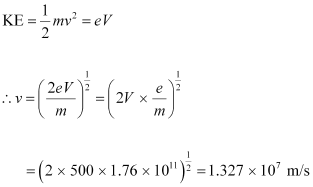
Therefore, the speed of each emitted electron is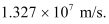
(b) Potential of the anode, V = 10 MV = 10 × 106 V
The speed of each electron is given as:
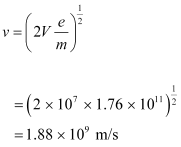
This result is wrong because nothing can move faster than light. In the above formula, the expression (mv2/2) for energy can only be used in the non-relativistic limit, i.e., for v << c.
For very high speed problems, relativistic equations must be considered for solving them. In the relativistic limit, the total energy is given as:
E = mc2
Where,
m = Relativistic mass

m0 = Mass of the particle at rest
Kinetic energy is given as:
K = mc2 - m0c2
(b) Potential of the anode, V = 10 MV = 10 × 106 V
The speed of each electron is given as:
This result is wrong because nothing can move faster than light. In the above formula, the expression (mv2/2) for energy can only be used in the non-relativistic limit, i.e., for v << c.
For very high speed problems, relativistic equations must be considered for solving them. In the relativistic limit, the total energy is given as:
E = mc2
Where,
m = Relativistic mass
m0 = Mass of the particle at rest
Kinetic energy is given as:
K = mc2 - m0c2
- #20-bUse the same formula you employ in (a) to obtain electron speed for an collector potential of 10 MV. Do you see what is wrong? In what way is the formula to be modified?Ans : Potential of the anode, V = 10 MV = 10 × 106 V
The speed of each electron is given as:
This result is wrong because nothing can move faster than light. In the above formula, the expression (mv2/2) for energy can only be used in the non-relativistic limit, i.e., for v << c.
For very high speed problems, relativistic equations must be considered for solving them. In the relativistic limit, the total energy is given as:
E = mc2
Where,
m = Relativistic mass
m0 = Mass of the particle at rest
Kinetic energy is given as:
K = mc2 - m0c2