NEET-XII-Physics
07: Alternating Current
- #15A 100 μF capacitor in series with a 40 ``\Omega`` resistance is connected to a 110 V, 60 Hz supply.
(a) What is the maximum current in the circuit?
(b) What is the time lag between the current maximum and the voltage maximum?
(a) What is the maximum current in the circuit?
(b) What is the time lag between the current maximum and the voltage maximum?Ans : Capacitance of the capacitor, C = 100 μF = 100 × 10-6 F
Resistance of the resistor, R = 40 ``\Omega``
Supply voltage, V = 110 V
(a) Frequency of oscillations, ν= 60 Hz
Angular frequency,
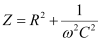
For a RC circuit, we have the relation for impedance as:
Peak voltage, V0 =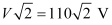
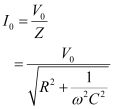
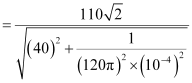
Maximum current is given as:
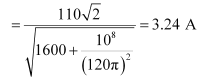
(b) In a capacitor circuit, the voltage lags behind the current by a phase angle ofΦ. This angle is given by the relation:
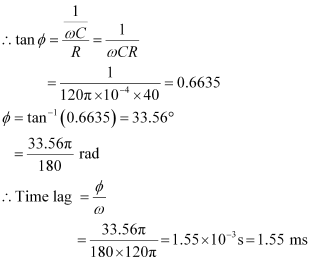
Hence, the time lag between maximum current and maximum voltage is 1.55 ms.
(a) Frequency of oscillations, ν= 60 Hz
Angular frequency,
For a RC circuit, we have the relation for impedance as:
Peak voltage, V0 =
Maximum current is given as:
(b) In a capacitor circuit, the voltage lags behind the current by a phase angle ofΦ. This angle is given by the relation:
Hence, the time lag between maximum current and maximum voltage is 1.55 ms.
- #15-aWhat is the maximum current in the circuit?Ans : Frequency of oscillations, ν= 60 Hz
Angular frequency,
For a RC circuit, we have the relation for impedance as:
Peak voltage, V0 =
Maximum current is given as:
- #15-bWhat is the time lag between the current maximum and the voltage maximum?Ans : In a capacitor circuit, the voltage lags behind the current by a phase angle ofΦ. This angle is given by the relation:
Hence, the time lag between maximum current and maximum voltage is 1.55 ms.