NEET-XI-Chemistry
04: The p-Block Elements
- #1-iB to Tl and () C to Pb.
() C to Pb.Ans : B to Tl
The electric configuration of group 13 elements is ns2 np1. Therefore, the most common oxidation state exhibited by them should be +3. However, it is only boron and aluminium which practically show the +3 oxidation state. The remaining elements, i.e., Ga, In, Tl, show both the +1 and +3 oxidation states. On moving down the group, the +1 state becomes more stable. For example, Tl (+1) is more stable than Tl (+3). This is because of the inert pair effect. The two electrons present in the s-shell are strongly attracted by the nucleus and do not participate in bonding. This inert pair effect becomes more and more prominent on moving down the group. Hence, Ga (+1) is unstable, In (+1) is fairly stable, and Tl (+1) is very stable.
-
Group 13 element Oxidation state B
+3
Al
+3
Ga, In, Tl
+1, +3
The stability of the +3 oxidation state decreases on moving down the group.
() C to Pb
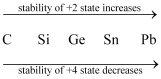
The electronic configuration of group 14 elements is ns2 np2. Therefore, the most common oxidation state exhibited by them should be +4. However, the +2 oxidation state becomes more and more common on moving down the group. C and Si mostly show the +4 state. On moving down the group, the higher oxidation state becomes less stable. This is because of the inert pair effect. Thus, although Ge, Sn, and Pb show both the +2 and + 4 states, the stability of the lower oxidation state increases and that of the higher oxidation state decreases on moving down the group.
Group 14 element
Oxidation state
C
+4
Si
+4
Ge, Sn, Pb
+2, +4
() C to Pb
The electronic configuration of group 14 elements is ns2 np2. Therefore, the most common oxidation state exhibited by them should be +4. However, the +2 oxidation state becomes more and more common on moving down the group. C and Si mostly show the +4 state. On moving down the group, the higher oxidation state becomes less stable. This is because of the inert pair effect. Thus, although Ge, Sn, and Pb show both the +2 and + 4 states, the stability of the lower oxidation state increases and that of the higher oxidation state decreases on moving down the group.
Group 14 element
Oxidation state
C
+4
Si
+4
Ge, Sn, Pb
+2, +4
-
- #1-iiC to Pb.Ans : C to Pb
The electronic configuration of group 14 elements is ns2 np2. Therefore, the most common oxidation state exhibited by them should be +4. However, the +2 oxidation state becomes more and more common on moving down the group. C and Si mostly show the +4 state. On moving down the group, the higher oxidation state becomes less stable. This is because of the inert pair effect. Thus, although Ge, Sn, and Pb show both the +2 and + 4 states, the stability of the lower oxidation state increases and that of the higher oxidation state decreases on moving down the group.
Group 14 element
Oxidation state
C
+4
Si
+4
Ge, Sn, Pb
+2, +4