NEET-XI-Biology
10: Cell Cycle and Cell Division
- #7Describe the following:
(a) synapsis (b) bivalent (c) chiasmata
Draw a diagram to illustrate your answer.
(a) synapsis (b) bivalent (c) chiasmata
Draw a diagram to illustrate your answer.
Ans : null (a) Synapsis
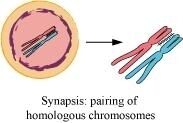
The pairing of homologous chromosomes is called synapsis. This occurs during the second stage of prophase I or zygotene.
(b) Bivalent
Bivalent or tetrad is a pair of synapsed homologous chromosomes. They are formed during the zygotene stage of prophase I of meiosis.

(c) Chiasmata
Chiasmata is the site where two non-sister chromatids of homologous chromosomes have crossed over. It represents the site of cross-over. It is formed during the diplotene stage of prophase I of meiosis.

(a) Synapsis
The pairing of homologous chromosomes is called synapsis. This occurs during the second stage of prophase I or zygotene.
(b) Bivalent
Bivalent or tetrad is a pair of synapsed homologous chromosomes. They are formed during the zygotene stage of prophase I of meiosis.
(c) Chiasmata
Chiasmata is the site where two non-sister chromatids of homologous chromosomes have crossed over. It represents the site of cross-over. It is formed during the diplotene stage of prophase I of meiosis.
- #7-asynapsisAns : Synapsis
The pairing of homologous chromosomes is called synapsis. This occurs during the second stage of prophase I or zygotene.
- #7-bbivalentAns : Bivalent
Bivalent or tetrad is a pair of synapsed homologous chromosomes. They are formed during the zygotene stage of prophase I of meiosis.
- #7-cchiasmata
Draw a diagram to illustrate your answer.
Ans : Chiasmata
Chiasmata is the site where two non-sister chromatids of homologous chromosomes have crossed over. It represents the site of cross-over. It is formed during the diplotene stage of prophase I of meiosis.