ICSE-X-Physics
Previous Year Paper year:2017
Note: Please signup/signin free to get personalized experience.
Note: Please signup/signin free to get personalized experience.
10 minutes can boost your percentage by 10%
Note: Please signup/signin free to get personalized experience.
- #ICSE Board
Class X Physics
SCIENCE Paper - I
Time: 2 hours Maximum Marks: 80
General Instructions:
Answers to this paper must be written on the paper provided separately.
You will not be allowed to write during the first 15 minutes.
This time is to be spent in reading the question paper.
The time given at the head of paper is the time allotted for writing the answers.
Section I is compulsory. Attend any four questions from Section II.
The intended marks of questions or parts of questions are given in brackets [ ].
- # [40]Section : IAttempt all questions from this section.Attempt all question from this Section.
- #1
- #1-a [2]
A brass ball is hanging from a stiff cotton thread. Draw a neat labelled diagram
showing the forces acting on the brass ball and cotton thread.Ans :Forces acting on the brass ball and thread:
Tension acts on the thread in the upward direction, while weight mg of the
ball acts downwards.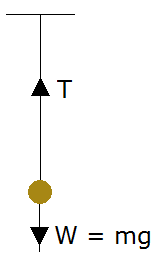
- #1-a [2]test1Ans : test2
- #1-b [2]The distance between two bodies is doubled. How is the magnitude of gravitational force between them affected?Ans : Force of gravity:
Force of gravity:
Gravitational Force : $$F= \frac{Gm_1m_2}{r^2} $$
Hence for two forces,
$$\frac{F1}{F2}= {\frac{Gm_1m_2}{r_1^2} \over \frac{Gm_1m_2}{r_2^2}} $$
Since G, m1 and m2 are same for the two conditions ,
$$\require{cancel} \frac{F1}{F2}= {\frac{\bcancel{Gm_1m_2}}{r_1^2} \over \frac{\bcancel{Gm_1m_2}}{r_2^2}} = \frac{r_2^2}{r_1^2}$$
As given ``r_= 2r_1`` , hence F2 =
$$ F2 = \frac{\cancel{r_1^2}}{(2*\cancel{ r_1)}^2} * F1= \frac{1}{4} F1 $$
Hence F2 is reduced to ``\frac {1}{4}th`` of that of original.
- #1-c [2]Why is a jack screw provided with a long arm?Ans : A jack screw is provided with a long arm in order to have the effort less than
the load. Per principle of moments:
$$(load * load arm) = (effort * effort arm) $$
hence magnitude of less effort can act on load with larger magnitude successfully.
- #1-d [2]If the power of a motor is ``\pu{100 kW}``, at what speed can it raise a load of ``\pu{50,000}``
N?Ans : Power is the product of force and velocity.
i.e. ``P = FV`` or V = \frac{P}{F} ``
$$V = \frac{\pu{100E3}}{50000} = 2 \pu{ms-1}$$
- #1-e [2]Which class of lever will always have MA > 1 and why?Ans : The mechanical advantage of the lever is the ratio of output force to input force.
A Class II lever will always have MA() > 1. This is because the load is between
the fulcrum and the effort. So, the effort arm is always bigger than the load
arm. Hence, MA = E/L > 1.
- #2
- #2-a [2]Define heat capacity and state its SI unit.Ans : Heat capacity of a body is the amount of heat energy required to raise its
temperature by 1 °C. Its SI unit is ``\pu{JK-1}``.
- #2-b [2]Why is the base of a cooking pan generally made thick?Ans : By making the base of a cooking pan thick, its thermal capacity becomes
large and it imparts sufficient heat energy at a low temperature to the food
for proper cooking. Further, it keeps the food warm for a long time after
cooking.
- #2-c [2]A solid of mass 50 g at 150 °C is placed in 100 g of water at 11 °C, when the final temperature recorded is 20 °C. Find the specific heat capacity of the solid.
(specific heat capacity of water = ``\pu{4.2 J//g}`` per``°C``)Ans : Mass of the solid, ms = 50 g
Initial temperature of the solid, ts = 150°C
Mass of water(``m_w``) = 100 g
Temperature of water(``t_w``tw) = 11°C
Final temperature of the mixture, t = 20° C
According to the principle of calorimetry,
Heat gained by water = Heat lost by the solid
``m_w * c_w *(t- t_w)= m_s * c_s *(t_w-t)``
100 *4.2*(20 -11) = 50*``c_s``*(150-20)
hence
6500*``c_w``= 3780
``c_w`` = 3780/6500 = 0.581 ``\pu{J//{gC}}``
- #2-d [2]How is the refractive index of a material related to:
- #2-d-ireal and apparent depth?Ans : Ratio of real depth to apparent depth is equal to the refractive index.
``\mu = \frac{Real-depth} {Apparent-depth}``