ICSE-VIII-Physics
06: Heat Energy Class 8 Physics
Note: Please signup/signin free to get personalized experience.
Note: Please signup/signin free to get personalized experience.
10 minutes can boost your percentage by 10%
Note: Please signup/signin free to get personalized experience.
- #4-cDuring boiling or vaporization
1. all molecules take part
2. temperature rises
3. no heat is absorbed
4. the average kinetic energy of molecules increases.
digAnsr: 1Ans :
1. all molecules take part
- #4-dThe boiling point of a liquid is increased by
1. increasing the volume of liquid
2. increasing the pressure, on liquid
3. adding ice to the liquid
4. decreasing pressure on liquid.
digAnsr: 2Ans :
2. increasing the pressure, on liquid
- #4-eTwo rods A and B of the same metal, but of length 1 m and 2 m respectively, are heated from 0°C to 100°C. Then
1. both the rods A and B elongate the same
2. the rod A elongates more than the rod B
3. the rod B elongates more than the rod A
4. the rod A elongates, but the rod B contracts.
digAnsr: 3Ans :
3. the rod B elongates more than the rod A
- #4-fTwo rods A and B of the same metal, same length, but one solid and the other hollow, are heated to the same rise in temperature. Then
1. the solid rod A expands more than the hollow rod B
2. the hollow rod B expands more than the solid rod A
3. the hollow rod B contracts, but the solid rod A expands
4. both the rods A and B expand the same.
digAnsr: 4Ans :
4. both the rods A and B expand the same.
- #4-gA given volume of alcohol and the same volume of water are heated from the room temperature to the same temperature then.
1. alcohol contracts, but water expands
2. water contracts, but alcohol expands
3. water expands more than alcohol
4. alcohol expands more than water.
digAnsr: 4Ans :
4. alcohol expands more than water.
- #4-hThe increase in length of a metal rod depends on
1. the initial length of the rod only
2. the rise in temperature only
3. the material of rod only
4. all the above three factors.
digAnsr: 4Ans :
4. all the above three factors.
- #4-iThe correct statement is
1. Iron rims are cooled before they are placed on the cart wheels.
2. A glass stopper gets tighten on warming the neck of the bottle.
3. Telephone wires sag in winter, but become tight in summer.
4. A little space is left between two rails on a railway track.
digAnsr: 4Ans :
4. A little space is left between two rails on a railway track.
- #Section : BShort/Long Answer
- Qstn #1What is matter ? What is it composed ofAns : Matter: Anything around us is a matter. Anything that has mass, occupies volume and can be felt by our senses. It is composed of molecules.
- Qstn #2Name the three states of matter and distinguish them on the basis of theirAns : Three States of Matter:
- Solid
- Liquid
- Gaseous
- Solid
- #2-ivolume, andAns : Volume:
- Solids: have least volume.
- Liquids: have definite volume.
- Gases: have maximum volume.
- Solids: have least volume.
- #2-iishapeAns : Shape:
- Solids: Have definite shape.
- Liquids: Have no definite shape.
- Gases: Have no definite shape.
- Solids: Have definite shape.
- Qstn #3Distinguish between liquid and vapour (or gas) states of matter on the basis of following factors
a) Arrangement of molecules
(b) Inter-molecular separation
(c) Inter-molecular force, and
(d) Kinetic energy of moleculesAns : Distinction between Liquid and Vapour on the basis of:
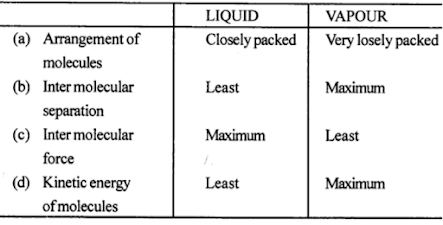
- Qstn #4What is evaporation ? Explain it on the basis of molecular motion.Ans : Evaporation: The change of liquid into its vapours at all temperature from its surface is called evaporation.
Explanation of Evaporation on the bases of molecular motion:
Molecules of liquid have more spaces, less molecular force of attraction and more K.E. than molecules of solids and can move through out the liquid.
While moving they can not escape the surface as they are being pulled inside by other molecules as there are no molecules above the surface. But when some molecules acquire sufficient K.E. (Threshold velocity), they over come the attractive forces of other molecules and escape into the open space above the liquid. These escaping molecules form the vapour of the liquid and the process called Evaporation continues till all the liquid evaporates.
- Qstn #5Do all the molecules of a liquid take part in evaporation ? If not, explain your answer.Ans : No, all the molecules of the liquid do not take part in evaporation only those molecules near the surface of liquid which acquire sufficient Kinetic energy (Threshold velocity) escape as they over come attractive forces of other molecules. Then other molecules come to the surface of the liquid and acquire more K.E. and escape the surface. This continues till all the liquid evaporates.