ICSE-VIII-Physics
06: Heat Energy Class 8 Physics
Note: Please signup/signin free to get personalized experience.
Note: Please signup/signin free to get personalized experience.
10 minutes can boost your percentage by 10%
Note: Please signup/signin free to get personalized experience.
- Qstn #6No heat is supplied to a liquid during evaporation. How does then the liquid change into its vapours ?Ans : Though no heat is supplied to the liquid but molecules near the surface of the liquid acquire sufficient kinetic energy by collisions with other liquid molecules and with this K.E. they over come the attractive forces of other molecules and change into vapours.
- Qstn #7Comment on the statement ‘evaporation is a surface phenomenon’.Ans : Change of liquid into vapours at all temperatures from the surface is called evaporation. Evaporation takes place at surface in those molecules which are at surface and have sufficient K.E. to over come attractive force due to inner surrounding molecules.
- Qstn #8Why is cooling produced when a liquid evaporates ?Ans : For changing liquid into vapours heat is needed this heat is taken from the container or surroundings and temperature of container or body itself fall and cooling is produced.
- #9-aair is blown above the liquidAns : Blowing Air on Liquid surface increase rate of evaporation: Blowing air takes away with it the molecules of liquid escaping out of the surface. To take their place, other molecules escape out from the surface of liquid.
- #9-bsurface area of liquid is increasedAns : Surface area increases the rate of evaporation: On increasing the area of the surface, number of molecules escaping out from the surface increases.
- #9-ctemperature of liquid is increased.Ans : Increase in temperature increases the rate of evaporation: Increase in temperature increases K.E.
(K.E = 1/2 Mv2). More and more molecules come to the surface of liquid hence the rate of evaporation will increase with increase in temperature.
- Qstn #10What is boiling ? Explain it on the basis of molecular motion?Ans : Boiling: The change of liquid to vapours on heating at a constant temperature is called BOILING”
K.E = Mv2: more the speed of molecules more is the kinetic energy.
Heating of the liquid increases the average K.E. of liquid molecules and molecules acquire sufficient
K.E. needed to overcome the force of attraction of other molecules. These molecules start leaving the liquid not only at the surface but also near the walls of the containing vessel and bubbles are seen on the walls of vessel. This causes the agitation in the whole of the liquid and this is called boiling.
dlt28862282554784818335">
- Qstn #11Why does bubbles appear when a liquid is heated ?Ans : When liquid is heated formation of vapours takes place which appear in the form of bubbles.
- Qstn #12What is the change in average kinetic energy of molecules of a liquid during boiling at its boiling point ?Ans : Average Kinetic Energy is the measure of temperature of body. When temperature of body increases the average kinetic energy increases and when Average Kinetic energy decreases there is decrease of body temperature and hence at boiling point average Kinetic energy increases.
- Qstn #13How is the heat energy supplied to a liquid used during boiling at a fixed temperature ?Ans : When heat is supplied, temperature of liquid rises continuously till the water starts boiling at 100°C. Once the water starts boiling, its temperature does not rise further, although heat is still being supplied. This heat is being used to change each and every water molecule into vapour.
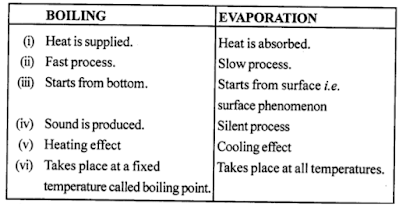
- Qstn #14Name two ways of change of liquid state to the vapour state and distinguish them.Ans : Two ways of change of liquid state to vapour state are:
i) Evaporation
(ii) Boiling.
Difference between evaporation and boiling:
- Qstn #15What do you understand by thermal expansion of a substance ?Ans : The expansion of a substance on heating is called the thermal expansion of the substance.
- Qstn #16Give two examples of the substances which expand on heating.Ans : Iron, water expand on heating.
- Qstn #17Describe an experiment to demonstrate the thermal expansion in solids.Ans : Experiment: [Gravesand’s ball and ring experiment]
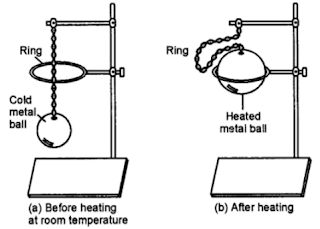
Take metallic ball and ring so that ball can pass through ring easily. Now heat the ball.
We see that heated ball cannot pass through the same ring. This is because on heating
the ball increases in size. Now on cooling the ball again it can pass through the ring.
This experiment shows that solids expand on heating and contract on cooling.