ICSE-VIII-Mathematics
16: Understanding Shapes (Including Polygons) Class 8 Maths
Note: Please signup/signin free to get personalized experience.
Note: Please signup/signin free to get personalized experience.
10 minutes can boost your percentage by 10%
Note: Please signup/signin free to get personalized experience.
- #19-iiiits exterior angle exceeds its interior angle by 60°.Ans : Let interior angle = x
Then exterior angle = x + 60
∴ x + x + 60˚ = 180˚
⇒ 2x = 180˚ - 60˚ = 120˚
⇒ x = 120˚/2 = 60˚
∴ Exterior angle = 60˚ + 60˚ = 120˚
∴ Number of sides = 360˚/120˚ = 3
- Qstn #20The sum of interior angles of a regular polygon is thrice the sum of its exterior angles. Find the number of sides in the polygon.Ans : Sum of interior angles = 3 x Sum of exterior angles
Let exterior angle = x
The interior angle = 3x
x + 3x=180°
⇒ 4x = 180°
⇒ x = 180˚/4
⇒ x = 45°
Number of sides = 360/45 = 8
- #Section : C
- Qstn #1Two angles of a quadrilateral are 89° and 113°. If the other two angles are equal; find the equal angles.Ans : Let the other angle = x°
According to given,
89° + 113° + x° + x° = 360°
⇒ 2x° = 360° - 202°
⇒ 2x° = 158°
⇒ x° = 158/2
other two angles = 79° each
- Qstn #2Two angles of a quadrilateral are 68° and 76°. If the other two angles are in the ratio 5:7; find the measure of each of them.Ans : Two angles are 68° and 76°
Let other two angles be 5x and 7x
68° + 76°+ 5x + 7x = 360°
⇒ 12x + 144° = 360°
⇒ 12x = 360° - 144°
⇒ 12x = 216°
⇒ x = 18°
angles are 5x and 7x
i.e. 5×18° and 7×18° i.e. 90° and 126°
- Qstn #3Angles of a quadrilateral are (4x)°, 5(x + 2)°, (7x - 20)° and 6(x + 3)°. Find : (i) the value of x. (ii) each angle of the quadrilateral.Ans : Angles of quadrilateral are,
(4x)˚, 5(x + 2)˚, (7x - 20)˚ and 6(x + 3)˚
∴ 4x + 5(x + 2) + (7x - 20)+ 6(x + 3) = 360˚
⇒ 4x + 5x + 10 + 7x - 20 + 6x + 18 = 360˚
⇒ 22x + 8 = 360˚
⇒ 22x = 360˚ - 8˚
⇒ 22x = 352˚
⇒ x = 16˚
Hence angle are,
(4x)˚ = (4 × 16)˚ = 64˚
5(x + 2)˚ = 5(16 + 2)˚ = 90˚
(7x - 20)˚ = (7 × 16 - 20)˚ = 92˚
6(x + 3)˚ = 6(16 + 3) = 114˚
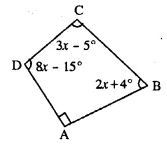
- Qstn #4Use the information given in the following figure to find : (i) x (ii) ∠B and ∠C
 Answer
∵ ∠A = 90˚ (Given)
∠B = (2x + 4˚)
∠C = (3x - 5˚)
∠D = (8x - 15˚)
∠A + ∠B + ∠C + ∠D = 360˚
90˚ + (2x + 4) + (3x - 5) + (8x - 15) = 360
⇒ 90 + 2x + 4 + 3x - 5 + 8x - 15 = 360
⇒ 74˚ + 13x = 360˚
⇒ 13x = 360˚ - 74˚
⇒ 13x = 286˚
⇒ x = 22˚
∵ ∠B = 2x + 4 = 2×22˚ + 4 = 48˚
∠C = 3x - 5 = 3 × 22˚ - 5 = 61˚
Hence (i)22˚ (ii) ∠B = 48˚, ∠C = 61˚
- Qstn #5In quadrilateral ABCD, side AB is parallel to side DC. If ∠A : ∠D = 1 : 2 and ∠C : ∠B = 4 : 5 (i) Calculate each angle of the quadrilateral. (ii) Assign a special name to quadrilateral ABCDAns :
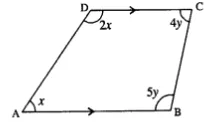
∵ ∠A : ∠D = 1 : 2
Let ∠A = x and ∠B = 2x
∵ ∠C : ∠B = 4 : 5
Let ∠C = 4y and ∠B = 5y
∵ AB ∥ DC
∴ ∠A + ∠D = 180˚
x + 2x = 180˚
⇒ 3x = 180˚
⇒ x = 60˚
∴ A = 60˚
∠D = 2x = 2 × 60˚ = 120˚
Again ∠B + ∠C = 180˚
5y + 4y = 180˚
⇒ 9y = 180˚
⇒ y = 20˚
∴ ∠B = 5y = 5 × 20˚ = 100˚
∠C = 4y = 4 × 20˚ = 80˚
Hence ∠A = 60˚ : ∠B = 100˚ : ∠C = 80˚ ∠D = 120˚
(iii) Quadrilateral ABCD is a trapezium because one pair of opposite side is parallel.
- #6-ixAns : In Quadrilateral ABCD,
x + 4x + 3x + 4x + 48° = 360°
⇒ 12x = 360° - 48°
⇒ 12x = 312
⇒ x = 312/12 = 26˚
- #6-ii∠ABCAns : ∠ABC = 4x
4 × 26 = 104˚
- #6-iii∠ACDAns : ∠ACD = 180˚ - 4x - 48˚
= 180˚ - 4×26 - 48 ˚
= 180˚ - 104˚ - 48˚
= 180˚ - 152˚
= 28˚
- Qstn #7Given : In quadrilateral ABCD ; ∠C = 64°, ∠D = ∠C - 8° ; ∠A = 5(a + 2)° and ∠B = 2(2a + 7)°.
Calculate ∠A.Ans : ∠C = 64° (Given)
∠D = ∠C - 8° = 64° - 8° = 56°
∠A = 5(a + 2)°
∠B = 2(2a + 7)°
Now, ∠A + ∠B + ∠C + ∠D = 360°
5(a + 2)° + 2(2a + 7)° + 64° + 56° = 360°
⇒ 5a + 10 + 4a + 14° + 64° + 56° = 360°
⇒ 9a + 144° = 360°
⇒ 9a = 360° - 144°
⇒ 9a = 216°
⇒ a = 24°
∠A = 5 (a + 2) = 5(24 + 2) = 130°
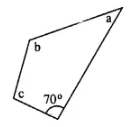
- Qstn #8In the given figure : ∠b = 2a + 15 and ∠c = 3a + 5; find the values of b and c.
 Answer
Stun of angles of quadrilateral = 360°
70° + a + 2a + 15 + 3a + 5 = 360°
⇒ 6a + 90° = 360°
⇒ 6a = 270°
⇒ a = 45°
b = 2a + 15 = 2×45 + 15 = 105°
c = 3a + 5 = 3×45 + 5 = 140°
Hence ∠b and ∠c are 105° and 140°
- Qstn #9Three angles of a quadrilateral are equal. If the fourth angle is 69°; find the measure of equal angles.Ans : Let each equal angle be x°
x + x + x + 69° = 360°
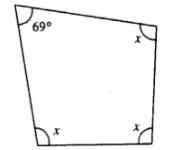
3x = 360° - 69
⇒ 3x = 291
⇒ x = 97°
Each, equal angle = 97°