CBSE-XI-Physics
05: Newton's Laws of Motion
Note: Please signup/signin free to get personalized experience.
Note: Please signup/signin free to get personalized experience.
10 minutes can boost your percentage by 10%
Note: Please signup/signin free to get personalized experience.
- #Section : iPage No 76
- Qstn #1The apparent weight of an object increases in an elevator while accelerating upward. A person sells peanuts using a beam balance in an elevator. Will he gain more if the elevator is accelerating up?Ans : No, the accelerating elevator will affect the weight of both sides of the beam balance. So, the net effect of the accelerating elevator cancels out, and we get the actual mass.
- Qstn #2A boy puts a heavy box of mass M on his head and jumps from the top of a multi-storied building to the ground. What is the force exerted by the box on the boy’s head during his free fall? Does the force greatly increase during the period he balances himself after striking the ground?Ans : During free fall:
Acceleration of the boy = Acceleration of mass M = g
Acceleration of mass M w.r.t. boy, a = 0
So, the force exerted by the box on the boy's head = M × a = 0
Yes, the force greatly increases during the period he balances himself after striking the ground because of the weight of the box.
- #3-aa car moving at constant velocity andAns : In the car, the path of the coin will be vertically downward because the only force acting on the coin is gravity in the downward direction.
- #3-bin a free falling elevator.Ans : In a free falling elevator, the coin as well as the person will be in a condition of weightlessness. So, the coin will remain stationary w.r.t. the person.
- Qstn #4Is it possible for a particle to describe a curved path if no force acts on it? Does your answer depend on the frame of reference chosen to view the particle?Ans : If no force acts on the particle it cannot change its direction. So, it is not possible for a particle to describe a curved path if no force acts on it.
Yes, the answer depends on the frame of reference chosen to view the particle if the frame of reference describes a curved path.
- Qstn #5You are travelling in a car. The driver suddenly applies the brakes and you are pushed forward. Why does this happen?Ans : We are pushed forward because of the inertia of motion, as our body opposes the sudden change.
- Qstn #6It is sometimes heard that the inertial frame of reference is only an ideal concept and no such inertial frame actually exists. Comment.Ans : We can't find a body whose acceleration is zero with respect to all other bodies in the universe because every body in the universe is moving with respect to other bodies.As we live on earth which itself is accelerates due to its revolution around the sun and spinning about its own axis, so whatever observations and measurements ,we make , are w.r.t to earth which itself is not an inertial frame.Similarly all other planets are also in motion around the sun so tdeally no inertial frame is possible.
- Qstn #7An object is placed far away from all the objects that can exert force on it. A frame of reference is constructed by taking the origin and axes fixed in this object. Will the frame be necessarily inertial?Ans : Yes, if the force on the object is zero, its acceleration w.r.t. all the other objects will we zero. So, the frame will necessarily be an inertial frame.
- Qstn #8The figure shows a light spring balance connected to two blocks of mass 20 kg each. The graduations in the balance measure the tension in the spring.
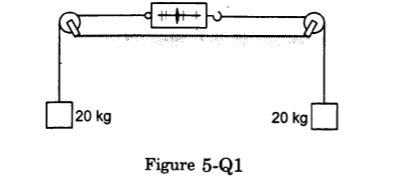
- #8-aWhat is the reading of the balance?Ans :
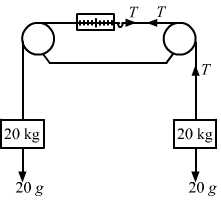
The reading of the balance = Tension in the string
And tension in the string = 20g
So, the reading of the balance = 20g = 200 N
- #8-bWill the reading change if the balance is heavy, say 2.0 kg?Ans : If the balance is heavy, the reading will not change because the weight of spring balance does not affect the tension in the string.
- #8-cWhat will happen if the spring is light but the blocks have unequal masses?Ans : If the blocks have unequal masses, the spring balance will accelerate towards the heavy block with an acceleration a. Then the reading will be equal to the tension in the string.
Suppose m1 > m2.
Then tension in the string,
`` T=\frac{2{m}_{1}{m}_{2}g}{{m}_{1}+{m}_{2}}``