CBSE-XI-Physics
05: Newton's Laws of Motion
Note: Please signup/signin free to get personalized experience.
Note: Please signup/signin free to get personalized experience.
10 minutes can boost your percentage by 10%
Note: Please signup/signin free to get personalized experience.
- Qstn #9The acceleration of a particle is zero, as measured from an inertial frame of reference. Can we conclude that no force acts on the particle?Ans : No. The acceleration of the particle can also be zero if the vector sum of all the forces is zero, i.e. no net force acts on the particle.
- Qstn #10Suppose you are running fast in a field and suddenly find a snake in front of you. You stop quickly. Which force is responsible for your deceleration?Ans : The force of friction acting between my feet and ground is responsible for my deceleration.
- Qstn #11If you jump barefoot on a hard surface, your legs are injured. But they are not injured if you jump on a soft surface like sand or pillow. Why?Ans : In both the cases, change in momentum is same but the time interval during which momentum changes to zero is less in the first case. So, by `` F=\frac{dP}{dt}`` , force in the first case will be more. That's why we are injured when we jump barefoot on a hard surface.
- Qstn #12According to Newton’s third law, each team pulls the opposite team with equal force in a tug of war. Then, why does one team win and the other lose?Ans : The forces on the rope must be equal and opposite, according to Newton's third law. But not all the forces acting on each team are equal. The friction between one team and the ground does not depend on the other team and can be larger on one side than on the other. In addition, the grips on the rope need not be equal and opposite. Thus, the net force acting on each team from all sources need not be equal.
- Qstn #13A spy jumps from an airplane with his parachute. The spy accelerates downward for some time when the parachute opens. The acceleration is suddenly checked and the spy slowly falls to the ground. Explain the action of the parachute in checking the acceleration.Ans : Air applies a velocity-dependent force on the parachute in upward direction when the parachute opens. This force opposes the gravitational force acting on the spy. Hence, the net force in the downward direction decreases and the spy decelerates.
- Qstn #14Consider a book lying on a table. The weight of the book and the normal force by the table on the book are equal in magnitude and opposite in direction. Is this an example of Newton’s third law?Ans : Yes, this is an example of Newton's third law of motion, which sates that every action has an equal and opposite reaction.
- Qstn #15Two blocks of unequal masses are tied by a spring. The blocks are pulled stretching the spring slightly and the system is released on a frictionless horizontal platform. Are the forces due to the spring on the two blocks equal and opposite? If yes, is it an example of Newton’s third law?Ans : Yes, the forces due to the spring on the two blocks are equal and opposite.
But it's not an example of Newton's third law because there are three objects (2 blocks + 1 spring). Spring force on one block and force by the same block on the spring is an action-reaction pair.
- Qstn #16When a train starts, the head of a standing passenger seems to be pushed backward. Analyse the situation from the ground frame. Does it really go backward? Coming back to the train frame, how do you explain the backward movement of the head on the basis of Newton’s laws?Ans : No, w.r.t. the ground frame, the person's head is not really pushed backward.
As the train moves, the lower portion of the passenger's body starts moving with the train, but the upper portion tries to be in rest according to Newton's first law and hence, the passenger seems to be pushed backward.
- Qstn #17A plumb bob is hung from the ceiling of a train compartment. If the train moves with an acceleration ‘a‘ along a straight horizontal track , the string supporting the bob makes an angle tan-1 (a/g) with the normal to the ceiling. Suppose the train moves on an inclined straight track with uniform velocity. If the angle of incline is tan-1 (a/g), the string again makes the same angle with the normal to the ceiling. Can a person sitting inside the compartment tell by looking at the plumb line whether the train is accelerating on a horizontal straight track or moving on an incline? If yes, how? If not, then suggest a method to do so.Ans : No, a person sitting inside the compartment can't tell just by looking at the plumb line whether the train is accelerating on a horizontal straight track or moving on an incline.
When the train is accelerating along the horizontal, the tension in the string is `` m\sqrt{{g}^{2}+{a}^{2}}``; when it is moving on the inclined plane, the tension is mg. So, by measuring the tension in the string we can differentiate between the two cases.
- #Section : ii
- Qstn #1A body of weight w1 is suspended from the ceiling of a room by a chain of weight w2. The ceiling pulls the chain by a force
(a) w1
(b) w2
(c) w1 + w2
(d)
w1+w22digAnsr: cAns : (c) w1 + w2

From the free-body diagram,
(w1 + w2) - N = 0
N = w1 + w2
The ceiling pulls the chain by a force (w1 + w2).
- Qstn #2When a horse pulls a cart, the force that helps the horse to move forward is the force exerted by
(a) the cart on the horse
(b) the ground on the horse
(c) the ground on the cart
(d) the horse on the grounddigAnsr: bAns : (b) the ground on the horse
The horse pushes the ground in the backward direction and, in turn, the ground pushes the horse in the forward direction, according to Newton's third law of motion.
- Qstn #3A car accelerates on a horizontal road due to the force exerted by
(a) the engine of the car
(b) the driver of the car
(c) the earth
(d) the roaddigAnsr: dAns : (d) the road
The car pushes the ground in the backward direction and according to the third law of motion, reaction force of the ground in the forward direction acts on the car.
- Qstn #4A block of mass 10 kg is suspended from two light spring balances, as shown in the figure.
Figure
(a) Both the scales will read 10 kg.
(b) Both the scales will read 5 kg.
(c) The upper scale will read 10 kg and the lower zero.
(d) The readings may be anything but their sums will be 10 kg.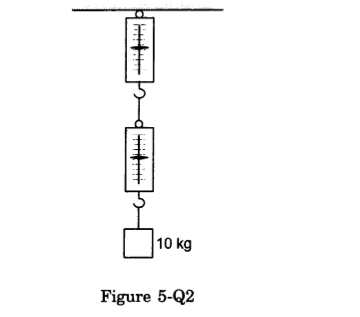 digAnsr: aAns : (a) Both the scales will read 10 kg.

From the free-body diagram,
K1x1 = mg = 10`` \times ``9.8 = 98 N
K2x2 = K1x1
So, K1x1 = K2x2 = 98 N
Therefore, both the spring balances will read the same mass, i.e. 10 kg.
- Qstn #5A block of mass m is placed on a smooth inclined plane of inclination θ with the horizontal. The force exerted by the plane on the block has a magnitude
(a) mg
(b) mg/cosθ
(c) mg cosθ
(d) mg tanθdigAnsr: cAns : (c) mg cosθ

From the free-body diagram,
N = mg cosθ
Normal force exerted by the plane on the block is mg cosθ.