NEET-XII-Chemistry
01: The Solid State
- #Section : IIPage
- Qstn #1Define the term ‘amorphous’. Give a few examples of amorphous solids.
Ans : Amorphous solids are the solids whose constituent particles are of irregular shapes and have short range order. These solids are isotropic in nature and melt over a range of temperature. Therefore, amorphous solids are sometimes called pseudo solids or super cooled liquids. They do not have definite heat of fusion. When cut with a sharp-edged tool, they cut into two pieces with irregular surfaces. Examples of amorphous solids include glass, rubber, and plastic.
- Qstn #2What makes a glass different from a solid such as quartz? Under what conditions could quartz be converted into glass?
Ans : The arrangement of the constituent particles makes glass different from quartz. In glass, the constituent particles have short range order, but in quartz, the constituent particles have both long range and short range orders.
Quartz can be converted into glass by heating and then cooling it rapidly.
- Qstn #3Classify each of the following solids as ionic, metallic, molecular, network (covalent) or amorphous.
Ans : Ionic → (ii) Ammonium phosphate (NH4)3PO4, (x) LiBr
Metallic → (viii) Brass, (ix) Rb
Molecular → (i) Tetra phosphorus decoxide (P4O10), (iv) I2, (v) P4.
Covalent (network) → (iii) SiC, (vii) Graphite, (xi) Si
Amorphous → (vi) Plastic
- #4
- Qstn #4-iWhat is meant by the term ‘coordination number’?Ans : The number of nearest neighbours of any constituent particle present in the crystal lattice is called its coordination number.
- #4-ain a cubic close-packed structure?Ans : in a cubic close-packed structure is 12, and
- #4-bin a body-centred cubic structure?Ans : in a body-centred cubic structure is 8
- Qstn #5How can you determine the atomic mass of an unknown metal if you know its density and the dimension of its unit cell? Explain.
Ans : By knowing the density of an unknown metal and the dimension of its unit cell, the atomic mass of the metal can be determined.
Let ‘a’ be the edge length of a unit cell of a crystal, ‘d’ be the density of the metal, ‘m’ be the mass of one atom of the metal and ‘z’ be the number of atoms in the unit cell.
Now, density of the unit cell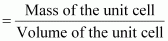

[Since mass of the unit cell = Number of atoms in the unit cell × mass of one atom]
[Volume of the unit cell = (Edge length of the cubic unit cell)3]
From equation (i), we have:

Now, mass of one atom of metal (m)
Therefore,
If the edge lengths are different (say a, b and c), then equation (ii) becomes:
M=d(abc)NAz(iv)
From equations (iii) and (iv), we can determine the atomic mass of the unknown metal.