NEET-XI-Biology
22: Chemical Coordination and Integration
Note: Please signup/signin free to get personalized experience.
Note: Please signup/signin free to get personalized experience.
10 minutes can boost your percentage by 10%
No item to list.
Note: Please signup/signin free to get personalized experience.
- #5-dAndrogensAns : Androgens - The leydig cells of testis produce androgens such as testosterone. Testosterone is a male sex hormone that regulates the development of secondary sex characteristics such as facial hair, hoarse voice, development of reproductive organ, etc. Androgens also regulate the development, maturation, and functions of various male accessory organs such as epididymis and prostate glands. It stimulates spermatogenesis and formation of mature sperms. It also influences male sexual behaviour.
- #5-eEstrogensAns : Estrogens- Estrogen is the female sex hormone that controls the development of secondary sex characteristics such as enlargement of breasts and development of female reproductive organs. It plays a role in the development, growth and maturation of female secondary characteristics. It also helps in the development of growing ovarian follicles. It influences female sexual behaviour.
- #5-fInsulin and GlucagonAns : Insulin and glucagon - Glucagon and insulin are secreted by cells of pancreas. They regulate the blood glucose level in the body. α-cells secrete glucagon that maintain a normal blood glucose level in the body, whereas β-cells secrete insulin that regulates the storage of glycogen in the liver.
Function of insulin - Insulin stimulates glycogenesis (conversion of glucose to glycogen). The rapid conversion of glucose from the blood to glycogen in hepatocytes and adipocytes results into a decreased glucose level. Insulin also prevents the formation of glucose from non-carbohydrate substances such as proteins and fats. Hence, it acts as a regulator of carbohydrate metabolism.
Function of glucagon - The main function of the glucagon is to increase the level of glucose when there is a deficiency of glucose in the body. This process is known as glycogenolysis.
- #6-aHyperglycemic hormone and hypoglycemic hormoneAns : Hyperglycemic hormone and hypoglycemic hormone:
Hyperglycemic hormone is glucagon, while hypoglycemic hormone is insulin.
- #6-bHypercalcemic hormoneAns : Hypercalcemic hormone:
Parathyroid hormone (PTH) is hypercalcemic hormone.
- #6-cGonadotrophic hormonesAns : Gonadotrophic hormones:
Luteinizing hormone and follicle stimulating hormones are examples of gonadotrophic hormone.
- #6-dProgestational hormoneAns : Progestational hormone:
Progesterone is a progestational hormone.
- #6-eBlood pressure lowering hormoneAns : Blood pressure lowering hormone:
Nor-adrenalin is a blood pressure lowering hormone.
- #6-fAndrogens and estrogensAns : Androgens and estrogens:
Testosterone is an example of androgen, while an example of estrogen is estradiol.
- #7-aDiabetes mellitus
(b) Goitre
(c) Cretinism
(b) Goitre
(c) CretinismAns : Diabetes mellitus is characterized by abnormally high glucose levels in the blood due to the deficiency of hormone, called insulin.
(b) Goitre is characterised by an abnormal enlargement of the thyroid gland due to the deficiency of thyroxin hormone in the body.
(c) Cretinism is characterized by stunted growth in the baby due to the deficiency of thyroid hormone in the body.
(b) Goitre is characterised by an abnormal enlargement of the thyroid gland due to the deficiency of thyroxin hormone in the body.
(c) Cretinism is characterized by stunted growth in the baby due to the deficiency of thyroid hormone in the body.
- #7-bGoitreAns : Goitre is characterised by an abnormal enlargement of the thyroid gland due to the deficiency of thyroxin hormone in the body.
- #7-cCretinismAns : Cretinism is characterized by stunted growth in the baby due to the deficiency of thyroid hormone in the body.
- Qstn #8Briefly mention the mechanism of action of FSH.
Ans : Follicle stimulating hormone (FSH) is secreted by the pars distalis region of the anterior pituitary.
It regulates the development, growth, and reproductive processes of the human body. In the ovary, FSH stimulates the growth and maturation of ovarian follicle. As the follicle grows and matures, it releases an inhibitory hormone known as inhibin that ends the process of FSH production.
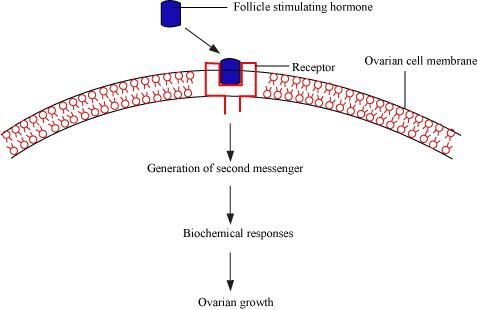
Action of FSH: Follicle stimulating hormone produces its effect by binding to its specific receptors present on the ovarian cell membrane.
Binding of FSH hormone to its receptor leads to the formation of hormone receptor complex. The formation of this complex leads to biochemical changes in the ovarian follicle, present in the ovarian. The ovarian follicles mature and release a mature ovum in the fallopian tube for fertilization.