NEET-XI-Biology
16: Digestion and Absorption
Note: Please signup/signin free to get personalized experience.
Note: Please signup/signin free to get personalized experience.
10 minutes can boost your percentage by 10%
No item to list.
Note: Please signup/signin free to get personalized experience.
- Qstn #8Describe the digestive role of chymotrypsin. What two other digestive enzymes of the same category are secreted by its source gland?
Ans : The enzyme trypsin (present in the pancreatic juice) activates the inactive enzyme chymotrypsinogen into chymotrypsin.
Chymotrypsinogen.gif) Chymotrypsin
Chymotrypsin
(Inactive) (Active)
The activated chymotrypsin plays an important role in the further breakdown of the partially-hydrolysed proteins.
Proteins.gif) Peptides
Peptides
The other digestive enzymes of the same category are trypsinogen and carboxypeptidase. These are secreted by the same source-gland, pancreas.
Trypsinogen is present in an inactive form in the pancreatic juice. The enzyme enterokinase - secreted by the intestinal mucosa - activates trypsinogen into trypsin.
Trypsinogen.gif) Trypsin + Inactive peptide
Trypsin + Inactive peptide
The activated trypsin then further hydrolyses the remaining trypsinogen and activates other pancreatic enzymes such as chymotrypsinogen and carboxypeptidase. Trypsin also helps in breaking down proteins into peptides.
Proteins.gif) Peptides
Peptides
Carboxypeptidases act on the carboxyl end of the peptide chain and help in releasing the last amino acids.
Peptides.gif) Small peptide chain + Amino acids
Small peptide chain + Amino acids
- Qstn #9How are polysaccharides and disaccharides digested?
Ans : The digestion of carbohydrates takes place in the mouth and the small intestine region of the alimentary canal. The enzymes that act on carbohydrates are collectively known as carbohydrases.
Digestion in the mouth:
As food enters the mouth, it gets mixed with saliva. Saliva - secreted by the salivary glands - contains a digestive enzyme called salivary amylase. This enzyme breaks down starch into sugar at pH 6.8.
Starch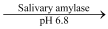 Maltose + Isomaltose + Limit dextrins
Salivary amylase continues to act in the oesophagus, but its action stops in the stomach as the contents become acidic. Hence, carbohydrate-digestion stops in the stomach.
Digestion in the small intestine:
Carbohydrate-digestion is resumed in the small intestine. Here, the food gets mixed with the pancreatic juice and the intestinal juice. Pancreatic juice contains the pancreatic amylase that hydrolyses the polysaccharides into disaccharides.
Starch Disaccharides
(Polysaccharides)
Similarly, the intestinal juice contains a variety of enzymes (disaccharidases such as maltase, lactase, sucrase, etc.). These disaccharidases help in the digestion of disaccharides. The digestion of carbohydrates is completed in the small intestine.
Maltose 2Glucose
Lactose Glucose + Galactose
Sucrose Glucose + Fructose
- Qstn #10What would happen if HCl were not secreted in the stomach?
Ans : Hydrochloric acid is secreted by the glands present on the stomach walls. It dissolves bits of food and creates an acidic medium. The acidic medium allows pepsinogen to be converted into pepsin. Pepsin plays an important role in the digestion of proteins. Therefore, if HCl were not secreted in the stomach, then pepsin would not be activated. This would affect protein digestion. A pH of about 1.8 is necessary for proteins to be digested. This pH is achieved by HCl.
- Qstn #11How does butter in your food gets digested and absorbed in the body?
Ans : Digestion of fats:
Butter is a fat product and gets digested in the small intestine. The bile juice secreted by the liver contains bile salts that break down large fat globules into smaller globules, so as to increase their surface area for the action of lipase. This process is referred to as emulsification of fats.
After this, the pancreatic lipase present in the pancreatic juice and the intestinal lipase present in the intestinal juice hydrolyse the fat molecules into triglycerides, diglycerides, monoglycerides, and ultimately into glycerol.
Fats Triglycerides + Diglycerides
Diglycerides and monoglycerides Fatty acids + Glycerol
Absorption of fats:
Fat absorption is an active process. During fat digestion, fats are hydrolysed into fatty acids and glycerol. However, since these are water insoluble, they cannot be directly absorbed by the blood. Hence, they are first incorporated into small droplets called micelles and then transported into the villi of the intestinal mucosa.
They are then reformed into small microscopic particles called chylomicrons, which are small, protein-coated fat globules. These chylomicrons are transported to the lymph vessels in the villi. From the lymph vessels, the absorbed food is finally released into the blood stream and from the blood stream, to each and every cell of the body.
- Qstn #12Discuss the main steps in the digestion of proteins as the food passes through different parts of the alimentary canal.
Ans : The digestion of proteins begins in the stomach and is completed in the small intestine. The enzymes that act on proteins are known as proteases.
Digestion in the stomach:
The digestive juice secreted in the gastric glands present on the stomach walls is called gastric juice. The main components of gastric juice are HCl, pepsinogen, and rennin. The food that enters the stomach becomes acidic on mixing with this gastric juice.
The acidic medium converts inactive pepsinogen into active pepsin. The active pepsin then converts proteins into proteases and peptides.
Proteins
 Proteases + Peptides
The enzyme rennin plays an important role in the coagulation of milk.
Digestion in the small intestine:
The food from the stomach is acted upon by three enzymes present in the small intestine - pancreatic juice, intestinal juice (known as succus entericus), and bile juice.
Action of pancreatic juice
Pancreatic juice contains a variety of inactive enzymes such as trypsinogen, chymotrypsinogen, and carboxypeptidases. The enzymes are present in an inactivated state. The enzyme enterokinase secreted by the intestinal mucosa activates trypsinogen into trypsin.
Trypsinogen
.gif) Trypsin + Inactive peptide
Trypsin + Inactive peptide
The activated trypsin then activates the other enzymes of pancreatic juice.
Chymotrypsinogen is a proteolytic enzyme that breaks down proteins into peptides.
Chymotrypsinogen
.gif) Chymotrypsin
Chymotrypsin
Proteins
.gif) Peptides
Peptides
Carboxypeptidases act on the carboxyl end of the peptide chain and help in releasing the last amino acids.
Peptides
.gif) Smaller peptide chain + Amino acids
Smaller peptide chain + Amino acids
Action of bile juice
Bile juice has bile salts such as bilirubin and biliverdin which break down large, fat globules into smaller globules so that pancreatic enzymes can easily act on them. This process is known as emulsification of fats. Bile juice also makes the medium alkaline and activates lipase. Lipase then breaks down fats into diglycerides and monoglycerides.
Action of intestinal juice
Intestinal juice contains a variety of enzymes. Pancreatic amylase digests polysaccharides into disaccharides. Disaccharidases such as maltase, lactase, sucrase, etc., further digest the disaccharides.
The proteases hydrolyse peptides into dipeptides and finally into amino acids.
Dipeptides
 Amino acids
Pancreatic lipase breaks down fats into diglycerides and monoglycerides.
The nucleases break down nucleic acids into nucleotides and nucleosides.
- Qstn #13Explain the term thecodont and diphyodont.
Ans : T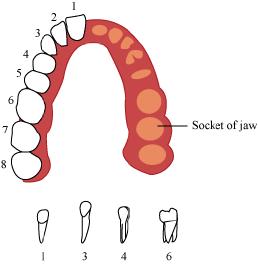 hecodont is a type of dentition in which the teeth are embedded in the deep sockets of the jaw bone. Ankylosis is absent and the roots are cylindrical.
Examples include living crocodilians and mammals.
Diphyodont is a type of dentition in which two successive sets of teeth are developed during the lifetime of the organism. The first set of teeth is deciduous and the other set is permanent.
The deciduous set of teeth is replaced by the permanent adult teeth.
This type of dentition can be seen in humans.
- Qstn #14Name different types of teeth and their number in an adult human.
Ans : There are four different types of teeth in an adult human. They are as follows:
(i) Incisors
The eight teeth in the front are incisors. There are four incisors each in the upper jaw and the lower jaw. They are meant for cutting.
(ii) Canines
The pointy teeth on either side of the incisors are canines. They are four in number, two each placed in the upper jaw and the lower jaw. They are meant for tearing.
(iii) Premolars
They are present next to the canines. They are eight in number, four each placed in the upper jaw and the lower jaw. They are meant for grinding.
(iv) Molars
They are present at the end of the jaw, next to the premolars. There are twelve molars, six each placed in the upper jaw and the lower jaw.
Hence, the dental formula in humans is.gif)
This means each half of the upper jaw and the lower jaw has 2 incisors, 1 canine, 2 premolars, and 3 molars. Hence, an adult human has 32 permanent teeth.
- Qstn #15What are the functions of liver?
Ans : Liver is the largest and heaviest internal organ of the body. It is not directly involved in digestion, but secretes digestive juices. It secretes bile which plays a major role in the emulsification of fats.