NEET-XI-Biology
15: Plant Growth and Development
Note: Please signup/signin free to get personalized experience.
Note: Please signup/signin free to get personalized experience.
10 minutes can boost your percentage by 10%
No item to list.
Note: Please signup/signin free to get personalized experience.
- #3-cSigmoid growth curveAns : Sigmoid growth curve
The growth of living organisms in their natural environment is characterised by an S-shaped curve called sigmoid growth curve. This curve is divided into three phases - lag phase, log phase or exponential phase of rapid growth, and stationary phase.
E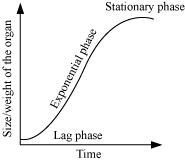 xponential growth can be expressed as:

Where,
W1 = Final size
W0 = Initial size
r = Growth rate
t= Time of growth
e = Base of natural logarithms
- #3-dAbsolute and relative growth ratesAns : Absolute and relative growth rates
Absolute growth rate refers to the measurement and comparison of total growth per unit time.
Relative growth rate refers to the growth of a particular system per unit time, expressed on a common basis.
- Qstn #4List five main groups of natural plant growth regulators. Write a note on discovery, physiological functions and agricultural/horticultural applications of any one of them.
Ans : Plant growth regulators are the chemical molecules secreted by plants affecting the physiological attributes of a plant. There are five main plant growth regulators. These are:
(i) Auxins
(ii) Gibberellic acid
(iii) Cytokinins
(iv) Ethylene
(v) Abscisic acid
(i) Auxins
Discovery:
The first observations regarding the effects of auxins were made by Charles Darwin and Francis Darwin wherein they saw the coleoptiles of canary gross bending toward a unilateral source of light.
It was concluded after a series of experiments that some substance produced at the tip of coleoptiles was responsible for the bending. Finally, this substance was extracted as auxins from the tips of coleoptiles in oat seedlings.
Physiological functions:
1. They control plant cell-growth.
2. They cause the phenomenon of apical dominance.
3. They control division in the vascular cambium and xylem differentiation.
4. They induce parthenocarpy and prevent abscission of leaves and fruits.
Horticultural applications:
1. They are used as the rooting hormones in stem cuttings.
2. 2-4 D is used weedicide to kill broadleaf, dicotyledonous weeds.
3. They induce parthenocarpy in tomatoes.
4. They promote flowering in pineapple and litchi.
(ii) Gibberellic acid
Discovery:
Bakane or the “foolish rice seedling” disease was first observed by Japanese farmers. In this disease, rice seedlings appear to grow taller than natural plants, and become slender and pale green. Later, after several experiments, it was found that this condition was caused by the infection from a certain fungus Gibberella fujikuroi. The active substance was isolated and identified as gibberellic acid.
Physiological functions:
1. It causes elongation of internodes.
2. It promotes bolting in rosette plants.
3. It helps in inducing seed germination by breaking seed dormancy and initiating the synthesis of hydrolases enzymes for digesting reserve food.
Horticultural applications:
1. It helps in increasing the sugar content in sugarcane by increasing the length of the internodes.
2. It increases the length of grape stalks.
3. It improves the shape of apple.
4. It delays senescence.
5. It hastens maturity and induces seed-production in juvenile conifers.
(iii) Cytokinins
Discovery:
Through their experimental observations, F. Skoog and his co-workers found that the tobacco callus differentiated when extracts of vascular tissues, yeast extract, coconut milk, or DNA were added to the culture medium. This led to the discovery of cytokinins.
Physiological functions:
1. They promote the growth of lateral branches by inhibiting apical dominance.
2. They help in the production of new leaves, chloroplasts, and adventitious shoots.
3. They help in delaying senescence by promoting nutrient mobilisation.
Horticultural applications:
1. They are used for preventing apical dominance.
2. They are used for delaying senescence in leaves.
(iv) Ethylene
Discovery:
It was observed that unripe bananas ripened faster when stored with ripe bananas. Later, the substance promoting the ripening was found to be ethylene.
Physiological functions:
1. It helps in breaking seed and bud dormancy.
2. It promotes rapid internode-elongation in deep-water rice plants.
3. It promotes root-growth and formation of root hairs.
4. It promotes senescence and abscission of leaves and flowers.
5. It hastens the respiration rate in fruits and enhances fruit ripening.
Horticultural applications:
1. It is used to initiate flowering and synchronising the fruit set in pineapples.
2. It induces flowering in mango.
3. Ethephon is used to ripen the fruits in tomatoes and apples, and accelerate the abscission of flowers and leaves in cotton, cherry, and walnut.
4. It promotes the number of female flowers in cucumbers.
(v) Abscisic acid
Discovery:
During the mid 1960s, inhibitor-B, abscission II, and dormin were discovered by three independent researchers. These were later on found to be chemically similar and were thereafter called ABA (Abscisic acid).
Physiological functions:
1. It acts as an inhibitor to plant metabolism.
2. It stimulates stomatal closure during water stress.
3. It induces seed dormancy.
4. It induces abscission of leaves, fruits, and flowers.
Horticultural application:
It induces seed dormancy in stored seeds.
- Qstn #5What do you understand by photoperiodism and vernalisation? Describe their significance.
Ans : Photoperiodism refers to the response of plants with respect to the duration of light (i.e., period of day and night). On the basis of its response to the duration of light, a plant is classified as a short-day plant, a long-day plant, or a day-neutral plant. Short-day plants flower when they are exposed to light for a period less than the critical day-length (for example: Chrysanthemum). Long-day plants flower when they are exposed to light for a period more than the critical day-length (for example: radish). When no marked correlation is observed between the duration of exposure to light and the flowering response, plants are termed as day-neutral plants (for example: tomato).
It is hypothesised that the hormonal substance responsible for flowering is formed in the leaves, subsequently migrating to the shoot apices and modifying them into flowering apices. Photoperiodism helps in studying the response of flowering in various crop plants with respect to the duration of exposure to light.
Vernalisation is the cold-induced flowering in plants. In some plants (such as the winter varieties of wheat and rye and biennials such as carrot and cabbage), exposure to low temperature is necessary for flowering to be induced. The winter varieties of rye and wheat are planted in autumn. They remain in the seedling stage during winters and flower during summers. However, when these varieties are sown in spring, they fail to flower. Similar response is seen in cabbage and radish.
- Qstn #6Why is Abscisic acid also known as stress hormone?
Ans : Abscisic acid is called stress hormones as it induces various responses in plants against stress conditions.
It increases the tolerance of plants toward various stresses. It induces the closure of the stomata during water stress. It promotes seed dormancy and ensures seed germination during favourable conditions. It helps seeds withstand desiccation. It also helps in inducing dormancy in plants at the end of the growing season and promotes abscission of leaves, fruits, and flowers.
- Qstn #7‘Both growth and differentiation in higher plants are open’. Comment.
Ans : Growth and development in higher plants is referred to as being open. This is because various meristems, having the capacity for continuously dividing and producing new cells, are present at different locations in these plant bodies.
- Qstn #8‘Both a short day plant and a long day plant can flower simultaneously in a given place’. Explain.
Ans : The flowering response in short-day plants and long-day plants is dependent on the durations for which these plants are exposed to light. The short-day plant and long-day plant can flower at the same place, provided they have been given an adequate photoperiod.
- #9-aInduce rooting in a twigAns : Induce rooting in a twig - Auxins
- #9-bQuickly ripen a fruitAns : Quickly ripen a fruit - Ethylene
- #9-cDelay leaf senescenceAns : Delay leaf senescence - Cytokinins
- #9-dInduce growth in axillary budsAns : Induce growth in axillary buds - Cytokinins
- #9-e‘Bolt’ a rosette plantAns : ‘Bolt’ a rosette plant - Gibberellic acid
- #9-fInduce immediate stomatal closure in leaves.Ans : Induce immediate stomatal closure in leaves - Abscisic acid
- Qstn #10Would a defoliated plant respond to photoperiodic cycle? Why?
Ans : A defoliated plant will not respond to the photoperiodic cycle.
It is hypothesised that the hormonal substance responsible for flowering is formed in the leaves, subsequently migrating to the shoot apices and modifying them into flowering apices. Therefore, in the absence of leaves, light perception would not occur, i.e., the plant would not respond to light.