CBSE-XI-Biology
17: Breathing and Exchange of Gases
- #4What are the major transport mechanisms for CO2? Explain.
Ans : Plasma and red blood cells transport carbon dioxide. This is because they are readily soluble in water.
(1) Through plasma:
About 7% of CO2 is carried in a dissolved state through plasma. Carbon dioxide combines with water and forms carbonic acid.
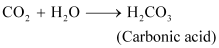
Since the process of forming carbonic acid is slow, only a small amount of carbon dioxide is carried this way.
(2) Through RBCs:
About 20 - 25% of CO2 is transported by the red blood cells as carbaminohaemoglobin. Carbon dioxide binds to the amino groups on the polypeptide chains of haemoglobin and forms a compound known as carbaminohaemoglobin.
(3) Through sodium bicarbonate:
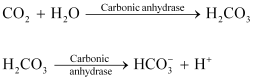
About 70% of carbon dioxide is transported as sodium bicarbonate. As CO2 diffuses into the blood plasma, a large part of it combines with water to form carbonic acid in the presence of the enzyme carbonic anhydrase. Carbonic anhydrase is a zinc enzyme that speeds up the formation of carbonic acid. This carbonic acid dissociates into bicarbonate (HCO3-) and hydrogen ions (H+).