NEET-XII-Physics
qstns with ansrs year:2022
- #NEET 2022 Physics Questions with
Answer s Key Solutions
- Qstn #1Two objects of mass `` 10\, kg `` and `` 20 \, kg `` respectively are connected to the two ends of a rigid rod of length `` 10\, m `` with negligible mass. The distance of the center of mass of the system from the `` 10\, kg `` mass is :
(A) `` 5 \, m ``
(B) `` \frac{10}{3} m ``
(C) `` \frac{20}{3} m ``
(D) `` 10\, m ``digAnsr: CAns :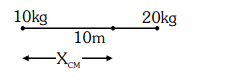
`` X _{ CM }=\frac{20 \times 10}{20+10}=\frac{20}{3} m ``
- Qstn #2Match List - I with List - II.
Choose the correct answer from the options given below:List I (Electromagnetic waves) List II (Wavelength) a AM radio waves i `` 10^{-10}m `` b Microwaves ii `` 10^2 m `` c Infrared radiations iii `` 10^{-2}m `` d X - rays iv `` 10^{-4}m ``
(A)
(a) - (ii),
(b) - (iii),
(c) - (iv),
(d) - (i)
(B)
(a) - (iv),
(b) - (iii),
(c) - (ii),
(d) - (i)
(C)
(a) - (iii),
(b) - (ii),
(c) - (i),
(d) - (iv)
(D)
(a) - (iii),
(b) - (iv),
(c) - (ii),
(d) - (i)digAnsr: AAns : (a) Radio wave (ii) `` \approx 10^{2} m `` (ii)
(b) Microwave `` \approx `` (iii) `` 10^{-2} m `` (iii)
(c) Infrared radiations `` \approx( iv ) 10^{-4} m `` (iv)
(d) X-ray (i) `` \approx \,Å=10^{-10} m `` (i)
(a) - (ii),
(b) - (iii),
(c) - (iv),
(d) - (i)
- Qstn #3The energy that will be ideally radiated by a `` 100 \,kW `` transmitter in `` 1 `` hour is :
(A) `` 1 \times 10^{5} J ``
(B) `` 36 \times 10^{7} J ``
(C) `` 36 \times 10^{4} J ``
(D) `` 36 \times 10^{5} J ``digAnsr: BAns : `` E=P \times t=100 \times 10^{3} \times 3600 ``
`` =36 \times 10^{7} J ``
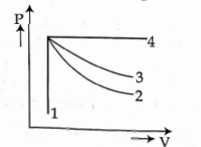
- Qstn #4An ideal gas undergoes four different processes from the same initial state as shown in the figure below. Those processes are adiabatic, isothermal, isobaric and isochoric. The curve which represents the adiabatic process among `` 1,2,3 `` and `` 4 `` is :
(A)4
(B)1
(C)2
(D)3digAnsr: CAns : `` 1 : `` Isochoric
`` 2 : `` Adiabatic
`` 3 : `` Isothermal
`` 4 : `` Isobaric
- Qstn #5Plane angle and solid angle have :
(A)Both units and dimensions
(B)Units but no dimensions
(C)Dimensions but no units
(D)No units and no dimensionsdigAnsr: BAns : Plane angle and solid angle are dimensionless but have units.
- Qstn #6In half wave rectification, if the input frequency is `` 60 \,Hz `` , then the output frequency would be:
(A) `` 120\, Hz ``
(B)zero
(C) `` 30 \,Hz ``
(D) `` 60 \,Hz ``digAnsr: DAns : In half wave rectification
`` f _{ in}= f _{ out } ``
`` \Rightarrow f _{\text {out }}=60 \,Hz ``
- Qstn #7When two monochromatic lights of frequency, `` v `` and `` \frac{v}{2} `` are incident on a photoelectric metal, their stopping potential becomes `` \frac{V_{S}}{2} `` and `` V_{S} `` respectively. The threshold frequency for this metal is :
(A) `` \frac{3}{2} v ``
(B) `` 2 v ``
(C) `` 3 v ``
(D) `` \frac{2}{3} v ``digAnsr: AAns : Using the equation
`` eV - hv -\phi ``
or `` eV = hv - hv _{ Th } ``
`` \frac{ eV _{ s }}{2}=\frac{ hv }{2}- hv _{ Th } ..... `` (1)
`` e V _{ s }= hv - hv _{ Th }...... `` (2)
Data Incorrect
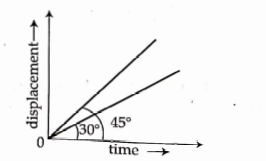
- Qstn #8The displacement-time graphs of two moving particles make angles of `` 30^{\circ} `` and `` 45^{\circ} `` with the `` x `` -axis as shown in the figure. The ratio of their respective velocity is :
(A) `` 1: \sqrt{3} ``
(B) `` \sqrt{3}: 1 ``
(C) `` 1: 1 ``
(D) `` 1: 2 ``digAnsr: AAns : Velocity is slope of `` x-t `` graph
`` V =\frac{ dx }{ dt }=\tan \theta ``
`` \frac{ V _{1}}{ V _{2}}=\frac{\tan \theta_{1}}{\tan \theta_{2}} ``
`` =\frac{\tan 30^{\circ}}{\tan 45^{\circ}}=\frac{1}{\sqrt{3}} ``
- Qstn #9The dimensions `` \left[ MLT ^{-2} A ^{-2}\right. `` ] belong to the :
(A)electric permittivity
(B)magnetic flux
(C)self inductance
(D)magnetic permeabilitydigAnsr: DAns : `` \left[ MLT ^{-2} A ^{-2}\right]= `` Magnetic permeability
- Qstn #10The peak voltage of the ac source is equal to:
(A) `` 1 / \sqrt{2} `` times the rms value of the ac source
(B)the value of voltage supplied to the circuit
(C)the rms value of the ac source
(D) `` \sqrt{2} `` times the rms value of the ac sourcedigAnsr: DAns : Peak voltage is `` \sqrt{2} `` times rms voltages in ac.
- Qstn #11The ratio of the distances travelled by a freely falling body in the `` 1^{\text {st }}, 2^{\text {nd }}, 3^{\text {rd }} `` and `` 4^{\text {th }} `` second :
(A) `` 1: 1: 1: 1 ``
(B) `` 1: 2: 3: 4 ``
(C) `` 1: 4: 9: 16 ``
(D) `` 1: 3: 5: 7 ``digAnsr: DAns : `` S _{ nth }= u +\frac{ a }{2}(2 n -1) ``
`` =0+\frac{ a }{2}(2 n -1) ``
`` S _{ nth } \propto(2 n -1) ``
`` \Rightarrow S _{1 st }, S _{2 nd }, S _{3 rd }, S _{4 th } ``
`` =[2(1)-1]:[2(2)-1]:[2(3)-1]:[2(4)-1] ``
`` =1: 3: 5: 7 ``
- Qstn #12A body of mass `` 60 \,g `` experiences a gravitational force of `` 3.0 \,N `` , when placed at a particular point. The magnitude of the gravitational field intensity at that point is :
(A) `` 180 \,N / kg ``
(B) `` 0.05\, N / kg ``
(C) `` 50 \,N / kg ``
(D) `` 20\, N / kg ``digAnsr: CAns : `` I_{g}=\frac{F}{m} ``
`` =\frac{3}{60 \times 10^{-3}}=50 \,N / kg ``
- Qstn #13In the given nuclear reaction, the element `` X `` is: `` { }_{11}^{22} Na \rightarrow X + e ^{+}+v ``
(A) `` { }_{12}^{22} Mg ``
(B) `` { }_{11}^{23} Na ``
(C) `` { }_{10}^{23} Ne ``
(D) `` { }_{10}^{22} Ne ``digAnsr: DAns : `` { }_{11}^{22} Na \longrightarrow X +e^{+}+v ``
This is `` \beta^{+}- `` decay
`` { }_{11}^{22} Na \longrightarrow{ }_{10}^{22} Ne + e ^{+}+ v ``
- Qstn #14If a soap bubble expands, the pressure inside the bubble:
(A)is equal to the atmospheric pressure
(B)decreases
(C)increases
(D)remains the samedigAnsr: BAns : `` P = P _{0}+\frac{4 T }{ R } ``
`` \Rightarrow R `` increases and `` P `` decreases