NEET-XII-Physics
P1 year:2019
- Qstn #1When a block of mass M is suspended by a long
wire of length L, the length of the wire
becomes (L + l). The elastic potential energy
stored in the extended wire is :
(1) Mgl
(2) MgL
(3)``\frac12 Mgl ``
(4)``\frac12 MgL ``digAnsr: 3Ans : ( 3 )
Sol.
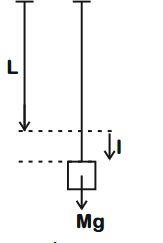
U = ``\frac12 `` (work done by gravity)
U = ``\frac12 ``Mgl
- Qstn #2A mass m is attached to a thin wire and
whirled in a vertical circle. The wire is most
likely to break when:
(1) the mass is at the highest point
(2) the wire is horizontal
(3) the mass is at the lowest point
(4) inclined at an angle of 60° from verticaldigAnsr: 3Ans : ( 3 )
Sol.
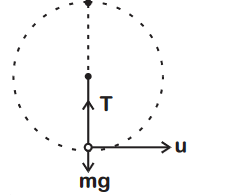
``T -mg = \frac{mu^2}{L}``
``T = mg + \frac{mu^2}{L}``
The tension is maximum at the lowest
position of mass, so the chance of breaking is
maximum.
- Qstn #3Ionized hydrogen atoms and α-particles with
same momenta enters perpendicular to a
constant magnetic field, B. The ratio of
their radii of their paths
``r_H : r_\alpha`` will be :
(1) 2 : 1
(2) 1 : 2
(3) 4 : 1
(4) 1 : 4digAnsr: 1Ans : ( 1 )
Sol.
``r_H = \frac{p}{eB}`` and ``r_\alpha = \frac{p}{2eB}``
on simplification, we get 2:1
- Qstn #4Body A of mass 4m moving with speed u
collides with another body B of mass 2m, at
rest. The collision is head on and elastic in
nature. After the collision the fraction of
energy lost by the colliding body A is :
(1)``\frac19``
(2)``\frac89``
(3)``\frac49``
(4)``\frac59``digAnsr: 2Ans : ( 2 )
Sol. Fractional loss of KE of colliding body
``\frac{\Delta KE}{KE} = \frac{4m_1m_2}{(m_1 + m_2)^2}``
On substitution ``m_1= 4m, m_2 = 2m``
= ``\frac{4.4m.2m }{ (4m+2m)^2} = \frac{32}{36}= \frac89``
- Qstn #5In a double slit experiment, when light of
wavelength 400 nm was used, the angular
width of the first minima formed on a screen
placed 1 m away, was found to be 0.2°. What
will be the angular width of the first minima,
if the entire experimental apparatus is immersed
in water? (``μ_{water}
= \frac43``)
(1) 0.266°
(2) 0.15°
(3) 0.05°
(4) 0.1°digAnsr: 2Ans : (2)
Sol. In air angular fringe width
``\theta_0 = {\beta}{D}``
Angular fringe width in water
``\theta_w = {\beta}{\mu D}``
``= \frac{0.2}{\frac{4}{3} } = {0.15}^{°}``
- Qstn #6In which of the following devices, the eddy
current effect is not used?
(1) Induction furnace
(2) Magnetic braking in train
(3) Electromagnet
(4) Electric heaterdigAnsr: 4Ans : ( 4 )
Sol. Electric heater does not involve Eddy
currents. It uses Joule's heating effect.
- Qstn #7A soap bubble, having radius of 1 mm, is
blown from a detergent solution having a
surface tension of ``2.5 × 10^{-2}`` N/m.
The pressure inside the bubble equals at a
point ``Z_0`` below the
free surface of water in a container. Taking
``g = 10 m/s^2``, density of water = ``10^3 kg/m^3``,
the value of ``Z_0`` is :
(1) 100 cm
(2) 10 cm
(3) 1 cm
(4) 0.5 cmdigAnsr: 3Ans : ( 3 )
Sol. Excess pressure =
`` \frac{4T}{R} ``
Gauge pressure
=`` ρgZ_0``
``P_0 + \frac{4T}{R} = P_o + ρgZ_0``
Hence ``\rho_0 = \frac{4T}{R ρ g}``
``Z_0 = \frac{4 \times\ 2.5 \times 10^{-2} }{10^{-3} \times 1000 \times 10 } ``
= 1 cm.
- Qstn #8Which colour of the light has the longest
wavelength?
(1) Red
(2) Blue
(3) Green
(4) VioletdigAnsr: 1Ans : ( 1 )
Sol. Red has the longest wavelength among the
given options.
- Qstn #9A disc of radius 2 m and mass 100 kg rolls on
a horizontal floor. Its centre of mass has speed
of 20 cm/s. How much work is needed to stop
it?
(1) 3 J
(2) 30 kJ
(3) 2 J
(4) 1 JdigAnsr: 1Ans : ( 1 )
Sol. Work required = change in kinetic energy
Final KE = 0
Initial KE = ``\frac12 mv^2 + \frac12 I {\omega}^2 = frac34 mv^2``
= ``\frac34 \times 100 \times (20 \times 10^{-2})^2 = 3J ``
|``\triangle `` KE| = 3 J
- Qstn #10The displacement of a particle executing
simple harmonic motion is given by
``y = A_0 + Asinωt + Bcosωt``
Then the amplitude of its oscillation is given
by :
(1) ``A_0 + \sqrt{A^2 + B^2}``
(2) ``\sqrt{A^2 + B^2}``
(3) `` \sqrt{ A_0^2 +(A + B)^2}``
(4) A + BdigAnsr: 2Ans : ( 2 )
Sol. B
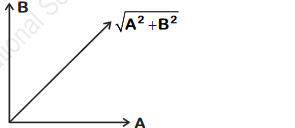
y = ``A_0 + Asinωt + Bsinωt``
Equate SHM
``y' = y - A_0 = Asinωt + Bcosωt``
Resultant amplitude
``R= \sqrt{(A^2+B^2 + 2ABcos90)}``
= ``\sqrt{A^2 + B^2}``
- Qstn #11Two similar thin equi-convex lenses, of focal
length f each, are kept coaxially in contact
with each other such that the focal length of
the combination is ``F_1``. When the space
between the two lenses is filled with
glycerine (which has the same refractive index
(μ = 1.5) as that of glass) then the equivalent
focal length is ``F_2``. The ratio ``F_1:F_2``
will be :
(1) 2 : 1
(2) 1 : 2
(3) 2 : 3
(4) 3 : 4digAnsr: 2Ans : ( 2 )
Sol.
Equivalent focal length in air =
``\frac1F_1 = \frac1f + \frac1f = frac2f``

When glycerin is filled inside, glycerin lens
behaves like a diverging lens of focal length (-f)=``\frac1F_2 = \frac1f + \frac1f- \frac1f= frac1f``
therefore ``\frac{F_1}{F_2}=\frac12``
- Qstn #12Increase in temperature of a gas filled
in a container would lead to :
(1) Increase in its mass
(2) Increase in its kinetic energy
(3) Decrease in its pressure
(4) Decrease in intermolecular distancedigAnsr: 2Ans : ( 2 )
Sol. Increase in temperature would lead to the
increase in kinetic energy of gas (assuming
far as to be ideal) as U= ``\frac F2 nRT``
- Qstn #13An electron is accelerated through a potential
difference of 10,000 V. Its de Broglie
wavelength is, (nearly) : (``m_e = 9 × 10^{-31}`` kg)
(1) ``12.2 × 10^{-13}`` m
(2) ``12.2 × 10^{-12}`` m
(3) ``12.2 × 10^{-14}`` m
(4) 12.2 nmdigAnsr: 2Ans : ( 2 )
Sol. For an electron accelerated through a
potential V,
``\lambda``=``\frac{12.27} {\sqrt v}`` Å= ``\frac{12.27 X 10^{-10} }{\sqrt 10000}``=``12.27 X 10 ^{-12} ``m
- Qstn #14A copper rod of 88 cm and an aluminium rod of
unknown length have their increase
in length independent of increase in
temperature. The length of aluminium rod is :
(``Α_{Cu}
= 1.7 × 10^{-5} K^{-1}`` and ``α_{
Al}= 2.2 × 10^{-5} K^{-1}``)
(1) 6.8 cm
(2) 113.9 cm
(3) 88 cm
(4) 68 cmdigAnsr: 4Ans : ( 4 )
Sol. ``α_{cu} L_{cu}= α_{AL} L_{AL}``
``1.7 × 10^{-5} × 88 cm = 2.2 × 10^{-5} × L_{AL}``
``L_ {AL}``=``\frac {1.7 X 88}{2.2}``
=68 cm
- Qstn #15Pick the wrong Ans. in the context with
rainbow.
(1) When the light rays undergo two internal
reflections in a water drop, a secondary
rainbow is formed
(2) The order of colours is reversed in the
secondary rainbow
(3) An observer can see a rainbow when his
front is towards the sun
(4) Rainbow is a combined effect of dispersion
refraction and reflection of sunlightdigAnsr: 3Ans : ( 3 )
Sol. Rainbow can't be observed when observer
faces towards sun.