ICSE-X-Physics
Previous Year Paper year:2019
- #6
- #6-aHow does the angle of deviation formed by a prism change with the increase in the angle of
incidence? Draw a graph showing the variation in the angle of deviation with the angle of incidence at a prism surface.
[3]
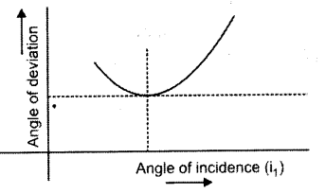
Ans : As the. angle of incidence increases the angle of deviation decreases becomes minimum and then increases.
The graph is as shown :
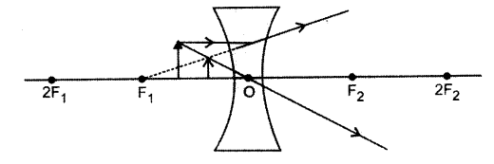
- #6-bA virtual, diminished image is formed when an object is placed between the optical centre and the principal focus of a lens.
- #6-b-iName the type of lens which forms the above image.Ans : Concave lens.
- #6-b-iiDraw a ray diagram to show the formation of the image with the above stated characteristics.
[3]
Ans : The ray diagram is as shown :
- #6-cAn object is placed at a distance 24 cm in front of a convex lens of focal length 8 cm.Ans : Given u = - 24 cm, f= + 8 cm, v = ?
- #6-c-iWhat is the nature of the image so formed ?Ans : Real, inverted and diminished.
- #6-c-iiCalculate the distance of the image from the lens.Ans : Using the lens formula
``\frac { v }{ u }`` = ``\frac { 12 }{ -24 }`` = ``\frac { 1 }{ 2 }`` .
- #6-c-iiiCalculate the magnification of the image.
[4]
- #7
- #7-aIt is observed that during march-past we hear a base drum distinctly from a distance compared to the side drums.
- #7-a-iName the characteristic of sound associated with the above observation.Ans : Intensity of sound.
- #7-a-iiGive a reason for the above observation.
[3]
Ans : This is because the amplitude of vibration of a base drum is far greater than the amplitude of vibration of the side drum.
(b) Given f= 4 vbs, T = ``\frac { 1 }{ f }`` = ``\frac { 1 }{ 4 }`` = 0.25 s, for a frequency of 6 vbs titme t= ``\frac { 0.25 }{ 4 }`` x 6 = 0.375 s, ,V=340ms-1
Using S = ``\frac{\mathbf{V} \times t}{2}`` = ``\frac{340 \times 0.375}{2}`` = 63.75 m
(c) (i) Free or natural oscillation.
(ii) Forced oscillation.
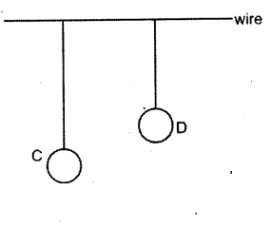
(iii) The amplitude of the oscillation of D will be equal to the amplitude of the oscillation of C.
(iv) Resonance.
- #7-bA pendulum has a frequency of 4 vibrations per second. An observer starts the pendulum and fires a gun simultaneously. He hears the echo from the cliff after 6 vibrations of the pendulum. If the velocity of sound in air is 340 m s1, find the distance between the cliff and the observer.
[3]
- #7-cTwo pendulums C and D are suspended from a wire as shown in the given figure. Pendulum C is made to oscillate by displacing it from its mean position. It is seen that D also starts oscillating.