ICSE-X-Mathematics
Previous Year Paper year:2017
- #9-c [4]Prove that
$$ \frac{\sin\theta +2\sin^3\theta}{2\cos^3\theta - \cos\theta} = \tan\theta$$Ans : ``\frac{sin \ \theta - 2 sin^3 \theta}{2cos^3 \theta - cos \ \theta} = tan \ \theta ``
LHS = ``\frac{sin \ \theta - 2 sin^3 \theta}{2cos^3 \theta - cos \ \theta} ``
``= \frac{sin \ \theta(1 - 2 sin^2 \theta)}{cos \ \theta ( 2cos^2 \theta - 1)} ``
``= \frac{sin \ \theta(1 - 2 (1- cos^2 \theta))}{cos \ \theta ( 2cos^2 \theta - 1)} ``
``= \frac{sin \ \theta ( 2cos^2 \theta - 1)}{cos \ \theta ( 2cos^2 \theta - 1)} ``
``= \frac{sin \ \theta }{cos \ \theta} ``
``= tan \theta ``
= RHS. Hence proved.
- #10Ans : Answers:
- #10-a [4]The sum of the ages of Vivek and his younger brother Amit is 47 years. The product of their
ages in years is 550. Find their ages.Ans : Let the age of Vivek = x
and Let the age of Amit = y
Given:``x + y = 47 \ and \ xy = 550 ``
Hence x(47-x) = 550
``\Rightarrow X ^2-47x+550=0 ``
``\Rightarrow X ^2 -25x-22x+550 = 0 ``
``\Rightarrow X (x-25) - 22(x-25) = 0 ``
``\Rightarrow(x-22)(x-25) = 0 ``
``\Rightarrow X = 22 \ or \ 25 ``
When x = 22, y = 47-22 = 25
When x = 25, y = 47-25 = 22
Hence the age of the two is ``22, \ 25 `` years.
- #10-b [6]
The daily wages of 80 workers in a project are given below.
Wages(in Rs.) 400-450 450-500 500-550 550-600 600-650 650-700 700-750 No. of Workers 2 6 12 18 24 13 5 Use a graph paper to draw an ogive for the above distribution. (Use a scale of 2 cm = Rs.50 on x-axis and 2 cm = 10 workers on y-axis). Use your ogive to estimate:
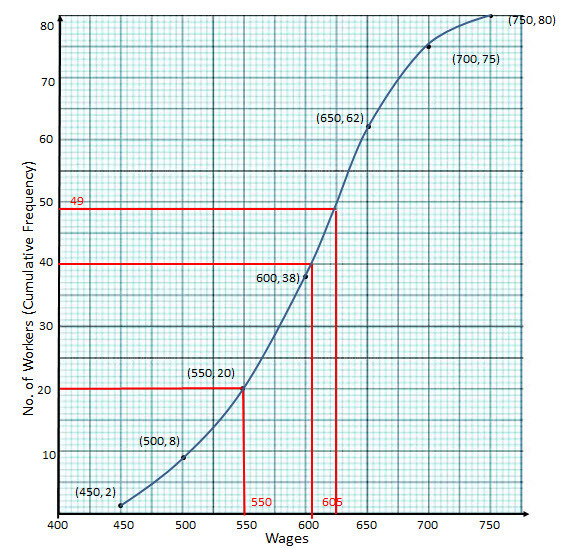
Ans :Wages No. workers (f) Cumulative Frequency (c.f) 400-450 2 2 450-500 6 8 500-550 12 20 550-600 18 38 600-650 24 62 650-700 13 75 700-750 5 80
On the graph paper, we plot the following points:
(2, 450), (8, 500), (20, 550), (38,600), (62, 650), (75,700), (80,750)
 '
'
n = 80
- #10-b-ithe median wage of the workersAns : Median = ``( \frac{n}{2})^{th} `` term = ``\frac{80}{2} =40^{th} ``term
From the graph ``40^{th} term = 605 ``
- #10-b-iithe lower quartile wage of workersAns : Lower quartile = ``( \frac{n}{4})^{th} \ term = \ \frac{80}{4} =20^{th}`` term
From the graph ``20^{th}`` term =550
- #10-b-iiithe numbers of workers who earn more than Rs. 625 dailyAns : The number of workers earning more that 625 per day = 80-49 = 31 students
- #11Ans : Answers:
- #11-a [3]
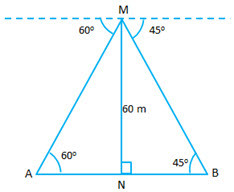
The angles of depression of two ships A and B as observed from the top of a light house 60 m
high are 60° and 45° respectively. If the two ships are on the opposite sides of the light house,
find the distance between the two ships, Give your answer correct to the nearest whole
number.Ans :In ``\triangle MNB: tan \ 45 ° = \frac{60}{NB} \Rightarrow NB = 60 \ m ``
 '
'
In ``\triangle MNA: tan \ 60 ° = \frac{60}{AN} \Rightarrow AN = \frac{60}{ \sqrt{3}} = 34.64 \ m ``
Hence AB = NB + NA = 60 + 34.64 = ``94.64 \ m ``
Rounding off the the nearest whole number, we get AB = ``95 \ m``
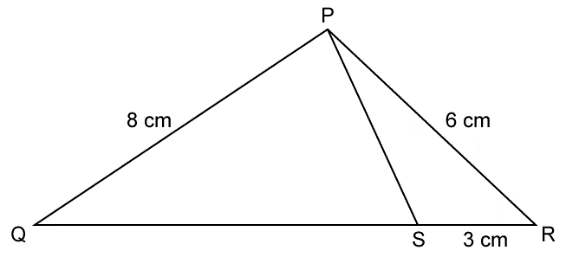
- #11-b [3]PQR is a triangle. S is a point on the side QR of ▲PQR such that ∠PSR = ∠QPR.
Given QP = 8 cm, PR = 6 cm and SR = 3 cmAns :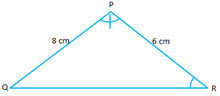 '
'
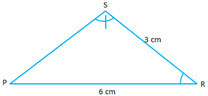 '
'
- #11-b-iProve ▲PQR ``\sim`` ▲SPRAns : Consider ``\triangle PQR`` and ``\triangle PSR``
``\angle QPR = \angle PSR`` (given)
PR is common
``\angle R `` is common.
Therefore by AAA postulate, ``\triangle PQR \sim \triangle PSR``
- #11-b-iiFind the length of QR and PSAns : Since ``\triangle PQR \sim \triangle PSR``
``\therefore \frac{PR}{SR} = \frac{QR}{PR}``
``\Rightarrow \frac{6}{3} = \frac{QR}{6}``
``\Rightarrow QR = 12 \ cm ``
- #11-b-iii
$$\frac{\text{area of ▲PQR}}{\text{area of ▲SPR}}$$
 Ans : ``\frac{Area \ of \ \triangle PQR}{Area \ of \ \triangle SPR} = \frac{6^2}{3^2} = \frac{35}{9} = 4:1``
- #11-c [4]Mr. Richard has a recurring deposit account in a bank for 3 years at 7.5% p. a. simple interest. If
he gets Rs. 8325 as interest at the time of maturity, findAns : I = ``8325 \ Rs.``
n = ``3 \times 12 = 36 months``
R = ``7.5 \% ``
- #11-c-iThe monthly depositAns : `` I = \frac{P \times n \times (n+1)}{2} \times \frac{r}{100} \times \frac{1}{12} ``
``8325 = \frac{P \times 36 \times 37}{2} \times \frac{7.5}{100} \times \frac{1}{12} ``
``\Rightarrow P = \frac{8325 \times 2 \times 100 \times 12}{36 \times 37 \times 7.5} = 2000 \ Rs.``