ICSE-X-Mathematics
Previous Year Paper year:2018
- #7-b [3]On a map drawn to a scale of 1 : 50,000, a rectangular plot of land ABCD has the
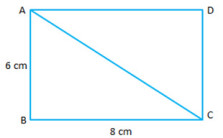
following dimensions. AB = 6 cm; BC = 8 cm and all angles are right angles. Find:Ans : Scale is 1:50000
 '
'
- #7-b-ithe actual length of the diagonal distance AC of the plot in km.Ans : ``AC = \sqrt{AB^2 +BC^2} = \sqrt{64+36} = \sqrt{100} = 10 \ cm``
Let the length of AC be ``x`` on the ground
Therefore ``\frac{1}{50000} = \frac{10}{x} \Rightarrow x = 500000 \ cm = 5 \ km``
- #7-b-iithe actual area of the plot in sq. km.Ans : AB on the ground ``= 6 \times 50000 = 300000 \ cm = 3 \ km``
BC on the ground ``= 8 \times 50000 = 400000 \ cm = 4 \ km``
Therefore Area of ``ABCD = 3 \times 4 \ km^2 = 12 \ km^2``
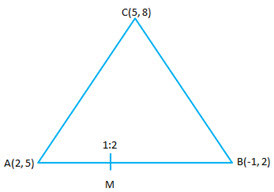
- #7-c [4]A(2, 5), B(-1, 2) and C(5, 8) are the vertices of a triangle ABC, `M' is a point on AB
such that AM : MB = 1 : 2. Find the co-ordinates of 'M’. Hence find the equation of the
line passing through the points C and M.Ans : ``m_1 : m_2 = 1:2 \ and \ A(2,5), B(-1, 2) \ and \ C(5,8)``
 '
'
Let M(x, y)
``x = \frac{m_1.x_2 + m_2.x_1}{m_1 + m_2} = \frac{1(-1) + 2(2)}{1+2} = \frac{3}{3} = 1``
``y = \frac{m_1.y_2 + m_2.y_1}{m_1 + m_2} = \frac{1(2) + 2(5)}{1+2} = \frac{12}{3} = 4``
Hence M(1, 4)
Slope of CM ``= \frac{y_2-y_1}{x_2-x_1} = \frac{8-4}{5-1} = \frac{4}{4} = 1``
Therefore equation of CM
``y - y_1 = m(x- x_1)``
``\Rightarrow y - 4 = 1 (x- 1)``
``\Rightarrow y - x = 3``
- #8
- #8-a [3]Rs. 7500 were divided equally among a certain number of children. Had there been
20 less children, each would have received Rs. 100 more. Find the original number
of children.Ans : Let the number of children be ``= x``
Therefore if ``x`` children received ``7500 \ Rs.``
Then 1 child received ``\frac{7500}{x} \ Rs``.
Let the number of children be = ``(x-20)``
Therefore if ``(x-20)`` children received`` 7500 \ Rs.``
Then 1 child received ``\frac{7500}{x-20} \ Rs.``
Given ``\frac{7500}{x-20} - \frac{7500}{x} = 100``
``\Rightarrow \frac{75}{x-20} - \frac{75}{x} = 1``
``75x-7x(x-20) = (x-20)x``
``x^2 - 20x - 1500= 0``
``(x+30)(x-50)=0 \Rightarrow x = -30 \ (not possible) or \ 50``
Therefore the number of children be = 50
- #8-b [3]If the mean of the following distribution is 24, find the value of 'a '.
Marks 0-10 10-20 20-30 30-40 40-50 Number of students 7 a 8 10 5 Ans : Marks Mid Term (\overline{x}) No. of Students (f) fx
0-10 5 7 35
10-20 15 a 15a
20-30 25 8 200
30-40 35 10 350
40-50 45 5 225
``\Sigma f = 30+a \Sigma fx= 810+15a``
``Mean (\overline{x}) = \frac{\Sigma fx}{\Sigma f}``
``\Rightarrow 24 = \frac{810+15a}{30+a}``
``\Rightarrow 720 + 24a = 810 + 15a``
``\Rightarrow 9a = 90``
``\Rightarrow a = 10``
- #8-c [4]Using ruler and compass only, construct a (triangle)triangle ▲ ABC such that BC = 5 cm and AB = 6.5
cm and ∠ABC = 120°Ans :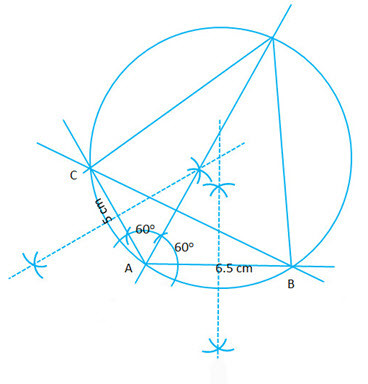 '
'
- #8-c-iConstruct a circum-circle of triangle ▲ABC
- #8-c-iiConstruct a cyclic quadrilateral ABCD, such that D is equidistant from AB and
BC.
- #9
- #9-a [3]Priyanka has a recurring deposit account of Rs. 1000 per month at 10% per annum.
If she gets Rs. 5550 as interest at the time of maturity, find the total time for which
the account was held.Ans : Monthly Income ``(x) = 1000 \ Rs.``
``r= 10\%, \ \ \ I = 5550 Rs. \ \ \ Number \ of \ months = n``
``I = \frac{n(n+1)}{2} \times \frac{1}{12} \times x \times \frac{r}{100}``
``\Rightarrow 5550 = \frac{n(n+1)}{2} \times \frac{1}{12} \times 1000 \times \frac{10}{100}``
``\Rightarrow n(n+1) = \frac{5550 \times 2 \times 12}{100}``
``\Rightarrow n^2+n - 1332 = 0``
``\Rightarrow n^2 + 37n = 36n - 1332 = 0``
``\Rightarrow n(n+37)-36(n+37) = 0``
``\Rightarrow (n+37)(n-36) = 0``
``\Rightarrow n = -37 \ or \ 36 ``(negative number is not possible)
Therefore n = 36
Therefore total time line= 36 months or 3 years
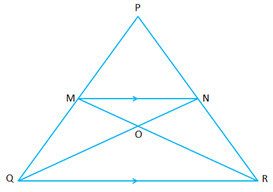
- #9-bIn triangle ▲PQR, MN is parrallel to QR and
``\frac{\text{PM}}{\text{MQ}} = \frac23``
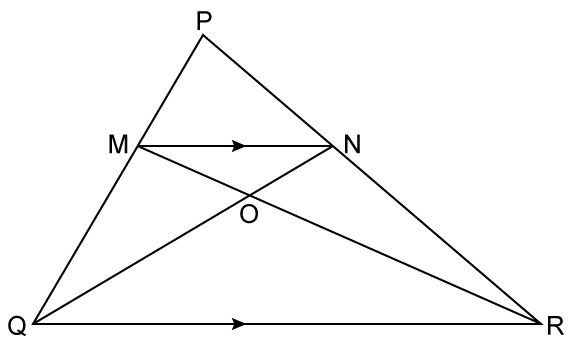 Ans : (i) In ``\triangle PMN \ and \ \triangle`` PQR
 '
'
``\angle P`` is common
SInce MN ``\parallel`` QR
``\Rightarrow \angle PMN = \angle PQR and \angle PNM = \angle PRQ `` (alternate angles)
Therefore ``\triangle PMN \sim \triangle PQR ``(by AAA Postulate)
``\Rightarrow \frac{PM}{PQ} = \frac{MN}{QR}``
``\Rightarrow \frac{PM}{PM+MQ} = \frac{MN}{QR} ``
Given ``\frac{PM}{MQ} = \frac{2}{3} ``
``\Rightarrow \frac{2}{2+3} = \frac{MN}{QR} ``
``\Rightarrow \frac{MN}{QR} = \frac{2}{3} ``
- #9-b-iFind
``\frac{MN}{QR}``
- #9-b-iiProve that triangle ▲OMN and triangle ▲ORQ are similar.Ans : Consider ``\triangle OMN`` & ``\triangle OQR``
Since ``MN \parallel QR``
``\angle MNQ = \angle OQR ``(alternate angles)
``\angle NMO = \angle ORQ ``(alternate angles)
Therefore ``\triangle OMN \sim \triangle OQR `` (AAA Postulate)