ICSE-X-HistCivics
Previous Year Paper year:2010
- #4-b [3]Mention the circumstances when the President can declare a national emergency.Ans : A proclamation of emergency can be made by the President at any time if he is satisfied that the security of India or any part is in danger, or is likely to be in danger either due to war or external aggression or armed rebellion.
- #4-c [4]Explain two Discretionary powers of the President.Ans : Two Discretionary powers of the President:
- He has a very important role to play in the actual working of the Parliamentary system in our country. The oath of office which the President takes in the name of God on assuming his office puts upon him a sacred obligation to be the guardian of the constitution and law. His oath binds him to render service for the well being of the people of India.
- In the case of no single party getting a clear majority, a coalition of parties makes its claim to form the Government. The President has to use his discretionary judgement and invite such a leader to head the Government as Prime Minister who can provide a stable Government to the country. His judgement and decision are of crucial importance.
- Qstn #5:
The Supreme Court is the apex court in the entire judicial set up in India. In this context answer the following questions:
- #5-a [3]What is meant by the term Single-integrated judicial system ?Ans : Single-integrated Judicial System: The parts of the system are :
- Supreme Court is the head of the entire system, supervises and exercises control over the Subordinate courts.
- There are same set of laws and a single civil and criminal system throughout the country.
- All cases can be taken from lower to high court and then to the Supreme Court.
- #5-b [3]Explain the impeachment procedure for the removal of judges.Ans : A judge of the Supreme Court can be removed from his office only on the ground of proved misbehaviour or 'incapacity'. Procedure for the removal has been prescribed in the Constitution itself. In order to remove a Judge of the Supreme Court, each House of Parliament will have to pass a resolution supported by a majority of the total membership of that House and by a 2/3 majority of the members of that House present and voting. Such a resolution passed by the both the Houses will be addressed to the President, who will then pass the order of removal of the Judge.
- #5-c [4]In the extensive jurisdiction of the Supreme Court state the difference between the original jurisdiction and the appellate jurisdiction. Mention two functions that come under Original jurisdiction.Ans :
Original Jurisdiction Appellate Jurisdiction Original jurisdiction means power to hear and determine cases in first instances. It means the court has a power to grant special leave to appeal against the judgement delivered by any court in the country. Such cases brought before the supreme court only through an appeal.
Functions that comes under Original Jurisdiction:
- A dispute between the Government of India and one or more states.
- Disputes between two or more states.
- A Dispute between the Union and any state on the one side and other states on the other.
- The Supreme Court entertains suits for the enforcement of Fundamental Rights also. Such suits can be brought by private individuals against the Union Government or a State Government.
- Original Jurisdiction extends to such other cases in which an Interpretation of the Constitution is involved. (any two)
- Qstn #6:
From 1905 to 1918, there emerged a new and a younger group of leaders within the Congress who did not agree with the old leadership. In this context, answer the following questions:
- #6-a [3]Differentiate between the Moderates and the Radical nationalists in their objectives and achievements, stating one objective and two achievements of each wing of the Congress.Ans : Objectives of Moderates: The ultimate objective of the Moderates was to bring constitutional and other reforms in India by presenting their demands before the British in peaceful way.
Achievements of Moderates:
- The moderates saved the Indian masses from being misled. They succeeded in creating national awakening by arousing among people the feeling that they belonged to one common nation India.
- They popularized the idea of democracy and civil liberties and representative institution. The efforts of the moderates led to the following reforms :
The appointment of Public Service Commission in 1886, Simultaneous ICS Examination in London and India, Appointment of 10 to 16 Additional members which were nominated to the G.Gs Council for Law making, The Government come out with the Indian Council Act in 1892 which was an improvement of the Act of 1861 due to the pressure put by the moderates.
Objectives of Radical nationalists: They believed in the ultimate objective of Swaraj or self-rule. They wanted to put pressure on England through revolutionary methods and political agitation.
Achievements of Radicals :
(i) They specified the goal of the national struggle for achieving total independence.
(ii) They tried to cripple the administration by using methods of non-cooperation and boycott.
- #6-b [3]Name the radical leader known as the forerunner of Gandhiji. Why is the person known as the forerunner of Gandhiji ?Ans : Forerunner—Bal Gangadhar Tilak.
Tilak is known as the forerunner of Mahatma Gandhi because the plank of Swadeshi and Boycott used by Gandhiji decades later had been introduced by Tilak. Like Gandhiji he too believed in the strength of the masses and wanted to include all classes of the society to make the National movement strong.
Although Tilak was the forerunner of Gandhi yet he differed in respect of methods in achieving goal. While Tilak wanted to use all means to achieve his goal but Gandhiji did not advocate the use of force or violence to achieve the goals.
- #6-c [4]Explain how the Repressive policies of Lord Curzon and influence of International events led to Radical nationalism.Ans : Repressive Policies of Lord Curzon:
(i) The Act of 1898 made it an offence to provoke people against imperial riders.
(ii) In 1899, Lord Curzon passed the Calcutta Corporation Act by which he increased the number of Englishmen on the list of official members of the corporation.
International Events : The feelings of nationalism were reinforced by certain events in the international sphere. In 1896, the Italian forces which tried to establish their military control over the freedom loving Abyssinians of Ethiopia were defeated. Japan successfully resisted the Russian onslaught in 1904-1905. This showed that Asians could defeat the European powers. In Russia, revolutionaries challenged the Czarist autocracy in 1905, thereby demonstrating the potential of peoples unity. The Boxer Rising in China against imperialist domination was another example of the courage of subjugated people. The revolutionary movements in Egypt, Turkey and Ireland were also followed with deep interest by the radical section in India. All these events made them realise that imperialism could be crushed, provided the people were united.
- Qstn #7:
The Simon Commission was appointed in November 1927 by the British Government. Subsequently the Civil Disobedience Movement began. In this context answer the following questions:
- #7-a [3]Why was the Simon Commission appointed by the British Government ? Why did the Congress boycott the Commission ?Ans : In November 1927, the British Government appointed the Indian Statutory Commission, known popularly (after the name of its chairman, Sir John Simon) as the Simon Commission, to investigate the need of further constitutional reform. The Congress boycott the commission because :
- It was an all-white commission and no Indian was associated with it.
- The self-respect of the Indian was hurt. Indians throught that its composition was a deliberate attempt to insult Indians.
- #7-b [3]The Civil Disobedience Movement was launched by Gandhiji with his famous Dandi March on 12th March 1930. Mention the significance of this historic event.Ans : Significance of the Dandi March:
- The British Government was put out of gear in many places. For example, Midnapore in Bengal, went out of control of the Government.
- Peasents in the United Provinces refused to pay taxes.
- It abolish the monopoly of the British over salt.
- #7-c [4]Why did Gandhiji call off the Civil Disobedience Movement and later renew it?Ans : The movement was suspended by Gandhiji as per the Gandhi-Irwin pact signed between the Viceroy and Gandhiji. In this pact with Irwin agreed to some of the demands of Gandhiji e.g., abolition of salt tax, release political prisoners etc. Therefore Gandhiji agreed to suspend the Civil Disobedience Movement and attend the Second Round Table Conference in London.
When Gandhiji returned from London, Gandhiji renewed the movement because of the failure of the 2nd Round table conference, he also sought an interview with viceroy Willington in India on his return and was refused, so he renewed the movement.
- Qstn #8:
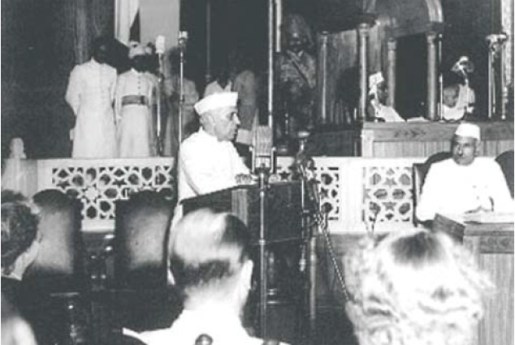 In the above historic photograph, Pandit Jawaharlal Nehru, is seen giving his famous speech in the Constituent Assembly on August 14, 1947. In this context, answer the following: